




Jackpot slots are games whose top prize keeps climbing until someone hits it, and that growing pot comes at a cost: lower base-game returns in exchange for a shot at a payout that can change your life. The trade-off is simple once you see it. You give up a bit of RTP on every spin, and in return you get a ticket into a prize pool that can run into the millions. Before you load any jackpot title, check what kind of jackpot it is and whether your bet size actually qualifies you to win it.
TL;DR:
- Players should ensure their bet size qualifies for the jackpot, especially on games that require maximum or specific stakes for the top prize.
- The contribution rate to progressive jackpots typically ranges from 1% to 3%, reducing the effective RTP and increasing volatility during normal spins.
- Networked progressives pool bets from multiple casinos, making the jackpots larger but significantly lowering the odds of hitting the top prize compared to standalone games.
- The “due” jackpot myth is false, as the random number generator has no memory, and each spin carries the same odds regardless of how long the jackpot has been climbing.
- Responsible gambling practices, including setting budgets and checking third-party certifications, are essential to enjoying jackpot slots safely.
Table of Contents
- What Are the Different Types of Jackpot Slots?
- How Do Progressive Jackpots Grow and Reset?
- What Are Qualifying Bets and Trigger Rules?
- How Do Jackpot Contributions Affect RTP and Odds?
- What Strategies Actually Help You Play Smarter?
- How Can You Gamble on Jackpot Slots Responsibly?
- Why Trust W88news for Jackpot Slot Guidance?
- What Makes Jackpot Slots Different From Regular Slot Machines?
- What Myths About Jackpot Slots Should You Ignore?
- How Do You Spot a High-Payout Jackpot Slot?
- How Does Volatility Change the Jackpot Slot Experience?
- How Should You Choose the Right Jackpot Slot for You?
- What Habits Should Jackpot Players Build Going Forward?
- Where Can You Track New Jackpot Releases and Odds?
- Useful Resources for Jackpot Slot Players
- Sources
- FAQ
What Are the Different Types of Jackpot Slots?
Not every jackpot slot works the same way, and picking the wrong type for your goals is the single biggest mistake casual players make. There are several distinct jackpot structures, and each one hits at a different frequency and pays out a different size of prize.
- Fixed jackpots pay a set amount that never changes, win or lose, session after session. You know exactly what you’re playing for, and these tend to hit more often than any progressive structure.
- Standalone/local jackpots grow only from bets placed on that one specific machine at that one casino. The pool is smaller than a network jackpot, but it also resets and refills faster, so you’ll see wins more regularly.
- Networked/progressive jackpots link the same game across dozens or even hundreds of casinos, pooling a tiny slice of every bet into one shared prize. This is how you get the seven and eight-figure headlines.
- Multi-tier jackpots stack several prizes into one game, usually labeled mini, minor, major, and grand. You’ll bank the smaller tiers often while the grand prize builds toward something enormous.
- Daily or time-based jackpots guarantee a payout by a set clock, whether that’s every hour or every midnight, which strips out the “will it ever hit” uncertainty entirely.
If you want action and regular small wins, standalone and daily jackpots suit you best. If you’re playing for a genuine life-changing number and don’t mind the odds, networked progressives like the games that made Mega Moolah and Mega Fortune famous are where those sums actually exist. Multi-tier games give you a bit of both, which is why they’ve become a default format for a lot of new releases.
How Do Progressive Jackpots Grow and Reset?
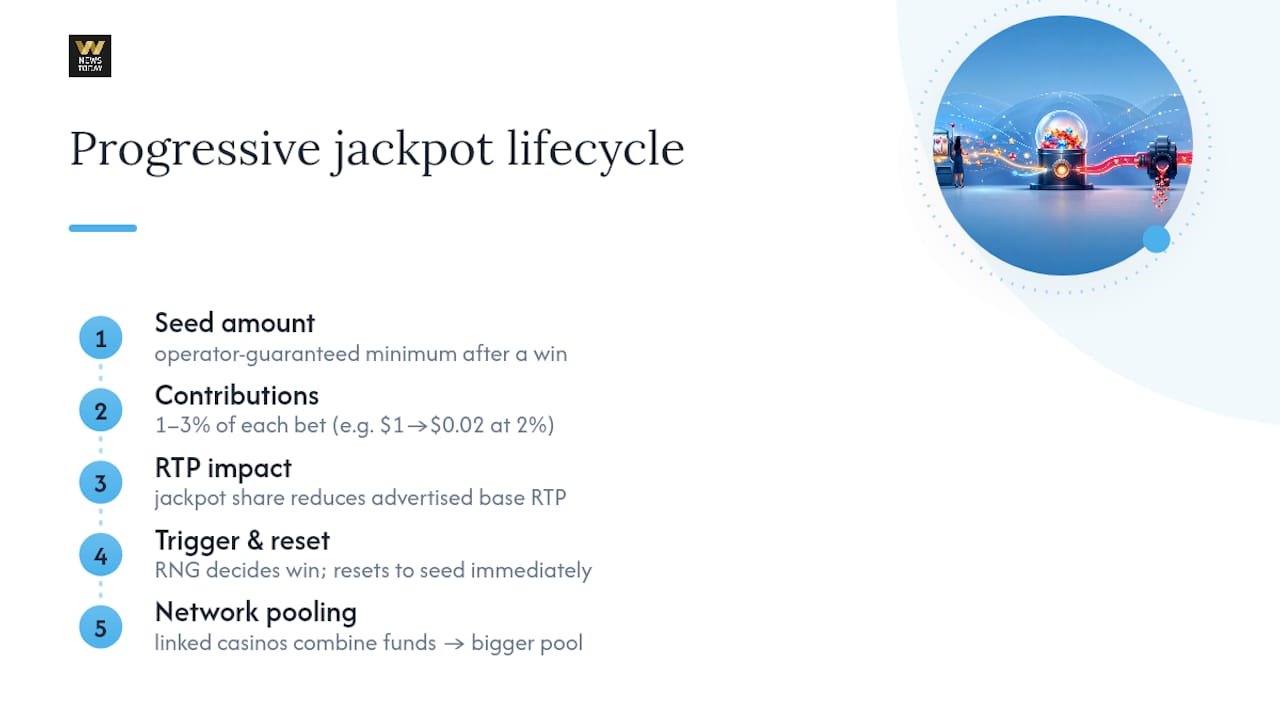
Every progressive jackpot starts from a seed amount, the minimum the operator guarantees will be sitting there even right after someone wins. From that floor, the jackpot climbs using a contribution rate skimmed from every real-money bet placed on the game, typically somewhere between 1% and 3%. Play a $1 spin on a game contributing 2%, and two cents of that goes straight into the growing pot regardless of whether your spin wins or loses.
That contribution has to come from somewhere, and it comes out of the base-game math. A slot advertising 96% RTP with a fat progressive jackpot attached is really splitting that 96% between the reels you’re spinning and the jackpot fund building in the background. Take the jackpot out and the base game alone often plays a good deal tighter than the headline number implies.
The trigger itself is governed by a random number generator, the same core system that decides every spin’s outcome. Third-party testing labs like eCOGRA audit these RNGs to confirm the results are genuinely random and not weighted against players, which is the trust signal worth checking before you commit real money to any jackpot title. Once someone lands the jackpot, the counter drops straight back to the seed amount and the climb starts over from scratch. That reset is exactly why chasing a jackpot right after a big win is usually the worst timing you could pick, since the pool has nowhere near the size it had the day before.
Networked jackpots scale this same math across every linked casino simultaneously. A game running on fifty operators pools contributions from every player at every one of those sites into a single shared prize, which is exactly how these pools swell into the kind of numbers that make headlines. You’re not just competing against players at your casino. You’re in a pool with everyone playing that exact game worldwide, which is precisely why the odds of landing it are so much longer than a standalone version of the same title.
What Are Qualifying Bets and Trigger Rules?
Before you spin a single credit into a jackpot slot, open the paytable and find the section covering jackpot eligibility. Many progressive games require a maximum or specific bet level to qualify for the top prize, and skipping this check is how players discover, after the fact, that their winning combination only paid the base-game prize.
Here’s how to read those rules correctly:
- Check the max-bet requirement first. Some titles only unlock the grand jackpot at maximum stake, while smaller tiers stay available at any bet size.
- Confirm whether it’s “any-bet” eligible. A growing number of modern progressives let every real-money spin qualify regardless of stake, which is friendlier to smaller bankrolls.
- Identify the trigger type. Jackpots fire in one of three ways: purely random (the RNG can strike on any spin), symbol-triggered (landing a specific combination or scatter pattern), or bonus-feature triggered (only reachable inside a bonus round or wheel spin).
- Note bonus-play restrictions. Some operators exclude bonus or free-spin credits from jackpot eligibility entirely, so a deposit bonus might play the base game but never the jackpot.
Random-trigger jackpots feel the most dramatic because they can land on literally any spin, but symbol and bonus-triggered versions often give you a visible countdown toward the feature, which some players find more satisfying to chase.
How Do Jackpot Contributions Affect RTP and Odds?
Every dollar that flows into a progressive pool is a dollar not paying out through the base game’s regular symbols and features. That’s the direct mechanical reason jackpot slots often carry a lower effective return during normal play than a comparable non-jackpot slot with the same headline RTP number.
Volatility compounds this. A game feeding a massive networked jackpot tends to run high volatility on the base game too, meaning longer stretches between meaningful wins and bigger swings when they do land. A standalone or local progressive, by contrast, usually plays closer to a standard slot’s volatility since its pool is smaller and refills faster.
The odds on a top-tier networked jackpot are genuinely long, often comparable to lottery-level probability, and no amount of strategy changes that math. What you can control is your expectation going in. If you’re chasing entertainment and steady small wins, a fixed or daily jackpot will treat your bankroll far better over a session. If you’re chasing the number that changes your life, accept that the base-game grind will feel tighter and budget for that reality up front rather than being surprised by it mid-session.
What Strategies Actually Help You Play Smarter?
Strategy in jackpot slots isn’t about beating the math, since the RNG doesn’t care how long you’ve been playing or how “due” a machine feels. It’s about managing your bankroll and matching your game choice to what you actually want out of the session.
- Set a session bankroll and a stop-loss. A common approach is risking no more than 1% to 5% of your total gambling budget per session, and walking away the moment you hit your stop-loss line.
- Match jackpot type to your actual goal. Standalone and daily jackpots for frequent small wins, networked progressives only if you’re specifically chasing a life-changing figure and can accept the odds.
- Favor higher base RTP when entertainment time matters more than jackpot size. Analysts generally frame progressive slots as high-risk, high-reward entertainment, best suited to players who’ve already budgeted for that risk profile rather than those hoping to grind out steady returns.
- Confirm bonus eligibility before you play with bonus funds. Check whether your deposit bonus or free spins actually qualify for jackpot contributions before assuming they do.
- Ignore “due” jackpot myths entirely. A machine that hasn’t paid in months has exactly the same odds on your next spin as one that just hit, because the RNG has no memory of past results.
Pro Tip: Screenshot or note the seed amount and current jackpot size before you start a session. If the pot is sitting close to its seed value, you’re playing right after someone else won it, and the odds of catching another hit soon are statistically no different, but psychologically it’s a useful reminder that patience alone won’t move the needle.
How Can You Gamble on Jackpot Slots Responsibly?
Jackpot slots are built to be exciting, and that excitement is exactly why guardrails matter more here than on lower-volatility games. Set your budget before you open the app, not after you’re three losses deep.
- Use your casino’s deposit and session limit tools to cap spending automatically rather than relying on willpower alone.
- Self-exclusion features exist for a reason. Use them if jackpot chasing starts to feel less like fun and more like compulsion.
- Verify the operator carries third-party certification from an auditor like eCOGRA, which confirms the RNG and payout percentages have been independently checked.
- Lean on organizations such as BeGambleAware for free, confidential support if gambling starts affecting your finances or wellbeing.
W88news maintains a full breakdown of these safeguards on its responsible gambling resource page, including how to set limits at most licensed operators.
Why Trust W88news for Jackpot Slot Guidance?
W88news covers jackpot mechanics, RTP breakdowns, and new slot releases daily, so our guides reflect what’s actually live in the market rather than outdated theory. Our editorial team, including contributors like jeff, builds these explainers from documented mechanics and industry reporting, not guesswork. Check our RTP guides to judge any game’s real value, and follow our latest slot news coverage to track fresh jackpot launches as they go live.
What Makes Jackpot Slots Different From Regular Slot Machines?
A regular slot pays its top prize as a fixed amount baked into the paytable, the same figure every time someone lands it. A jackpot slot’s top prize moves, often growing continuously between wins, and that single difference changes almost everything else about how the game plays.
Regular slots typically run tighter, more predictable volatility because their entire RTP budget goes into the base game’s regular symbols and features. Jackpot slots divert a slice of that RTP into the jackpot pool, which is why a jackpot title and a non-jackpot title with the same headline percentage often feel meaningfully different to play over a long session.
The bet structure differs too. Plenty of regular slots let you win the full top prize at any stake, while jackpot slots frequently gate the grand prize behind a max-bet or minimum-bet threshold. And the visual experience is built around the jackpot itself. Expect a live jackpot meter, jackpot-specific bonus rounds, and marketing built entirely around the size of the pot rather than the base game’s features.
None of this makes jackpot slots better or worse than standard machines. It just makes them a different tool. Regular slots suit players who want consistent, predictable entertainment. Jackpot slots suit players willing to trade some of that consistency for a shot at something bigger, exactly the trade-off the core jackpot mechanics are built around.
What Myths About Jackpot Slots Should You Ignore?
The “due” jackpot myth is the biggest one out there, and it’s worth repeating because it’s genuinely costing players money. A jackpot that hasn’t hit in weeks isn’t building toward an inevitable payout on your next spin. The RNG has no memory, so every spin carries the same odds regardless of how long the pot has been climbing.
Another common misconception: bigger jackpots mean better odds of winning something. In reality, the opposite tends to be true. The larger the advertised jackpot, generally the wider the network feeding it and the longer the odds against hitting the top tier, even though smaller tiers within a multi-tier structure may still hit reasonably often.
Players also assume time of day or day of the week affects jackpot frequency, timing your spins for “peak hours” changes nothing, since the RNG operates independently of the clock. Similarly, the belief that playing max bet guarantees a better hit rate on the base game is false. Max bet only affects jackpot eligibility on games that require it, not your odds on any individual spin.
Finally, plenty of players assume a slot that just paid a huge jackpot is now “cold” and should be avoided. The seed resets, sure, but the underlying RNG odds on your very next spin are unchanged from the moment before someone won.
How Do You Spot a High-Payout Jackpot Slot?
Higher published RTP generally means a more generous base game, even on titles carrying a large progressive pool.
Next, check the current jackpot size against its seed amount, which many operators display live on the game screen or lobby. A jackpot sitting well above its seed has had time to build, which on some titles correlates loosely with how “primed” the pool looks, though it changes nothing about the actual odds on any single spin.
Look at the volatility rating if the operator publishes one. Games branded low or medium volatility tend to pay smaller prizes more frequently, which suits players who want their bankroll to last. High volatility games, common among the biggest networked progressives, can go long stretches without a meaningful win before delivering something substantial.
Finally, read independent game reviews rather than relying purely on promotional copy. A detailed breakdown, like our review of Buffalo Blitz: Cash Collect, will typically list the max win multiplier, hit frequency, and jackpot structure in plain terms, which tells you far more than a marketing banner ever will.
How Does Volatility Change the Jackpot Slot Experience?
Volatility describes how wins are distributed over time, not how often you win overall, and it matters enormously once a jackpot is layered on top of a slot’s base math. A low-volatility jackpot slot pays smaller amounts more consistently, so your bankroll drains slowly and you’ll see wins often enough to keep sessions feeling active.
High-volatility jackpot slots, which describes most of the large networked progressives, behave completely differently. You can spin for a long time without a meaningful base-game win while the jackpot itself climbs in the background, and then the game can deliver a burst of value all at once, either through a big base-game feature or the jackpot itself.
This matters directly for bankroll planning. A $200 session bankroll on a high-volatility networked jackpot slot might realistically last only a fraction of the spins that same $200 would buy on a low-volatility fixed-jackpot game. Neither approach is wrong, but you need to pick the volatility profile that matches how long you actually want to play versus how big a swing you’re comfortable absorbing.
Multi-tier jackpot games often soften this tension nicely, since the mini and minor tiers hit with enough frequency to feel like a lower-volatility game day to day, while the major and grand tiers still carry that networked-progressive upside in the background.
How Should You Choose the Right Jackpot Slot for You?
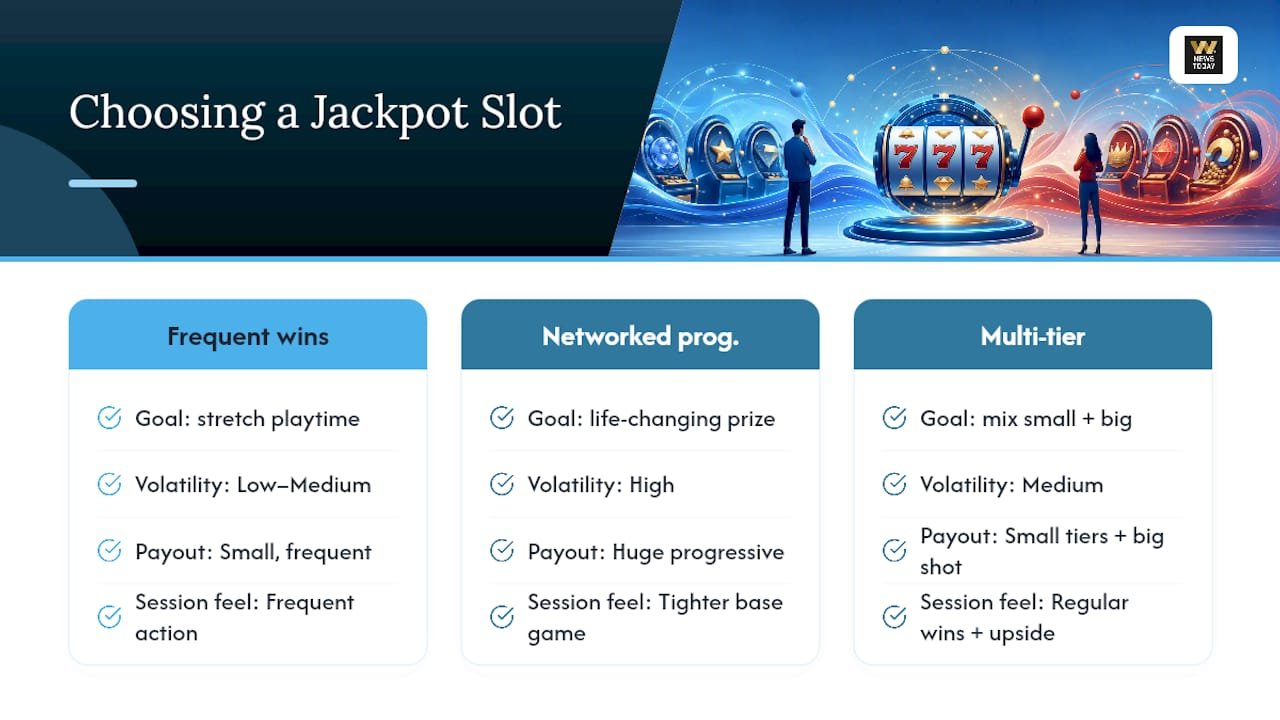
Start with your own goal, because the “best” jackpot slot genuinely depends on what you’re after, not on some universal ranking. Ask yourself whether you want frequent small wins to stretch out playtime, or one shot at a genuinely transformative payout, since those two goals point toward completely different game types.
If frequent action matters most, look toward standalone, local, or daily jackpots with published RTP above 95% and low to medium volatility. These games reward patience with regular smaller payouts and rarely leave you on a long dry stretch.
If you’re specifically chasing a life-changing sum, networked progressives are the only category that realistically delivers those numbers, but go in accepting the longer odds, the tighter base-game feel, and the possibility of a long losing stretch before anything meaningful lands. Set a strict entertainment budget for these sessions specifically, separate from your regular slot bankroll.
Multi-tier games are a solid middle ground for players who want both. You’ll bank the smaller tiers with enough regularity to keep sessions enjoyable while still holding a ticket into the bigger prize. Whatever you choose, always confirm the qualifying-bet rules first. A perfect game choice means nothing if your stake doesn’t actually qualify for the tier you’re chasing.
What Habits Should Jackpot Players Build Going Forward?
The players who get the most out of jackpot slots aren’t the ones with a secret system. They’re the ones who treat the jackpot as a bonus on top of an entertainment budget they’ve already accepted as spent, not as money they expect back. That mental shift changes everything about how a losing stretch feels.
Before you load any new jackpot title, take thirty seconds to check its RTP and qualifying-bet rules. That habit alone will save you from the single most common jackpot disappointment: hitting a big combination on the wrong bet tier. Keep an eye on W88news’s new release coverage too, since fresh jackpot titles launch constantly and early information helps you separate the genuinely generous games from the ones riding on marketing alone.
— jeff
Where Can You Track New Jackpot Releases and Odds?
New jackpot slots launch across major studios every month, and keeping up with which ones carry genuinely favorable RTP and qualifying-bet structures takes more than scrolling a casino lobby. W88news tracks new game releases and jackpot news as it happens, which means you get the mechanics breakdown before you’ve spent a single credit finding out the hard way.

Our team pulls apart new jackpot titles the same way this guide breaks down mechanics: RTP first, contribution rates second, qualifying-bet rules always checked before we recommend anything. That’s a different approach from relying on a casino’s own marketing page, which understandably leads with the jackpot size and says little about the base-game trade-offs you’re actually accepting. Head over to our latest slot news hub to see what’s launched recently, or bookmark the RTP guides section so you can check a game’s real numbers before your next session. If you’re weighing a networked jackpot title specifically, our operator-level coverage of linked jackpot networks gives useful context on how those wider pools actually function.
Useful Resources for Jackpot Slot Players
- eCOGRA for third-party fairness certification
- BeGambleAware for confidential problem-gambling support
- Are online slots rigged? for RNG fairness checks
- W88news RTP guides for base-game value comparisons
Sources
FAQ
How Do You Bet on a Jackpot and Actually Win It?
You place a real-money wager on a qualifying jackpot slot, and the win triggers either randomly through the RNG, through a specific symbol combination, or inside a bonus feature, depending on the game’s rules. Always check the paytable first to confirm your bet size actually qualifies for the top prize, since many progressives require max bet.
What Is the Difference Between a Fixed and a Progressive Jackpot?
A fixed jackpot pays the same set amount every time, while a progressive jackpot grows continuously from a small percentage of every bet placed until someone wins it. Progressive jackpots offer much bigger potential prizes but hit far less often than fixed ones.
Do Jackpot Slots Have Lower RTP Than Regular Slots?
The base game portion of a jackpot slot’s RTP is typically lower than a comparable non-jackpot slot, because roughly 1% to 3% of every bet gets diverted into the jackpot pool. The published headline RTP already includes that jackpot contribution as part of the total figure.
Can You Improve Your Odds of Winning a Jackpot?
No strategy changes the underlying RNG odds on any single spin, since jackpots trigger randomly regardless of past results or how long you’ve played. What you can control is choosing games with clear qualifying-bet rules and matching your bankroll and volatility tolerance to a realistic goal.
Are Networked Progressive Jackpots Better Than Standalone Ones?
Neither is objectively better, since they serve different goals. Networked progressives offer far larger potential prizes but longer odds and tighter base-game feel, while standalone jackpots pay out more frequently in smaller amounts.