




Closing line value is the single best early signal that your betting process has a real edge, and pro syndicates trust it more than win rate or short-term profit. Positive CLV, tracked against a sharp closing reference across hundreds of bets, correlates with long-run profitability far more reliably than raw results over the same stretch. The catch: you need a consistent closing benchmark, a large enough sample, and honest recordkeeping to trust what the number is telling you. Everything below shows you how to calculate it, track it, and turn it into actual bankroll growth.
TL;DR:
- Consistently beating the close is a more reliable indicator of long-term profitability than ROI or win rate, especially with a large sample size.
- Tracking CLV accurately requires recording both opening and closing odds at the same bookmaker and applying de-vigging for a clearer measure of true market value.
- A CLV of +2% to +5% generally signals a sustainable edge, whereas above +5% often indicates unsustainable small-sample luck needing further validation.
- Avoid measuring CLV with incorrect references, rushing bets at the last second, or in thin markets, as these practices distort the true edge.
- Building a strong CLV habit depends on line shopping, disciplined staking, and maintaining honest logs over hundreds of bets to differentiate skill from variance.
Table of Contents
- What Closing Line Value Is and How You Measure It
- Why CLV Beats ROI and Win Rate as a Skill Indicator
- How to Calculate CLV Step by Step
- How to Actually Generate Positive CLV
- What Good CLV Actually Looks Like
- Common Mistakes That Wreck Your CLV Numbers
- Why Trust This Guide
- Why Measurement Discipline Beats Clever Shortcuts
- Sources
- FAQ
What Closing Line Value Is and How You Measure It
Closing line value, or CLV, is the gap between the odds you bet and the odds the market settled on right before the game started. Beat the close consistently, and you’re outpricing the market. That’s the whole game.
The most common formula converts both prices to a percentage difference:
CLV% = (your odds ÷ closing odds − 1) × 100
If you bet a team at +150 and the line closed at +130, you locked in better value than the market eventually offered, and that’s positive CLV. A sharper method strips out the bookmaker’s margin first, known as de-vigging, which turns raw odds into implied probabilities before comparing them. This matters because half-point and quarter-point moves carry different weight depending on the market, so a probability-based comparison travels better across sports and bet types than raw odds alone.
Say you bet a total at Over 220.5 at odds of 1.91, and it closes at Over 220.5 at 1.83. That’s meaningful positive CLV on a number that never even moved.
- Same-book CLV: compares your bet to the closing line at the same sportsbook you wagered with.
- Sharp-reference CLV: compares your bet to a market-setting book or exchange, often considered the cleaner benchmark.
Why CLV Beats ROI and Win Rate as a Skill Indicator
ROI and win rate are outcome metrics. They tell you what happened, but variance drowns out skill for a long stretch. CLV is a process metric. It tells you whether your bet was priced better than the market’s eventual consensus, regardless of whether it actually won.
That distinction is why CLV stabilizes much faster than ROI. A bettor can go on a losing streak while showing consistently strong CLV, and that combination is usually a sign of bad luck rather than a bad process. Flip it around: a bettor riding a hot streak with negative CLV is often just getting lucky on bets the market never liked.
- CLV tends to produce a readable signal after a large number of logged bets, depending on variance in the sport and market.
- ROI often needs a much larger sample than CLV to separate skill from noise.
- Betting syndicates and professional trading desks track CLV internally as a primary performance KPI, sometimes ahead of raw profit.
Pro Tip: Don’t panic over a losing month if your CLV log stays positive. Check your CLV trend before you touch your staking plan.
How to Calculate CLV Step by Step
Building a reliable CLV habit comes down to four repeatable steps, done the same way every time.
- Log the bet immediately. Record the market, stake, odds received, exact timestamp, and the book you used.
- Capture the closing price. Note the same book’s closing odds for that exact market, and ideally a sharp-reference price from a market-setting book or exchange too.
- Run the calculation. Convert both prices to decimal or implied probability, apply the CLV% formula, and de-vig the closing number when you can for a cleaner read.
- Store and review. Drop every result into a tracker and check rolling windows (50, 100, 500 bets) rather than judging any single wager.
A basic spreadsheet handles this fine. The discipline is in the consistency, not the tool.
How to Actually Generate Positive CLV
Getting good CLV isn’t about finding a secret trick. It comes from a handful of scalable habits, each with real limits worth knowing.
- Line shopping across multiple accounts. Comparing prices at several books before you bet, and opening accounts specifically to access early or soft numbers, is the single most repeatable way to bank CLV. Our sports betting tips and odds coverage is a good starting point for spotting price gaps across markets.
- Building a pricing model. If your own numbers consistently disagree with the opening line in a specific direction, and you’re right more often than not, you’re generating a durable modeling edge rather than a one-off guess.
- Reacting to verifiable news fast. Injury news, lineup scratches, and weather shifts move lines quickly. Betting within minutes of confirmed news, rather than rumors, captures value before the market fully adjusts. Information edges are real but shrink fast once enough bettors act on the same news.
- Staking with discipline. CLV only becomes real money if your stakes are sized sensibly. Flat or Kelly-based staking, tied to a solid bankroll management plan, keeps a strong CLV record from being wasted on erratic bet sizing.
Pro Tip: Books limit or restrict accounts that consistently beat the closing line. Spread volume across accounts and keep bet sizes reasonable if long-term access matters to you.
Practical staking guidance from outside sources, like BetMzansi’s bankroll management framework, can reinforce the same discipline from a different angle.
What Good CLV Actually Looks Like
Numbers without context don’t mean much, so here’s a rough scale used across the industry for interpreting CLV:
- +1% to +2%: marginal edge, worth tracking but not yet conclusive.
- +2% to +5%: a solid, sustainable edge over a large sample.
- +5% or higher: strong, though very high CLV on small samples is often unsustainable and worth double-checking rather than celebrating outright.
Market type changes the read. Low-hold markets like major spreads and totals give a cleaner CLV signal than high-hold markets like player props, where wide margins distort the raw number. Always look at the distribution, not just the average. A handful of huge-CLV bets on obscure lines can inflate your mean while the bulk of your bets sit near zero. That’s a sign to check the outliers, not celebrate the headline figure.
Common Mistakes That Wreck Your CLV Numbers
Most CLV tracking errors come from sloppy measurement, not bad betting.
- Switching closing references mid-sample. Comparing some bets to same-book closes and others to a sharp exchange muddies the data. Pick one method and stay consistent.
- Skipping the de-vig step. Raw closing odds still carry the bookmaker’s margin, which can flatter or understate your real edge.
- Betting right at the close. If you consistently wager seconds before kickoff, you’re not measuring CLV against anything meaningful.
- Judging thin markets the same as liquid ones. Low-volume prop markets move erratically and don’t reflect true consensus pricing the way major spreads and totals do.
Contrarian bettors who intentionally fade the public late tend to show odd CLV patterns that don’t fit the usual framework, so treat CLV as one tool, not the entire scorecard.
Why Trust This Guide
W88 News Today covers sportsbook reviews, bonus breakdowns, casino guides, and betting education with a focus on accuracy overhype. This piece was written by Jeff, a contributor who covers betting metrics and bankroll strategy for the site. For deeper reading, browse our full betting guides library or see how totals markets specifically respond to line moves in our over/under betting guide. The practical next step is simple: open a spreadsheet today, log your next ten bets with odds and closing prices, and start building a real CLV record before you change anything else about your process.

Why Measurement Discipline Beats Clever Shortcuts
Most betting advice chases the next hot pick. CLV asks a more useful question: was your process sound, independent of what the scoreboard said afterward? That reframing is the biggest thing casual bettors get wrong. They judge a bet by whether it won, then wonder why their results swing wildly month to month.
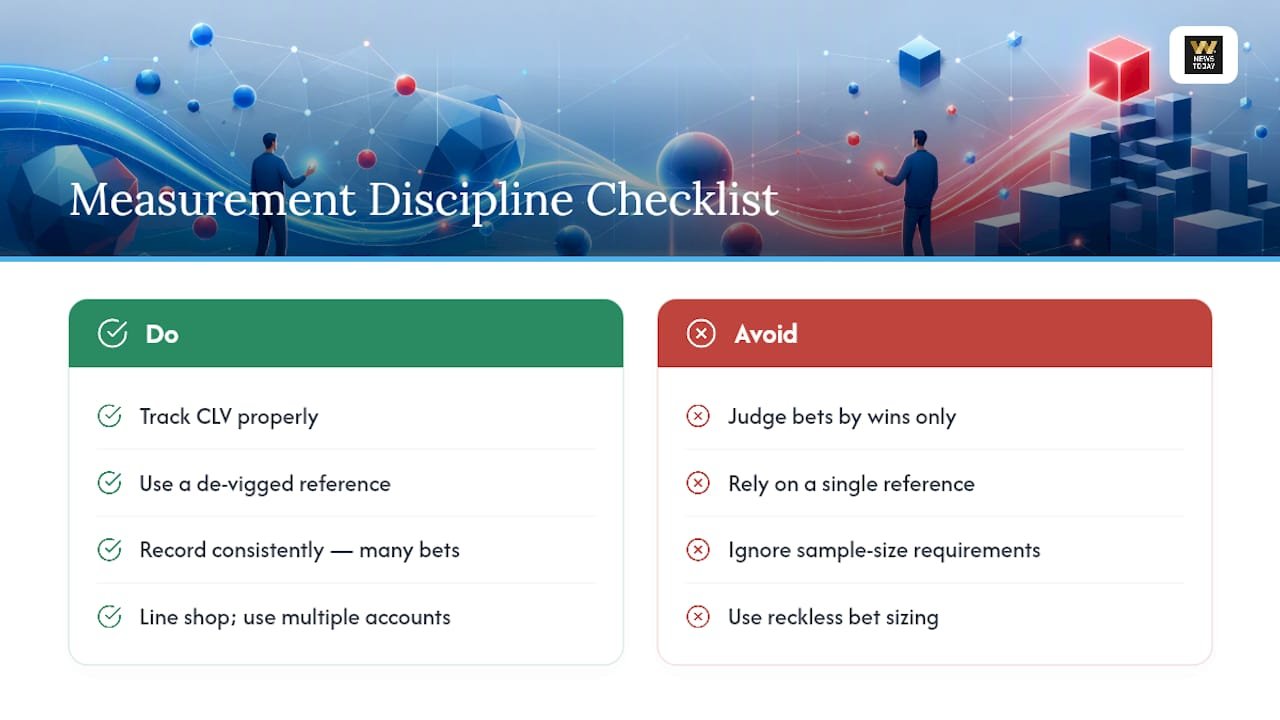
The conventional advice on this topic tends to stop at “track your CLV,” without explaining that a single sharp reference, a de-vigged number, and a few hundred bets are what make the metric trustworthy. Skip those and you’re just staring at noise dressed up as insight.
If there’s one place to focus first, it’s line shopping and a consistent recording habit. Modeling edges take real time to build and information edges fade fast once everyone has the same news. Multiple accounts and disciplined logging cost you nothing but effort, and they compound. Responsible staking matters just as much. A great CLV record built on reckless bet sizing still ends badly, so keep bankroll rules tight and consult resources like BeGambleAware if betting ever stops feeling like a controlled hobby.
— jeff
Sources
- Closing-Line Value (CLV) — The Edge Proof | Dynatyze
- Closing line value (CLV) | WagerBird Learn
- Closing Line Value (CLV) in Sports Betting: What It Is and Why It Matters | CalcMyBets
- BeGambleAware
FAQ
What is closing line value?
Closing line value, or CLV, is the difference between the odds you bet and the odds the market closed at right before the event started. Positive CLV means you got a better price than the market eventually settled on.
What does a +6.5 line mean?
A positive spread means that team gets a points cushion added to its final score, so the bet wins if the team loses by fewer points than the spread.
What does goal line 2.0 or 2.5 mean?
Goal line markets work like totals in soccer betting, where lines with fractions determine whether the combined final score goes over or under that number, and lines with whole numbers can include a push if the total lands exactly on that number.
What is a closing line?
The closing line is the final set of odds a sportsbook or exchange offers on a market right before the event begins, reflecting the most complete pricing information the market has absorbed.
How many bets do I need before my CLV means anything?
Most trackers see a reliable CLV signal emerge after a large number of logged bets, though a smaller sample can still hint at a trend worth watching.