




Non-sticky bonuses let you withdraw your deposit and any real-money winnings at any time. Sticky bonuses do not: your deposit and bonus funds get merged into one balance, and that balance stays locked until you have finished the wagering requirement.
That single mechanical difference decides whether a $50 bonus is a genuine gift or a promise you will probably never collect on. Casinos use both structures constantly, often on the exact same promotion page, and the marketing copy rarely spells out which one you’re claiming.
Here’s what you need to know before you click “claim”:
- Withdrawal timing: Non-sticky bonuses treat your deposit as untouched cash. Sticky bonuses remove the bonus amount at cashout and hold everything until wagering clears.
- Proof points worth trusting: Behavioral research reviewed by the UNLV study on free-play promotions shows promotion structure changes how players bet, not just how much they win. W88news’s editorial team applies that same scrutiny when reviewing new bonus offers.
- Quick-play impact: Sticky offers extend your session because you’re playing with more total funds. Non-sticky offers give you an exit ramp the moment you’re ahead.
The single most important action before claiming anything: check whether the casino lets you withdraw your deposit while the bonus is still active. If the answer is no, you’re looking at a sticky bonus, whatever the promo banner calls it.
Key Takeaways
Non-sticky bonuses keep your deposit withdrawable at all times, while sticky bonuses lock your deposit and bonus together until wagering clears in full.
| Point | Details |
|---|---|
| Withdrawal test | Ask if you can withdraw your deposit while the bonus is active; if not, it’s sticky. |
| Wagering math differs | Sticky bonuses often apply multipliers to the combined balance, roughly doubling total exposure. |
| Non-sticky fits most players | The exit option reduces expected losses during clearing for the majority of play styles. |
| Sticky can work narrowly | Only worth it when the multiplier is unusually low or extended bankroll is the goal. |
| Play responsibly | Treat bonus funds as entertainment spending, not guaranteed income. |
| W88news helps you compare | Use W88news’s bonus comparison coverage to filter offers by withdrawal type before you claim. |
Table of Contents
- What Is a Sticky Bonus and How Does It Work?
- What Is a Non-Sticky Bonus and Why Does It Matter?
- Sticky vs Non-Sticky Bonus: Side-by-Side Comparison
- How Do Wagering Requirements Change Between the Two?
- What Happens When You Try to Withdraw Early?
- How Do You Choose the Right Bonus for Your Goals?
- Tips to Protect Your Winnings and Maximize Bonus Value
- Three Worked Examples: The Real Cashout Math
- How We Read the Fine Print on Sticky and Non-Sticky Bonuses
- Which Bonus Type Should You Actually Choose?
- Find and Compare Non-Sticky Bonuses Faster With W88news
- Sources
- FAQ
What Is a Sticky Bonus and How Does It Work?
A sticky bonus adds funds to your playing balance, but those funds are never yours to withdraw. You can bet with them, win with them, and build a bankroll around them. When you try to cash out, the casino subtracts the original bonus amount and pays you only what’s left.
Casinos apply sticky bonuses by merging your deposit and the bonus into a single wagering pool. That combined balance is what the wagering requirement multiplies against, which we’ll break down with real numbers in a later section. Wagering typically starts the moment you make your first real-money bet, and most sticky offers carry a maximum bet size per spin or hand. Break that cap, even once, and many operators will void your entire bonus and any winnings tied to it.
Watch for this kind of clause when you’re reading terms and conditions: “Bonus and deposit must be wagered together; withdrawals are not permitted while the bonus is active.” That phrasing, or something close to it, is the fingerprint of a sticky structure. Guides like AskGamblers’ breakdown of sticky versus non-sticky terms recommend scanning specifically for “wagering purposes only” language attached to the bonus line item.
Sticky bonuses aren’t automatically bad. Here’s when they make sense and when they don’t:
- Pro: Bigger starting bankroll means more spins or hands before you’re out of funds, which suits high-volatility slot players chasing a jackpot.
- Pro: Some sticky offers carry lower wagering multipliers than their non-sticky counterparts, which can offset the withdrawal lock.
- Con: You can never touch the bonus amount itself, no matter how the session goes.
- Con: Max-bet violations and forfeiture rules punish careless play harder than they do on non-sticky offers.
- Best fit: Players who plan to play through the full requirement anyway and care more about playtime than an early exit.
What Is a Non-Sticky Bonus and Why Does It Matter?
A non-sticky bonus, also called a cashable or parachute bonus, keeps your deposit completely separate from the bonus funds. Your original deposit stays withdrawable at any point. The bonus only becomes relevant if you lose your deposit and need it as a backup, or once you clear its own separate wagering requirement.
Non-sticky offers typically run in two phases. First, you play with your real deposit. If you win, you can walk away with those winnings immediately, no strings attached. If you lose the deposit, the bonus kicks in as a second life, letting you keep playing without depositing again. SlotDecoded’s comparison of the two bonus structures points out that this design gives non-sticky bonuses their nickname: a parachute that only opens when you need it.
Look for terms and conditions phrased like this: “You may withdraw your deposit at any time; bonus funds are separate and cashable after the wagering requirement is met.” That’s the signature of a genuine non-sticky offer, and it’s worth screenshotting for reference if a dispute ever comes up.
- Pro: You keep full control over your deposit from the first spin.
- Pro: Early winning sessions convert directly into real, withdrawable cash.
- Con: If you don’t lose your deposit, the bonus itself may go untouched or unused.
- Con: Some non-sticky offers carry higher wagering multipliers to compensate for the added flexibility.
- Best fit: Cautious players, low-bankroll players, and anyone who wants the option to bank a win instead of grinding through a full playthrough.
Sticky vs Non-Sticky Bonus: Side-by-Side Comparison
The practical differences between sticky and non-sticky bonuses come down to six factors that determine how much real control you keep over your money.
| Dimension | Sticky Bonus | Non-Sticky Bonus |
|---|---|---|
| Withdrawalability | Bonus amount is removed at cashout; never withdrawable | Deposit and cleared winnings are withdrawable anytime |
| Wagering treatment | Applied to combined deposit + bonus balance | Applied to bonus only, deposit stays untouched |
| Deposit handling | Locked together with bonus until wagering clears | Kept separate and accessible throughout |
| Game contribution | Varies by title; slots usually count 100%, table games less | Same variance, but check per-casino contribution tables |
| Max-bet and max-cashout rules | Often stricter, with forfeiture risk for violations | Usually more lenient, though caps still apply |
| Best player fit | High-volatility players seeking extended bankroll | Players who want an early exit or lower risk exposure |
If you want the option to lock in a win the moment luck turns your way, a non-sticky offer usually serves you better. Sticky bonuses only make sense when the wagering multiplier is unusually low or you’re specifically chasing playtime over flexibility.
How Do Wagering Requirements Change Between the Two?
Wagering requirements look identical on paper, something like “35x,” but they apply to completely different numbers depending on the bonus type. That gap is where most players get blindsided.
Sticky bonuses generally multiply the combined deposit plus bonus. Deposit $100, claim a $100 sticky bonus, and a 35x requirement applies to $200, not $100. You’d need to wager $7,000 in total bets before a single dollar becomes eligible for withdrawal, and even then, the $100 bonus itself never converts to cash. Non-sticky bonuses, by contrast, usually apply the multiplier to the bonus amount alone.
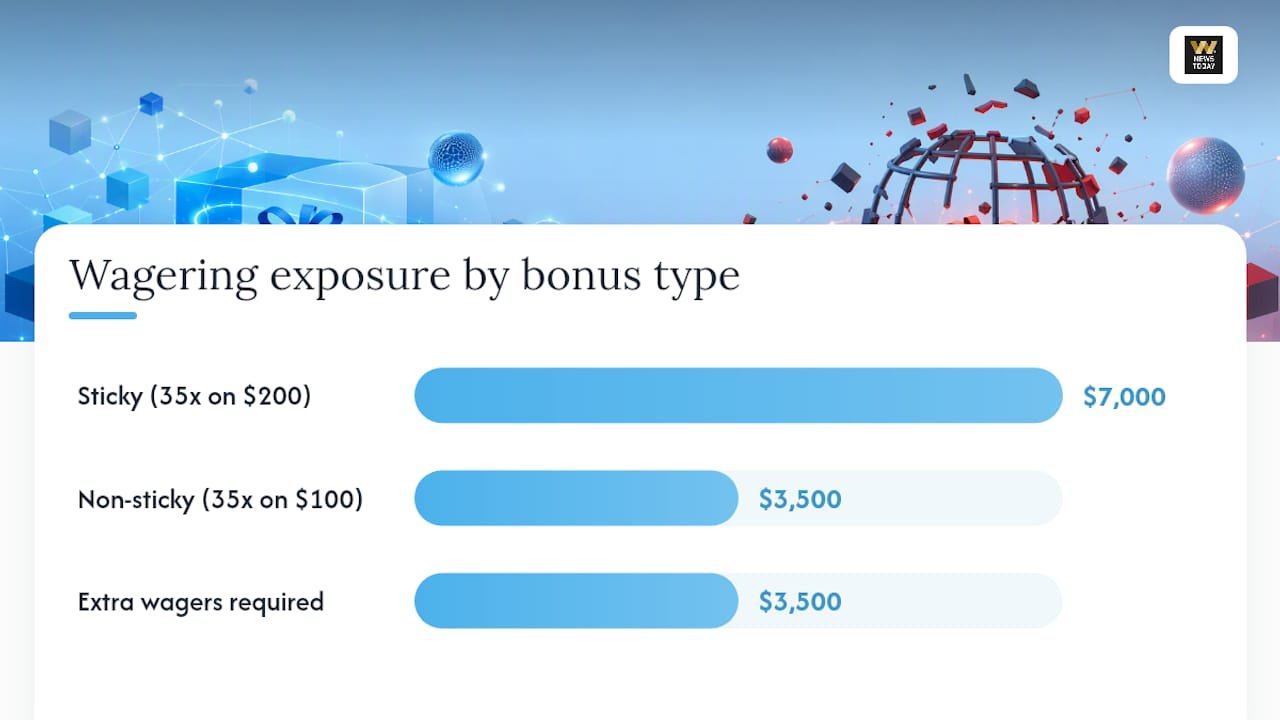
Industry breakdowns of sticky bonus structures confirm that combined-balance wagering routinely doubles the total betting exposure compared with bonus-only wagering, even when the advertised multiplier is identical.
Before you claim anything, scan the terms for these exact phrases:
- “Combined balance wagering” — a clear signal you’re facing the doubled exposure of a sticky structure.
- “Bonus-only wagering” — confirms your deposit sits outside the requirement entirely.
- Game weighting tables — slots often count 100% toward wagering, while blackjack and roulette can count as little as 10% or 0%.
- “Wagering starts on deposit” — tells you the clock begins before you’ve even touched the bonus funds.
What Happens When You Try to Withdraw Early?
The moment you attempt a withdrawal reveals exactly what kind of bonus you’re playing with. Three scenarios cover almost every real-world situation you’ll run into.
Scenario A: You win early. With a non-sticky bonus, you can withdraw your original deposit plus any winnings generated from it right away. With a sticky bonus, your withdrawal request triggers the removal of the bonus amount first, and you often can’t withdraw anything at all until wagering finishes.

Scenario B: You lose your deposit, then rely on the bonus. Non-sticky offers let the bonus step in as backup funds once your deposit is gone, giving you a second chance to build a bankroll. Sticky offers already had the bonus mixed in from the start, so there’s no separate “backup” phase. You’re simply playing down the combined balance.
Scenario C: You try to withdraw while the bonus is still active. Non-sticky casinos generally process this fine, since your deposit was never locked. Sticky casinos will typically block the withdrawal outright, or process it while forfeiting the entire bonus and any bonus-generated winnings.
Watch for these red flags in the fine print, since they predict a rough cashout experience regardless of bonus type:
- Low maximum cashout caps (some sticky bonuses cap winnings at 2x to 5x the bonus amount).
- Short expiry windows, often 7 days or less, that force rushed, careless betting.
- Heavy game exclusions that quietly shrink your effective wagering progress.
- Vague forfeiture language that lets the casino cancel winnings for “irregular play patterns.”
The BonusCheckr guide to picking between sticky and non-sticky offers recommends a simple test: attempt a small, low-stakes withdrawal early in your session. How the casino handles that request tells you more than any T&C paragraph ever will.
How Do You Choose the Right Bonus for Your Goals?
Picking between sticky and non-sticky isn’t about which one sounds better in the promo email. It comes down to your bankroll, your risk tolerance, and how much time you’re willing to spend clearing wagering.
Start with these criteria before you claim anything:
- Cashout priority: If locking in early wins matters most to you, non-sticky wins every time.
- Bankroll size: Smaller bankrolls benefit from the flexibility of non-sticky offers, since you’re not risking your entire deposit on a locked structure.
- Game volatility: High-volatility slot players sometimes prefer sticky bonuses for the extended bankroll cushion, similar to strategy discussions around titles like Ride the Beat by Play’n GO.
- Time available: Shorter wagering windows favor non-sticky bonuses, since bonus-only wagering clears faster than combined-balance wagering.
- Max-bet tolerance: If you like to bet big, sticky bonuses’ stricter max-bet rules can work against you fast.
Before you claim, ask the cashier support team or dig through the terms for these answers: Can you withdraw your deposit while the bonus is active? What’s the exact wagering multiplier, and does it apply to deposit plus bonus or bonus alone? Is there a maximum cashout cap? Comparing offers side by side, like the options covered in W88news’s roundup of top casino bonuses, makes these differences easier to spot before you commit real money.
Avoid any offer that combines deposit-plus-bonus wagering with a tiny time window and low game contribution rates. That combination is close to a guaranteed loss on paper.
Tips to Protect Your Winnings and Maximize Bonus Value
Getting real value out of either bonus type comes down to a handful of habits you can apply before you ever place a real bet.
- Test a small withdrawal early, before you’re deep into wagering, to confirm the casino’s actual behavior matches its terms.
- Keep bet sizes under the stated max-bet limit at all times; one oversized wager can void an entire bonus.
- Favor games with 100% wagering contribution, usually slots, over table games that often count for far less.
- Track expiry windows on a calendar or reminder app so you’re not rushing through wagering in the final hours.
- Review payment method rules too, since some credit card processors add delays that eat into short bonus windows.
Pro Tip: If you claim a non-sticky bonus, play your real-money deposit conservatively first. Once you’ve either banked a small win or exhausted the deposit, you’ll know exactly where you stand before the bonus phase even starts, which gives you far more control over your total risk.
Whichever bonus you choose, treat it as entertainment spending, not income. W88news’s responsible gambling resources cover bankroll limits and self-exclusion tools worth setting up before you claim your next offer.
Three Worked Examples: The Real Cashout Math
Numbers settle arguments that marketing language can’t. Here are three scenarios that show exactly how sticky and non-sticky bonuses play out in practice.
- Low-volatility session, non-sticky bonus. You deposit $100 and claim a $100 non-sticky bonus at 35x wagering (applied to the bonus only). You play conservatively and turn your $100 deposit into $150 through a lucky early streak. Because the deposit was never locked, you withdraw the full $150 immediately, regardless of what happens to the untouched bonus.
- High-volatility session, sticky bonus. You deposit $100 and claim a $100 sticky bonus, but this one carries a lower 20x requirement applied to the combined $200 balance, meaning $4,000 in total wagering. A volatile slot session swings your balance up to $300 before settling at $180. At cashout, the casino removes the $100 bonus, leaving you $80, still a net gain, and the lower multiplier made clearing realistic within the expiry window.
- Mid-case comparison, expected loss during clearing. Deposit $100, claim a $100 bonus at 35x on both structures for comparison. On the non-sticky version, you need $3,500 in wagering; on the sticky version, $7,000. Assuming a typical 5% house edge across that wagering volume, expected losses run roughly $175 on the non-sticky path versus $350 on the sticky path, even before accounting for the bonus itself being unwithdrawable in the sticky case.
These figures illustrate the mechanics using typical multipliers and a standard house edge assumption; your actual results depend on the games you play and the specific casino’s terms.
How We Read the Fine Print on Sticky and Non-Sticky Bonuses
W88news’s editorial approach to bonus terms starts with one rule: never trust the promo headline, always trust the clause that describes withdrawal conditions. Ambiguous phrasing like “bonus funds subject to standard terms” usually hides a sticky structure, and we flag it as such whenever we review a new offer.
The decisive test isn’t how big the bonus number looks. It’s whether you can withdraw your deposit while that bonus is still sitting in your account. That single check cuts through almost every piece of marketing language a casino uses.
Search for these exact phrases when you’re reading terms and conditions yourself:
- “Combined balance wagering” or “wagered together”
- “Withdrawals not permitted with active bonus”
- “Forfeit bonus on withdrawal” or “bonus voided upon cashout request”
- “For wagering purposes only”
- “Bonus funds are non-withdrawable”
This kind of scrutiny matters because promotion mechanics genuinely change how people play, not just how much they can theoretically win. Research reviewed in a PMC study on gambling promotions and behavior found that the structure of a promotion, not just its headline value, shapes play duration and risk-taking patterns. That’s exactly why W88news treats T&C interpretation as a core part of every bonus review, rather than a footnote.
Which Bonus Type Should You Actually Choose?
My honest read after digging through dozens of these offers: non-sticky bonuses win for the overwhelming majority of players, and the industry’s continued push toward sticky structures says more about house economics than player value.
The math backs this up plainly. A non-sticky bonus with bonus-only wagering almost always produces lower total betting exposure and lower expected losses during clearing, even when the advertised multiplier looks less attractive on paper. Sticky bonuses only start making sense in a narrow set of cases: when the wagering multiplier is unusually low, or when a player specifically wants extended bankroll for a high-volatility strategy and accepts that the bonus itself will never be cashed out. Outside those cases, sticky structures mostly just extend how long you play, which benefits the casino’s hold rate more than it benefits you.
W88news exists to make these distinctions visible before you deposit a dollar, not after you’ve discovered them the hard way in a support chat. Between our bonus comparison coverage and ongoing new game release reporting, the goal is simple: help you match the right offer to the right game, every time.
Find and Compare Non-Sticky Bonuses Faster With W88news
W88news gives you something most promo pages won’t: a plain-language read on whether a bonus locks your deposit or lets you walk away with it. That’s the exact distinction this article just walked through, and it’s the first thing our editorial team checks before any bonus makes it into a roundup.

W88news earns a commission when readers sign up through some of the links on this site, and that relationship never changes which bonuses we recommend. Use our top casino bonuses roundup to filter for non-sticky, cashable structures, or check our cashback offers guide if you’d rather sidestep wagering requirements altogether. Crypto players comparing structures on platforms like Solana Casino’s bonus page will notice the same sticky and non-sticky patterns apply there too. Start by browsing our current bonus comparisons and pick the offer that actually matches how you want to play.
Sources
- Sticky Bonus vs Non-Sticky Bonus: Which to Pick (2026) | BonusCheckr
- Sticky vs Non-Sticky Bonus: 3 Critical Differences Revealed | SlotDecoded
- The Difference Between Sticky and Non Sticky Bonuses: What Are They and Which One to Choose? | AskGamblers
- PMC review on gambling promotions and player behavior
- UNLV study on diminishing impact of free-play promotions
W88news reviews bonus terms periodically as operators update their promotions, since wagering rules and cashout caps change without much notice.
FAQ
What Does “Non-Sticky” Mean in a Casino Bonus?
Non-sticky means your deposit stays separate from the bonus funds and remains withdrawable at any time, even while the bonus itself is still active or unused.
What Happens When You Bet With a Bonus?
Your bet amount counts toward the wagering requirement, and depending on the bonus type, either your entire combined balance (sticky) or just the bonus portion (non-sticky) gets used up as you play.
Are Sticky Bonuses Ever Better Than Non-Sticky Ones?
Sticky bonuses can be competitive when they carry an unusually low wagering multiplier or when a player specifically wants a larger bankroll cushion for high-volatility games.
How Do I Know If a Bonus Is Sticky Before Claiming It?
Check the terms for phrases like “wagered together,” “combined balance,” or “withdrawals not permitted with active bonus.” If deposit withdrawal is blocked, the bonus is sticky.
Can W88news Help Me Find Non-Sticky Bonuses Specifically?
Yes. W88news’s bonus comparison coverage flags withdrawal conditions for each offer, making it easier to filter for cashable, non-sticky structures before you deposit.