



Double chance is a betting market that covers two of the three possible full-time outcomes in one selection, labeled 1X, X2 or 12. It gives you a higher chance to win than a single-result moneyline bet, but bookmakers price that extra coverage with shorter odds. It’s not the same as Draw No Bet, and mixing it up can cost you.
TL;DR:
- Bookmakers price double chance by combining three-way match probabilities and adding their margin, making the odds shorter than individual outcomes.
- Double chance 12 loses completely on a draw, unlike Draw No Bet, which simply refunds the stake at that result.
- The market typically applies to the 90-minute result, excluding extra time and penalties unless explicitly stated, so verify rules for cup matches.
- Using double chance inside parlays increases your win probability but lowers payout, so it suits risk-averse betting strategies.
- Carefully read combined market conditions before betting, as missing a single leg can void the entire wager.
Table of Contents
- What double chance means: the three variants and settlement logic
- Worked examples: when each selection wins or loses
- How bookmakers price double chance and what it means for value
- Common confusions: draw no bet, bet builders and market labels
- When to use double chance and how to size your stakes
- Why we cover double chance the way we do
- Our take: the real edge is in the settlement rules, not the odds
- FAQ
- Sources
What double chance means: the three variants and settlement logic
Double chance takes the three possible results of a match, home win, draw, or away win, and bundles two of them into a single bet. That’s the whole trick: you’re buying coverage, not picking a single winner. Here’s how each label settles once the final whistle blows.
- 1X: wins if the home team wins or the match ends in a draw; loses only if the away team wins.
- X2: wins if the away team wins or the match ends in a draw; loses only if the home team wins.
- 12: wins if either team wins; loses only on a draw.
The settlement window matters just as much as the label. Double chance typically applies to the 90-minute full-time result, so extra time and penalty shootouts in knockout matches are excluded unless the market explicitly says otherwise. Always check the market description before you stake, since a cup match can quietly change the rules on you.
Worked examples: when each selection wins or loses
Numbers make this stick faster than definitions, so run through these three game-day scenarios.
- Favorite at home: say a team is a short favorite playing at home, and you back 1X. If the match ends 2-1 or finishes 0-0, your bet wins either way. A standard home-win moneyline bet would have lost the draw scenario entirely, which is the whole point of buying the extra coverage.
- Even match, either direction: picture two evenly matched sides where the draw feels live. Backing X2 wins on an away win or a 1-1 draw, but loses the moment the home side scores the winner. Backing 12 instead flips that risk: it wins on either team scoring the winner but loses outright on a draw, even a 3-3 thriller.
- Two-sided contest, 12 versus Draw No Bet: imagine a match that finishes level. A 12 bet loses the stake in full. A Draw No Bet wager on either team, by contrast, simply refunds your stake on that same draw. Same scoreline, two very different results on your account balance.
How bookmakers price double chance and what it means for value
Covering two outcomes instead of one naturally shortens your odds, since you’re removing most of the risk a single-result bet carries. Bookmakers generally price double chance by summing the relevant three-way probabilities and layering on their margin, which is why the math isn’t a clean addition of the two underlying prices.
Here’s the step-by-step way to check what you’re actually getting. To find implied probability from decimal odds, divide 100 by the decimal price. Compare that figure to what you’d get by summing the implied probabilities of the two individual outcomes from the standard 1X2 market; if the double chance price implies a noticeably lower combined probability, the bookmaker’s margin is eating more of your edge than usual.
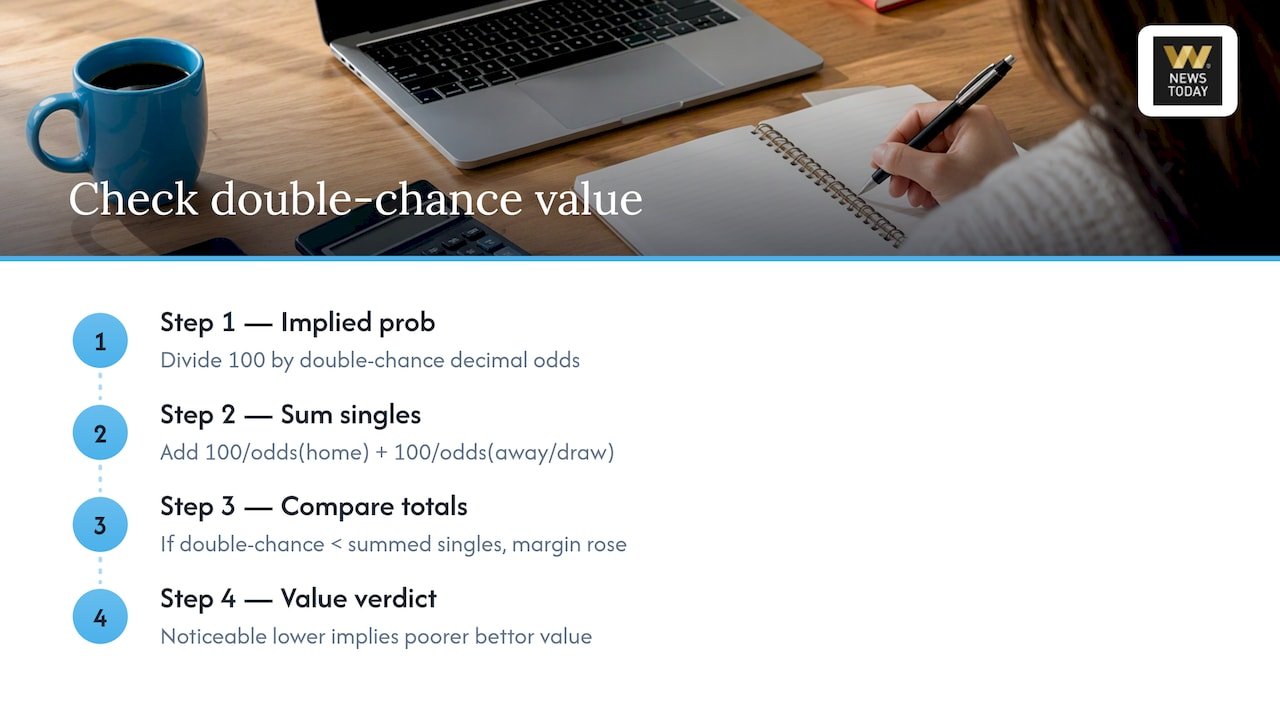
Statistic callout: Bookmakers price double chance by combining the three-way match probabilities and adding their margin, which explains why a double chance price is always shorter than either of its underlying single-result odds.
Common confusions: draw no bet, bet builders and market labels
The two mix-ups betters make most are confusing double chance with Draw No Bet, and underestimating what happens when double chance gets folded into a builder.
- Double chance 12 loses outright on a draw, while Draw No Bet simply refunds the stake on that same result, no winnings either way.
- A ticket labeled “double chance under 4.5” is usually a bet builder or same-game parlay, not a standard double chance market, and it multiplies the number of conditions that all have to land.
- Combining markets this way strips out the simple risk reduction that makes standalone double chance attractive in the first place, since every added leg brings its own way to lose.
- Market labels and IDs vary between data feeds and sportsbooks, so lean on the label the slip actually shows you rather than assuming 1X always sits in the same spot.
Pro Tip: Before you confirm any slip that mixes double chance with another market, read every condition listed, since one missed leg voids the whole combination.
If you want a deeper look at how combined markets shift the math, our guide to bet builder odds breaks down exactly how correlated picks trim your payout.
When to use double chance and how to size your stakes
Double chance earns its spot in your toolkit in specific situations, not every matchday.
- Use 1X or X2 when you have a lean toward one side but the draw genuinely worries you, rather than removing the draw outcome entirely like Draw No Bet would.
- Use it inside parlays when you want to trim variance: swapping a moneyline leg for its double chance equivalent raises your parlay’s overall hit rate while lowering the total payout, so you’re trading ROI for a steadier ride.
- Skip it when the draw is extremely unlikely, since you’d be paying for coverage you barely need.
Stake sizing matters here just like any other bet. A common approach is capping any single wager at a small, fixed percentage of your total bankroll so one bad week doesn’t wipe out your month. Our bankroll management playbook walks through the sizing rules in more detail, and if betting ever stops feeling fun, GambleAware has free, confidential support worth reaching out to.
Why we cover double chance the way we do
This article is designed to deliver accurate, informative, and easy to understand content, with high editorial standards and a commitment to factual reporting and responsible gambling. This piece reflects that approach: settlement rules, odds math and common mix ups, laid out so you can read a slip correctly before you ever tap confirm.
- Author credentials for jeff are not publicly listed at this time.
- For broader industry coverage and bonus news, our partner coverage at WildSlotz tracks offers and updates worth a look.
- If gambling stops feeling like entertainment, Gamblers Anonymous and our own responsible gambling resources are there to help.
Our take: the real edge is in the settlement rules, not the odds
Most explainers treat double chance as a beginner’s shortcut, a safer bet for nervous punters. That undersells it.
The conventional advice, “double chance is safer,” is only half true. It’s safer than a single-result bet on the same match, but it is not a free hedge, and it stops being safe the moment you stack it with other markets. Readers chasing value should prioritize understanding the settlement window first (90 minutes only, extra time excluded unless stated) before ever comparing odds. Get the rule wrong and the best price in the world won’t save your stake.
— jeff
FAQ
How does a double chance bet work?
A double chance bet combines two of the three possible full-time results, home win, draw, or away win, into one selection labeled 1X, X2 or 12. It wins if either of its two covered outcomes happens and loses only on the single excluded result.
What does double chance 1X2 mean?
The 1X2 market is the standard three-way bet on home win, draw, or away win, while double chance groups two of those same outcomes together. So “1X” in double chance means you win on either a home win or a draw from that same 1X2 result.
How do I calculate double chance odds?
Bookmakers generally combine the relevant three-way probabilities and add their margin rather than simply adding the two individual odds together.
What does “double chance under 4.5” mean in a bet?
A label combining double chance with another condition like total goals usually signals a bet builder or same-game parlay rather than a standard double chance market. Every added condition has to hit for the ticket to pay, which raises the overall risk compared to a standalone double chance bet.
What’s the difference between double chance and Draw No Bet?
Double chance 12 loses your stake outright on a draw, while Draw No Bet refunds your stake on that same draw with no winnings either way. They cover similar ground but settle very differently once the final whistle sounds.
Sources
- Double chance betting: how 1X, X2 and 12 work – Sportmonks
- What Is a Double Chance in Soccer Betting? – Action Network
- Goal
- GambleAware