



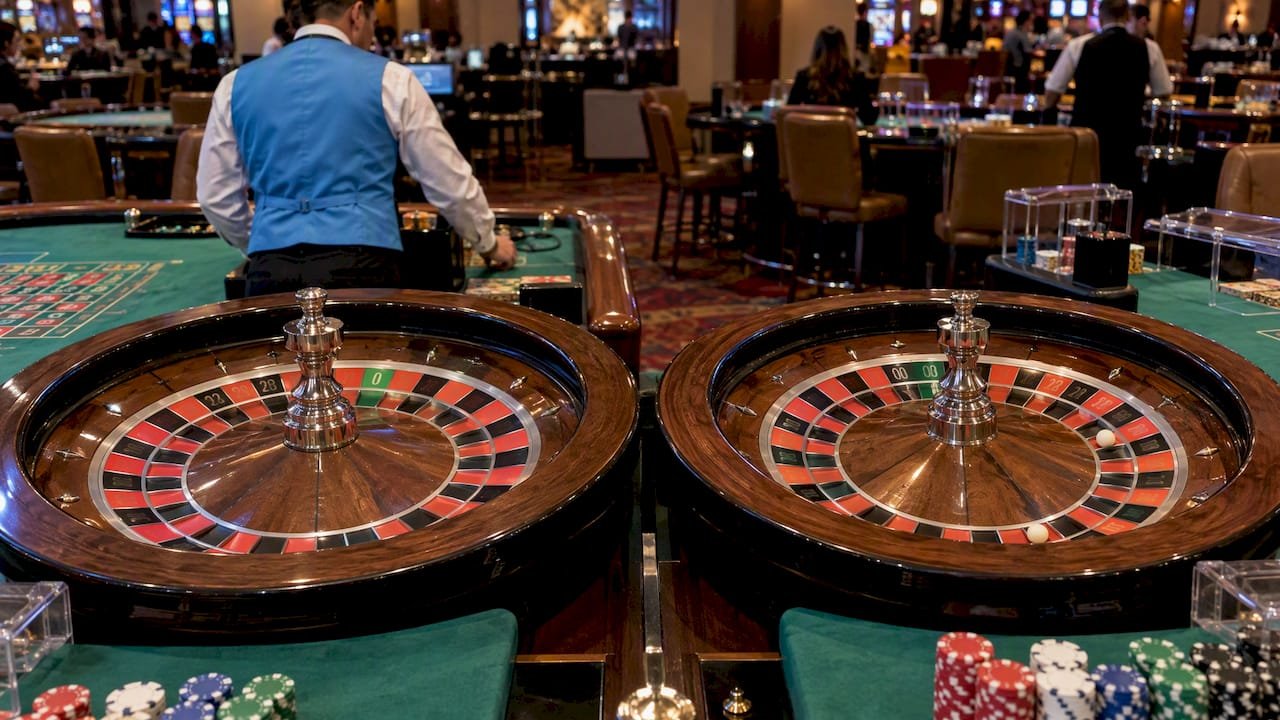
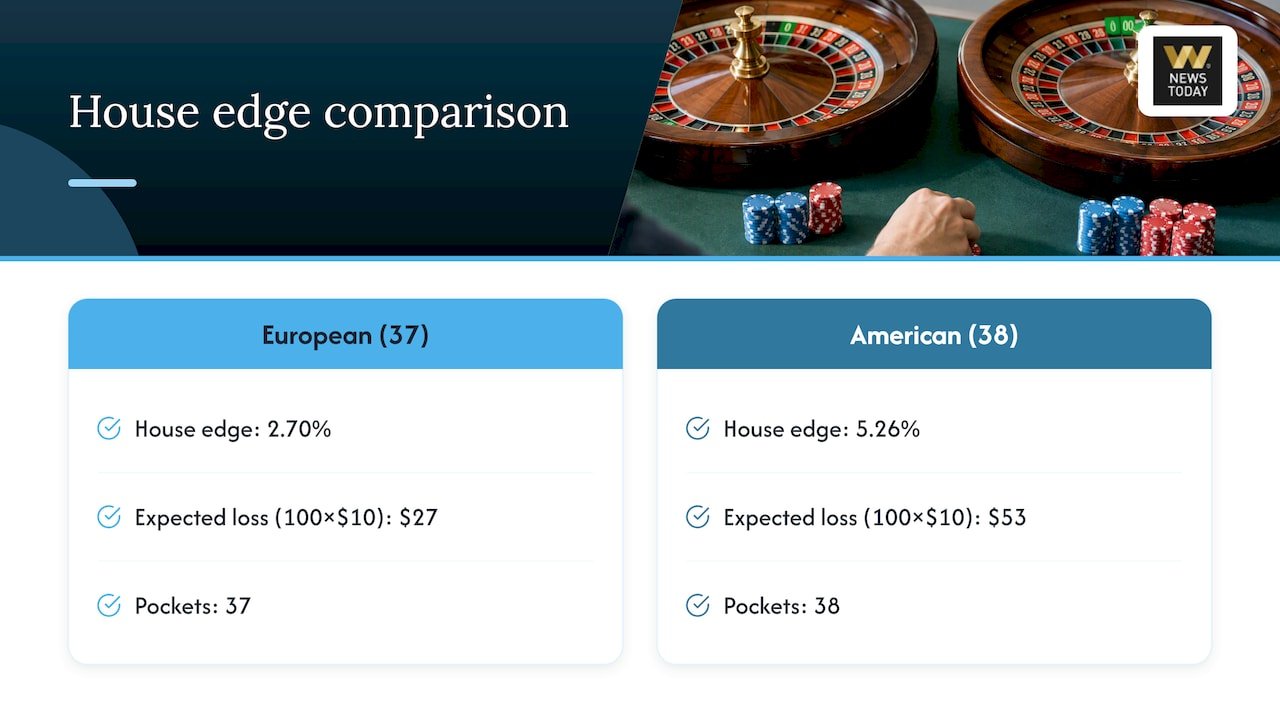
European roulette gives you better odds than American roulette, and the reason comes down to one extra pocket. The single-zero wheel has 37 pockets and a house edge of about 2.70%, while the double-zero American wheel has 38 pockets and a house edge of about 5.26%. If you can choose, single-zero wheels are generally the preferable option.
TL;DR:
- Choosing European roulette with La Partage or En Prison rules reduces the house edge on even-money bets to about 1.35%, compared to 5.26% on American wheels.
- The presence of a single zero in European roulette results in a 2.70% house edge, whereas the American double-zero wheel increases it to approximately 5.26%.
- The five-number basket bet on American tables has a house edge near 7.89%, making it the most costly wager and best avoided.
- Always verify the wheel type and available rules before playing, and set strict session and bankroll limits to minimize losses.
- Online roulette offers easier table selection, with clear labels for wheel type, making it simpler to choose the more favorable single-zero option.
Table of Contents
- How the wheels differ: layout, pocket counts, and payouts
- House edge, probabilities and EV for common bets
- Special rules and exceptional bets that change player cost
- Practical advice: table selection, bet choices, and session controls
- Final recommendation with reader scenarios
- W88 News Today perspective, author placeholder, and links to deeper guides
- Historical origins and development of American and European roulette
- Differences in table layout beyond the wheel, such as betting options
- Regional popularity and where each variant is predominantly found
- Impact of betting strategies on both variants and their effectiveness
- Editor viewpoint: the single most important choice players make
- Primary sources used for house-edge math and rules
- Sources
- FAQ
How the wheels differ: layout, pocket counts, and payouts
The physical wheel is where this whole comparison starts. A European (sometimes called French) wheel carries 37 numbered pockets: zero through 36, with a single green zero. An American wheel squeezes in an extra green pocket, 00, bringing the total to 38 pockets. That single addition is the entire source of the gap in house edge between the two games.
The number sequence around the rim also differs between the two wheels, which matters if you ever bet neighbor or call bets, since those wagers depend on which numbers physically sit next to each other. On a European wheel, the zero sits between 26 and 32. On an American wheel, 0 and 00 sit roughly opposite each other, splitting the number sequence into two mirrored halves.
What does not change is the payout schedule. Both variants pay:
- Straight-up bets at 35 to 1
- Split bets at 17 to 1
- Street bets at 11 to 1
- Column and dozen bets at 2 to 1
- Even-money bets (red/black, odd/even, high/low) at 1 to 1
Since the prizes are identical but the American wheel has one more losing pocket, your probability of winning any given bet drops, and that drop is what produces the higher house edge.
House edge, probabilities and EV for common bets
House edge is just the house’s share of every dollar wagered over the long run, and it comes directly from pocket counts. On a 37-pocket wheel, a straight-up number wins 1 time in 37, so the game keeps 1/37, or about 2.70%, of every bet. On a 38-pocket wheel, that same bet wins 1 time in 38, but the extra pocket pushes the long-run cost to about 5.26%, nearly double.
That ratio holds across almost every bet type on the layout, since payouts stay fixed while probability shifts with pocket count.
European wheels hold a 2.70% house edge versus about 5.26% on American wheels, meaning your long-run cost per dollar wagered is roughly half on a single-zero table. A concrete example makes this real: betting $10 per spin across 100 spins, a player can expect to lose around $27 on a European wheel compared to roughly $53 on an American wheel, nearly double the cost for the same action.
Special rules and exceptional bets that change player cost
Two French-table rules can shrink your cost even further on even-money bets, and one American bet can blow it up. Here’s what to know before you sit down:
- La Partage returns a portion of your stake when an even-money bet loses to zero, cutting the effective edge on those bets to roughly 1.35%.
- En Prison lets a losing even-money bet “ride” for another spin instead of losing outright, producing the same roughly 1.35% effective edge through a different mechanic.
- Some American tables offer a infrequent surrender rule that returns part of your even-money stake on a 0 or 00 spin, similar in spirit to La Partage but far less common.
- The American five-number “basket” bet, covering 0, 00, 1, 2, and 3 in one wager, carries a house edge near 7.89%, the worst single bet on the layout.
Skip the basket bet outright. It exists only on the American wheel, and nothing else on the table costs you more per dollar wagered.
Practical advice: table selection, bet choices, and session controls
Your single biggest lever over the house edge isn’t a betting system, it’s which table you sit down at. Follow this sequence before you place a chip:
- Scan the table placard for wheel type, minimum and maximum bets, and whether La Partage or En Prison applies.
- Choose single-zero (European or French) whenever it’s on the floor, and favor tables with La Partage or En Prison if you mostly play even-money bets.
- Build your bet mix around outside bets (red/black, odd/even, dozens, columns) to manage variance, and skip the American basket bet entirely.
- Set a session time limit and a bankroll limit before your first spin, and stick to both regardless of how the wheel is running.
Pro Tip: If you’re playing online and the lobby lists both wheel types, open the French or European table first since its lower edge compounds in your favor over a long session.
Online rooms often make this easier than a physical casino floor, since you can check the rules panel before committing any funds. Our online roulette guide breaks down what to look for in a live-dealer or RNG table.
Final recommendation with reader scenarios
Default to single-zero European or French roulette whenever it’s available. The lower edge, especially with La Partage or En Prison in play, gives you meaningfully more playing time and a smaller expected loss per dollar wagered.
American roulette still has its place. If it’s genuinely the only wheel on the floor, if you’re chasing the novelty of a double-zero table, or if you specifically want to study the basket bet’s math for your own curiosity, it’s a reasonable choice. Just walk in knowing the cost.
Before you play either variant, run through this:
- Confirm the pocket count (37 or 38) before your first bet.
- Ask about La Partage or En Prison if you’re playing even-money bets.
- Rule out the five-number basket bet entirely.
- Set your limits before the wheel starts spinning, not after.
W88 News Today perspective, author placeholder, and links to deeper guides
This site covers casino games with a focus on accurate, factual reporting, including roulette rules, bonus comparisons, and responsible-play resources. For more on live and online formats, see our online roulette guide and, if you want a lighter-stakes variant to practice bankroll discipline, our piece on mini roulette. We also maintain a dedicated responsible gambling resource for session and deposit limits.
This guide was written by Jeff, an editorial team member covering casino games and odds analysis.
Historical origins and development of American and European roulette
Roulette traces back to 18th-century France, where the single-zero wheel took shape as a refinement of earlier wheel games. The French layout, with its 37 pockets and distinctive betting terms like En Prison, became the template that spread across European casinos and stayed largely intact for more than two centuries.
The American version emerged when the game crossed the Atlantic in the 1800s. Operators in the United States added the second zero pocket, 00, which simplified some aspects of wheel construction while quietly doubling the house’s structural advantage on most bets. Over time, the American wheel also dropped some of the French-language betting terms and rules like La Partage, trading them for a simpler, faster-paced table that suited the pace of American casino floors.
Both versions evolved side by side through the 20th century, with European casinos largely sticking to single-zero wheels and American casinos standardizing on double-zero tables. The split isn’t just cosmetic. It reflects two different approaches to the same base game: one that preserved player-favorable rules from its French origins, and one that optimized for a different casino floor experience. That historical fork is still exactly what you see on casino floors and online lobbies today.
Differences in table layout beyond the wheel, such as betting options
The wheel gets most of the attention, but the betting layout (the felt where you actually place chips) has its own quirks worth knowing. European and French tables often use a single layout with betting positions on one side and a “racetrack” oval above it, used for neighbor bets, orphelins, and tiers du cylindre: groupings of numbers based on their physical position on the wheel rather than their value.
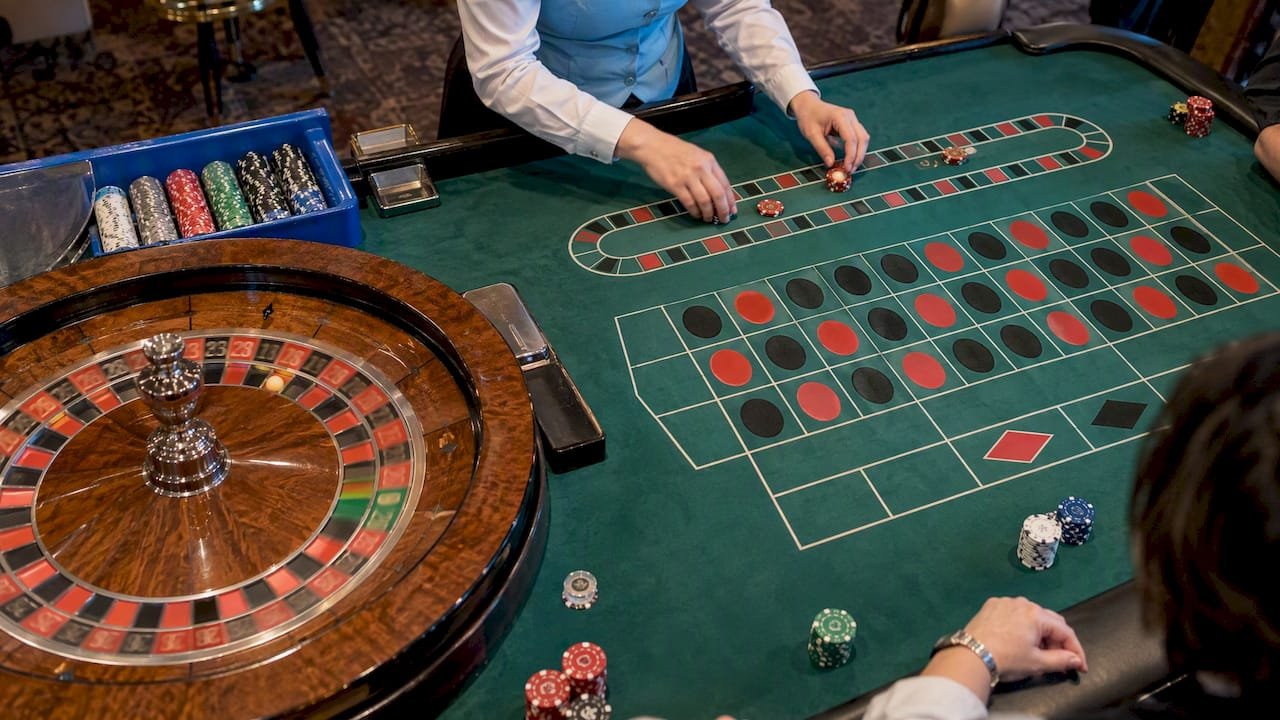
American tables typically skip the racetrack layout entirely and sometimes feature two betting layouts on either side of the wheel so more players can reach the table. The core inside and outside bets (straight-up, split, street, corner, column, dozen, red/black, odd/even, high/low) exist on both layouts, but the French-style call bets built around wheel position are rarely offered on American tables.
Table minimums and maximums also tend to run differently depending on the house and the format. A French table in a high-end room might carry higher minimums alongside the La Partage rule, while a standard American double-zero table often runs lower minimums aimed at faster, higher-volume play. None of this changes the math behind house edge, but it does change how the game feels to play, and it’s worth scanning the placard for both the wheel type and the layout style before you buy in.
Regional popularity and where each variant is predominantly found
European and French single-zero wheels dominate casino floors across Europe, and they’re also the standard format for most online and live-dealer roulette tables aimed at a global audience. If you’re playing roulette online, there’s a strong chance the default table you’re offered is already single-zero, which works in your favor.
American double-zero wheels remain the standard in land-based casinos across the United States, where the format has been entrenched since the 1800s. Double-zero tables also show up in some other markets, often alongside single-zero options rather than replacing them outright, giving players a direct choice on the same floor.
For online play, lobbies frequently list both variants side by side, labeled clearly as European roulette and American roulette. That labeling makes table selection genuinely simple, since you no longer need to guess which wheel is better: you just pick European or French when it’s listed, and the better odds come with it.
Impact of betting strategies on both variants and their effectiveness
Betting systems like Martingale, Fibonacci, and D’Alembert get discussed constantly around roulette, but none of them change the underlying probability of any spin. Every spin is independent, which means the wheel has no memory of past outcomes: the odds of red on this spin stay identical whether the last ten spins were red, black, or split evenly.
What these systems actually do is change the shape of your risk, not your expected loss. Martingale, for example, doubles your bet after each loss to chase a single win that recovers the deficit, which can work over short bursts but exposes you to table maximums and bankroll wipeouts during a long losing streak. None of that math improves with wheel type: a betting system run on an American wheel still loses money faster than the same system on a European wheel, because the underlying house edge is higher to begin with.
The one lever that reliably reduces your long-run expected loss is the wheel and rule set you choose, not the betting pattern you layer on top of it. Table selection does more for your bottom line than any betting system, a point worth remembering before you build an elaborate staking plan around either variant. If you enjoy the structure a system gives your session, by all means use one, but anchor it to a single-zero table with favorable rules first.
Editor viewpoint: the single most important choice players make
If there’s one number worth carrying with you to any roulette table, it’s the pocket count. Thirty-seven beats thirty-eight every time, and no betting system changes that math. Choosing single-zero with La Partage or En Prison, when it’s on offer, is a bigger lever than any staking plan you’ll find online.
Set your bankroll and session limits before you sit down, not after a rough streak convinces you to chase losses. Roulette is meant to be entertainment with a known cost, not a plan to beat the math.
— jeff
Primary sources used for house-edge math and rules
For readers who want to dig into the math themselves, these references cover the probability tables and rule variations referenced throughout this guide: Wizard of Odds’ roulette basics for full bet-by-bet EVs, Roulette-Strat’s odds reference for La Partage and En Prison mechanics, and VegasInsider’s wheel comparison for pocket layouts. For a broader look at how expected value works across casino games, WildSlotz’s guide to RTP and volatility is a useful companion read.
Sources
- Roulette odds and wheel differences (VegasInsider)
- Roulette basics and bet EVs (Wizard of Odds)
- Roulette odds and payout reference (Roulette-Strat)
- American vs European roulette: The house edge explained (AncientGames)
FAQ
What did Albert Einstein say about roulette?
Einstein is widely quoted as saying the only way to beat roulette is to steal money from the table, a line reflecting the game’s fixed house edge rather than any flaw you can exploit through strategy. No betting system changes the math behind single-zero or double-zero wheels.
Is roulette 100% luck?
Yes, each spin is an independent, random event, and no betting system or prior result changes the odds of the next spin. Your only real control is which wheel and rule set you choose to play, since that’s what sets the house edge before you ever place a bet.
What is the 3/2 rule in roulette?
There’s no standardized “3/2 rule” in mainstream roulette probability or rules, and definitions circulating online vary widely without a consistent source. If you’ve seen it referenced for a specific betting system, treat it as that system’s own term rather than an established odds principle.
What is the smartest bet on roulette?
Outside, even-money bets like red/black or odd/even carry the lowest house edge on most tables, especially on a single-zero wheel with La Partage or En Prison, where the effective edge drops to roughly 1.35%. Avoid the American five-number basket bet, which carries the highest edge on the table at roughly 7.89%.