





For quick, on-the-go sessions, choose mobile. For long, precision-driven play with bigger screens and steadier controls, choose desktop. The real trade-offs come down to three things: performance, convenience, and security, and licensed operators now close most of the gap between them, so the “right” answer depends far more on how you play than which platform is objectively better.
TL;DR:
- Mobile platforms excel in portability and quick access, making them ideal for short, impulsive betting sessions during breaks or travel.
- Desktop offers superior graphics, input precision, and a more immersive experience for longer, strategic play sessions, especially with live dealer tables.
- Load times and animation smoothness are generally better on desktops, but mobile performance is improving with adaptive content delivery and optimized assets.
- Payment methods like biometric logins dominate mobile for speed, while desktop supports a wider range of payment options with added security from browser-based verifications.
- Choosing the right platform depends on your session goals, device capabilities, connection quality, and safety practices, with many players benefiting from switching between both.
Table of Contents
- Mobile Casino vs Desktop: The Quick Comparison
- Performance and Graphics: What Your Device Actually Delivers
- How Touch and Screen Size Shape Your Play
- Payments and Security: What Changes by Device
- Game Library and Live Dealer Access on Each Platform
- Which Platform Fits Your Play Style?
- How to Choose Your Platform Right Now
- How Mobile and Desktop Platforms Are Typically Evaluated
- The Bottom Line on Mobile vs Desktop Casino Play
- Why the “Which Platform Is Best” Debate Misses the Point
- Sources
- FAQ
Mobile Casino vs Desktop: The Quick Comparison
Neither platform wins across the board, but each dominates specific axes. Here’s how they stack up when you break it down by what actually affects your session:
- Portability: Mobile wins outright. You can spin a slot on a train, at lunch, or between meetings. Desktop ties you to a chair.
- Visual fidelity: Desktop wins. Bigger monitors, higher resolutions, and steadier frame rates make slot animations and live dealer streams look sharper.
- Session length: Mobile favors short, frequent bursts. Desktop favors longer, deliberate sessions where you’re tracking multiple hands or studying a roulette wheel.
- Input precision: Desktop wins for anything requiring exact clicks, like adjusting bet sizes on a crowded blackjack table. Touchscreens are faster to launch but less exact.
- Payment flow: Mobile wins on speed thanks to Apple Pay, Google Pay, and biometric logins. Desktop wins on flexibility, since it supports a wider range of saved wallets and card options.
The growth story backs mobile’s momentum. Statista’s online gambling market outlook shows steady year-over-year gains in mobile’s share of gambling traffic, which is exactly why operators keep pouring resources into app-first design. That said, AndroidHeadlines’ comparison of app versus desktop gaming notes that desktop still holds the edge for players who want longer, more immersive sessions rather than quick hits.
Performance and Graphics: What Your Device Actually Delivers
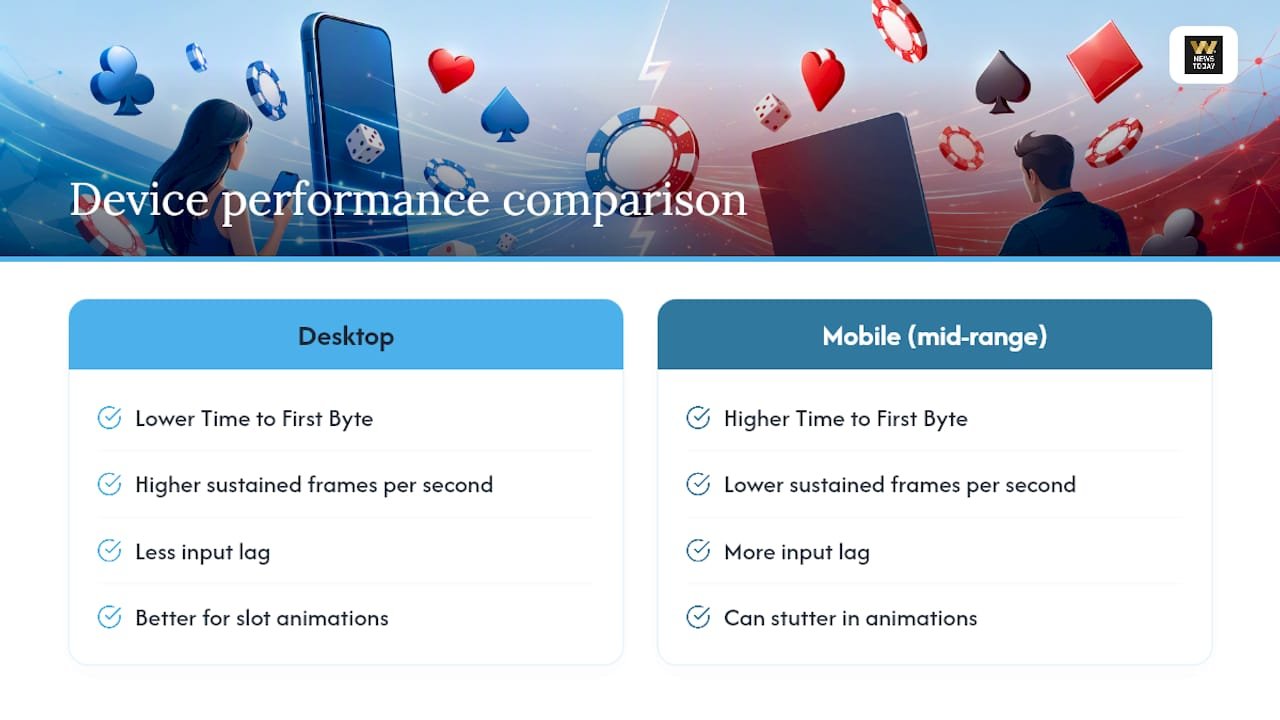
Load times and animation smoothness aren’t just cosmetic. They shape whether a slot feels responsive or sluggish. Two metrics matter most here: Time to First Byte (TTFB), which measures how fast a server starts responding to your request, and First Contentful Paint (FCP), which measures how fast something visible actually appears on your screen. According to a technical comparison from Kenlive, desktop platforms generally post lower TTFB and higher sustained frames per second than mid-range mobile devices, along with less input lag.
That gap matters most in two spots: slot bonus animations that need to render smoothly, and live dealer games where a half-second delay can mean missing your betting window. The good news is that this gap keeps narrowing. Content delivery networks (CDNs) now detect your device type and serve compressed, mobile-optimized assets like WebP images and adaptive video streams, which cuts load penalties significantly for phone users. If your mobile casino app feels choppy, the problem is often your connection, not the platform itself.
How Touch and Screen Size Shape Your Play
Your device’s interface does more than change how things look. It changes how you play. Mobile apps lean on one-tap biometric logins, fingerprint or Face ID, so you’re in and spinning within seconds. Desktop trades that speed for multitasking: you can run a live dealer stream in one tab and check your bankroll history in another.
- Smaller screens can bury important details. Pay tables, bonus terms, and wagering requirements sometimes get tucked behind extra taps that desktop displays upfront.
- Mobile’s fast entry point encourages short, frequent sessions. Desktop’s setup friction tends to produce longer, more deliberate ones.
- Notification pop-ups on mobile (bonus alerts, tournament reminders) pull you back in more often than a browser tab ever will.
Pro Tip: Before you deposit on a mobile app, zoom into the promotions page and actually read the wagering terms. Small screens hide fine print more easily than desktop, and that’s exactly where confusing bonus terms tend to live.
Payments and Security: What Changes by Device
Desktop’s browser-based checkout typically runs through 3D Secure, the extra verification step your bank adds before approving a card payment, along with saved wallets stored in your browser. Mobile skips a step by tapping into Apple Pay, Google Pay, or carrier billing, all secured by device-level biometrics rather than typed passwords.
Under the hood, mobile apps often store payment tokens in a hardware-backed keychain, while desktop machines rely on a Trusted Platform Module (TPM) chip for similar protection, though desktop carries added exposure from browser extensions and phishing pop-ups. Either way, a few habits matter more than the platform: turn on two-factor authentication, avoid rooted or jailbroken phones since they weaken those hardware protections, and stick to licensed operators. For deposit specifics, our guide to credit cards for online gambling transactions breaks down which cards offer the strongest fraud protections on either platform.
Game Library and Live Dealer Access on Each Platform
Most slots today run on HTML5, which means the same game plays identically whether you load it on a phone or a laptop. Parity is close to universal for standard reels. Where desktop still pulls ahead is in wider UI detail, some operators show extended stat panels, side-bet breakdowns, or multi-table views that get simplified or dropped entirely on smaller screens.
Live dealer tables tell a similar story. Desktop’s larger canvas fits multiple camera angles and side-bet trackers without crowding the feed. Mobile compresses that into a single main view, which works fine on strong Wi-Fi but can stutter over patchy mobile data. Titles like the new baccarat squeeze format from Gameplay Interactive are built mobile-first, showing how far live studios have come. Still, check the promotions page carefully. Some operators quietly restrict certain bonuses or tournament-linked offers to desktop-only sign-ups, and you won’t always see that flagged inside the app.
Which Platform Fits Your Play Style?
Match the device to how you actually gamble, not how you wish you gambled. A commuter squeezing in five spins between subway stops needs mobile’s speed. A high-stakes blackjack grinder tracking count and bankroll across a three-hour session needs desktop’s screen real estate and keyboard shortcuts.
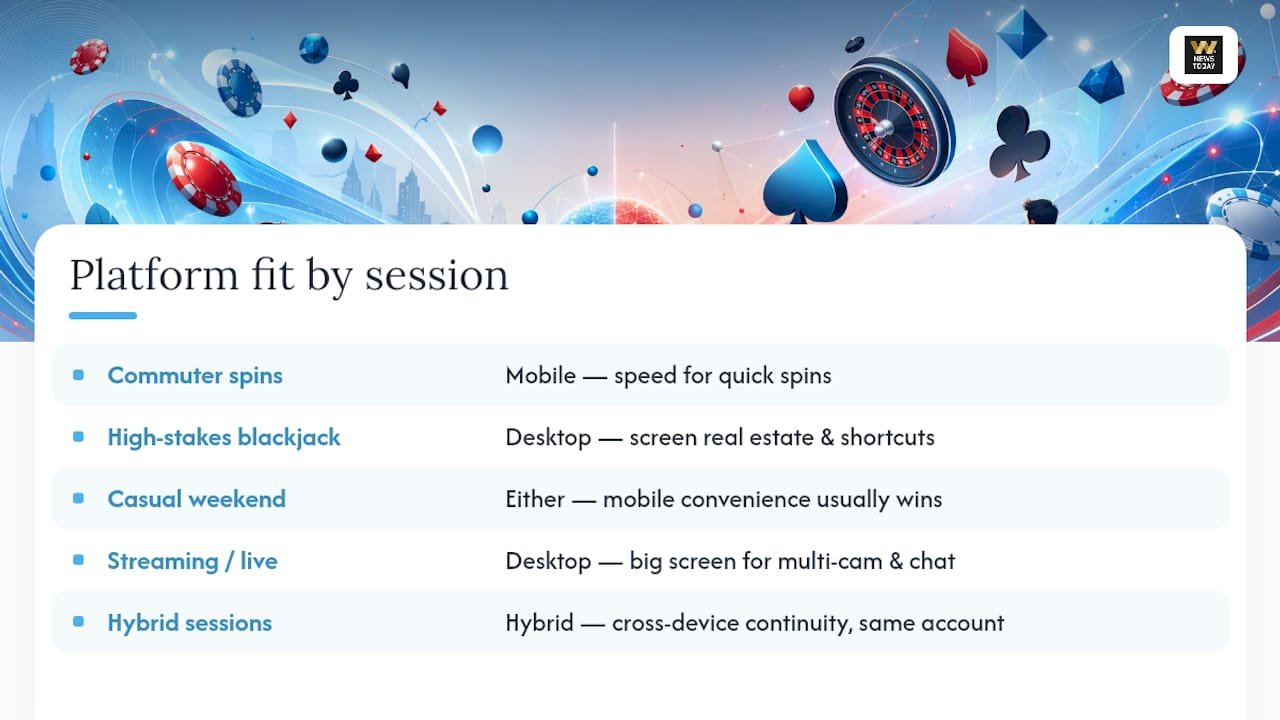
A casual weekend spinner does fine on either, though mobile’s convenience usually wins by default. Streamers and serious live dealer fans skew desktop, since a bigger display makes multi-cam feeds and chat overlays easier to follow. Plenty of players run a hybrid: start a session on mobile during a commute, then finish it later on desktop with the same account and balance carried over seamlessly with handy tools from ParlayGeeks. That continuity is one of the more underrated perks of sticking with a single licensed operator across devices.
How to Choose Your Platform Right Now
Run through this before you load your next session:
- Define your session intent. Quick spin or extended play?
- Check your device’s capability. An older phone with a small screen struggles with detailed live tables.
- Test your connection. Weak mobile data will hurt live dealer streams more than slots.
- Confirm your payment method works on that platform. Some carrier billing options are mobile-only.
- Verify safety basics. Look for HTTPS, licensing info, and visible responsible-gambling tools before you deposit.
Stop and double-check if a site lacks HTTPS, doesn’t display any responsible-gambling resources, or asks for unusual payment steps outside standard card or e-wallet flows. A commuter with fifteen minutes to spare should default to mobile every time; someone planning a deliberate two-hour session should default to desktop.
Pro Tip: Desktop’s extra setup steps, opening a browser, logging in, navigating menus, actually work in your favor. That small friction gives you a beat to reconsider before you bet, which is part of why it tends to produce more deliberate play than mobile’s instant tap-and-go access.
How Mobile and Desktop Platforms Are Typically Evaluated
Platforms are commonly reviewed based on session speed, screen usability, payment security, and game parity across devices. Editorial teams often check whether operators genuinely optimize both experiences instead of treating mobile as an afterthought. For deeper reading on specific game categories, see our coverage of live casino tables and new releases like Fortune Horse by PG Soft, both built to perform well on phone screens without sacrificing detail on desktop.
The Bottom Line on Mobile vs Desktop Casino Play
- Choose mobile for short, spontaneous sessions, biometric logins, and quick slot spins.
- Choose desktop for extended play, live dealer immersion, and precise bet control.
- Many players benefit from running both, starting on mobile and finishing on desktop with the same account.
- Always play on licensed platforms and use tools like deposit limits or self-exclusion through resources such as BeGambleAware.
- Browse W88news for new slot releases and platform-specific guides before you pick where to play next.
Why the “Which Platform Is Best” Debate Misses the Point
The conventional advice treats this like a horse race, mobile versus desktop, pick a winner. That framing falls apart once you look at the actual data. Desktop wins on raw technical metrics almost every time: lower TTFB, higher sustained frame rates, tighter input response. But those numbers only matter if your play style needs them. A player doing quick five-minute slot sessions during a lunch break gets zero benefit from desktop’s superior frame rate, because the animation was never the bottleneck. The bottleneck was how fast they could unlock their phone and start spinning.
What gets underrated in most comparisons is the behavioral angle. Desktop’s extra setup friction isn’t a flaw, it’s arguably a built-in responsible-gambling feature that mobile’s one-tap convenience removes entirely. If you’re someone who tends to play more impulsively, that friction is worth protecting rather than optimizing away. My take: stop asking which platform is “better” and start asking which platform matches your actual risk profile and session goals. That’s a more honest question, and it’s the one that actually keeps you playing safely longer.
— jeff
Sources
Key references for this comparison include AndroidHeadlines’ platform analysis, Kenlive’s technical security comparison, and Statista’s gambling market outlook. For player support, visit BeGambleAware or Gambling Therapy. Visit W88news for ongoing coverage.
- Is It Better to Play Online Gaming Through Apps or Desktop?
- Online gambling market outlook (Statista)
- Desktop vs Mobile on leading gaming platforms – A technical & security comparison – Kenlive
- BeGambleAware
FAQ
Is Gaming Better on PC or Mobile?
Neither is universally better. Desktop generally delivers stronger graphics, lower input lag, and steadier frame rates, while mobile wins on convenience and short-session accessibility, so the right choice depends on how and when you play.
Is the Mobile Gambling Market Bigger Than Desktop?
Mobile’s share of online gambling traffic has grown steadily, according to Statista’s market outlook, and that trend is a major reason operators keep investing in app-first design and mobile-optimized sites.
Which Is Harder to Master, Playing on PC or Mobile?
Desktop tends to have a steeper initial learning curve because of its fuller feature sets and multitasking layout, while mobile is simpler to pick up but can hide detailed pay tables and terms behind smaller screens.
What’s the Difference Between Mobile and Desktop Casino Traffic?
Mobile traffic tends to spike in short, frequent bursts throughout the day, while desktop sessions cluster into longer, less frequent visits, reflecting the different ways players use each device.
Can I Play Live Dealer Games on Mobile?
Yes, most live dealer tables now run on mobile with HTML5 streaming, though desktop typically shows more camera angles and side-bet details thanks to its larger screen.