





Arbitrage betting is mathematically sound but operationally fragile. The math works when you lock two or more outcomes at odds that guarantee profit no matter who wins, but odds movement, bet voids, and sportsbook limits turn that guarantee into a coin flip. The three risk categories that actually erode your edge are execution timing, bookmaker pushback, and capital friction. Understanding all three, and the fixes for each, is what separates a hobby that pays for itself from one that quietly bleeds your bankroll.
TL;DR:
- Odds can shift within seconds, making timing crucial and increasing the risk of holding only one bet without the hedge if the market moves suddenly.
- Bookmakers use automated systems to detect sharp betting patterns and typically limit or ban accounts that place frequent, calculator-like bets without recreational activity.
- Running arbitrage at scale requires pre-funding multiple accounts, with fees, delays, and currency conversions eroding the actual profit margins well below the theoretical 1.5% average.
- Placing bets on slower-moving, less liquid sportsbooks first, and diversifying across several books, helps manage account restrictions and reduces detection risk.
- Effective arbitrage involves disciplined calculation, stake rounding, conditional thresholds, and keeping a friction reserve to absorb voided or one-sided bets without losing overall profitability.
Table of Contents
- Arbitrage Betting Risks You’ll Hit Before You Even Place the Bet
- How Sportsbooks Spot Arbers and Shut Them Down
- The Real Cost of Capital, Fees, and Liquidity
- Cutting Your Risk Without Killing Your Edge
- How to Calculate an Arb Before You Commit Real Money
- The Mental Toll Nobody Warns You About
- Taxes on Arbitrage Betting Profits
- Treat Arbing Like Trading, Not Gambling
- Where These Numbers Come From
- Sources
- FAQ
Arbitrage Betting Risks You’ll Hit Before You Even Place the Bet
Arbitrage windows close fast. Most arbs stay live for 30 seconds to five minutes before a sportsbook adjusts its line or the market catches up, and margins in that window typically run 0.5% to 3%. Miss that window and you’re stuck holding one leg of a bet with no hedge on the other side.
A one-sided position happens when you get your first bet placed but the second sportsbook changes its odds, suspends the market, or rejects your stake before you can lock the opposite side. Instead of a guaranteed win, you’re now exposed to a straight bet with no arbitrage protection at all. This is the single most common way arbers lose money, and community discussion on forums like r/arbitragebetting consistently names timing and syncing errors as the top culprits.
Palpable errors add another layer of danger. When a line is obviously mispriced (a typo, a stale feed, a data error), sportsbooks routinely void or reverse those bets after the fact, as Sporting News points out. That leaves you holding your other leg with zero hedge, turning a “guaranteed” arb into a straight loss.
Technical failures compound all of this:
- Spotty connectivity or an app freeze at the wrong second
- Two-factor authentication prompts that stall your second bet
- Fat-finger stake entry that throws off your whole calculation
- Odds feeds lagging behind the live market by even a few seconds
Pro Tip: Always place your bet on the less liquid, slower-moving book first. If a line is going to shift on you, it usually moves on the sharper, faster-moving book second, giving you a better shot at locking both legs.
How Sportsbooks Spot Arbers and Shut Them Down
Sportsbooks run automated risk models built specifically to catch patterns that look like arbing rather than recreational betting. Action Network’s education desk notes that these systems flag accounts with no “recreational noise”: no parlays, no prop bets on your favorite team, nothing but calculator-precise stakes placed the instant a line moves.
The escalation path tends to follow a predictable order:
- Stake limits often occur after dozens to around a hundred bets show a sharp pattern
- Market restrictions next, where you can still bet but only on less profitable lines
- Promo and bonus bans, cutting off one of arbing’s most profitable entry points
- Full account closure if the pattern persists
Once a book limits you to $5 or $10 stakes, your income from that account effectively caps out, according to OddsShopper’s analysis of common limiting timelines. Scale requires fresh accounts across more books, and each new account carries its own ramp-up period before it gets flagged too.
Here’s the legal wrinkle worth understanding clearly: arbitrage betting is generally legal in most jurisdictions since you’re just betting on both sides of an event through separate legitimate operators. But it’s typically prohibited under individual sportsbook terms of service, which is why limiting and closure are the operator’s tool of choice rather than any criminal penalty.
Pro Tip: Track how many bets you’ve placed at each book and roughly what percentage look “sharp.” If you’re closing in on triple digits with zero recreational action mixed in, you’re due for a limit soon.
The Real Cost of Capital, Fees, and Liquidity
Running arbitrage at any real scale means pre-funding accounts across a dozen or more sportsbooks simultaneously. If you want to catch an arb the moment it appears, your money has to already be sitting in the right place, which means your effective capital requirement multiplies fast compared to betting through a single account.
That capital doesn’t move freely either. Withdrawal holds, identity verification delays, and currency conversion fees on international books all slow down your cash flow and quietly shave off your realized return. A theoretical 1.5% edge routinely lands closer to 0.7% to 1.2% after friction, according to OddsCipher’s operational analysis of realized versus theoretical arb margins.
| Friction Source | Typical Effect on Margin |
|---|---|
| Currency conversion fees | Reduces margin by a fraction of a percent per leg |
| Withdrawal holds and verification delays | Delays access to capital, raising opportunity cost |
| Rounding stakes to avoid detection | Small reduction in theoretical profit per bet |
| Voided or one-sided bets | Can eliminate profit entirely on that event |
Locking capital across many books also means it isn’t earning anywhere else, and that opportunity cost is easy to underestimate until you tally it over a full month. Solid bankroll management planning treats this friction as a real line item, not an afterthought.
Cutting Your Risk Without Killing Your Edge
You can’t eliminate arbitrage risk, but you can shrink it with discipline. Here’s the order of operations experienced arbers actually follow:
- Confirm both legs before committing. Double check stakes and odds on both books, and place your bet on the slower, less liquid book first so you’re not left exposed if a line moves.
- Skip anything that looks like a palpable error. A line that’s wildly out of step with the market is more likely to get voided than paid out.
- Round your stakes. Betting $47.83 instead of $50 screams “calculator,” and rounding is one of the simplest, highest-impact tactics for slowing detection.
- Mix in recreational bets. A parlay here, a same-game prop there, gives your betting history some noise that doesn’t fit the sharp pattern risk models look for.
- Spread your action across more books. Don’t put all your volume through two or three sportsbooks; diversifying slows how fast any single operator builds a profile on you.
- Keep a friction reserve. Set aside extra capital beyond your calculated stakes to absorb the occasional voided bet or one-sided loss without derailing your bankroll.
- Walk away below your margin threshold. If an arb clears less than roughly 1% after fees, the risk of a void or line move usually isn’t worth chasing it.
Pro Tip: Use a dedicated device or browser profile for each sportsbook account. Logging into five different books from the same browser session on the same device is exactly the kind of pattern that gets accounts linked and limited together.
How to Calculate an Arb Before You Commit Real Money
An arbitrage opportunity exists when the sum of implied probabilities across all outcomes is less than 1. The formula, per Smarkets’ help documentation, is straightforward: 1 divided by the decimal odds on outcome A, plus 1 divided by the decimal odds on outcome B. If that total comes in under 1, you’ve found a genuine arb.
Here’s a two-leg example. Say Book A offers 2.10 on Team X and Book B offers 2.05 on Team Y. Implied probability on Team X is 1/2.10, or 47.6%. Implied probability on Team Y is 1/2.05, or 48.8%. Add them together and you get 96.4%, which is under 100%, confirming a 3.6% theoretical margin.
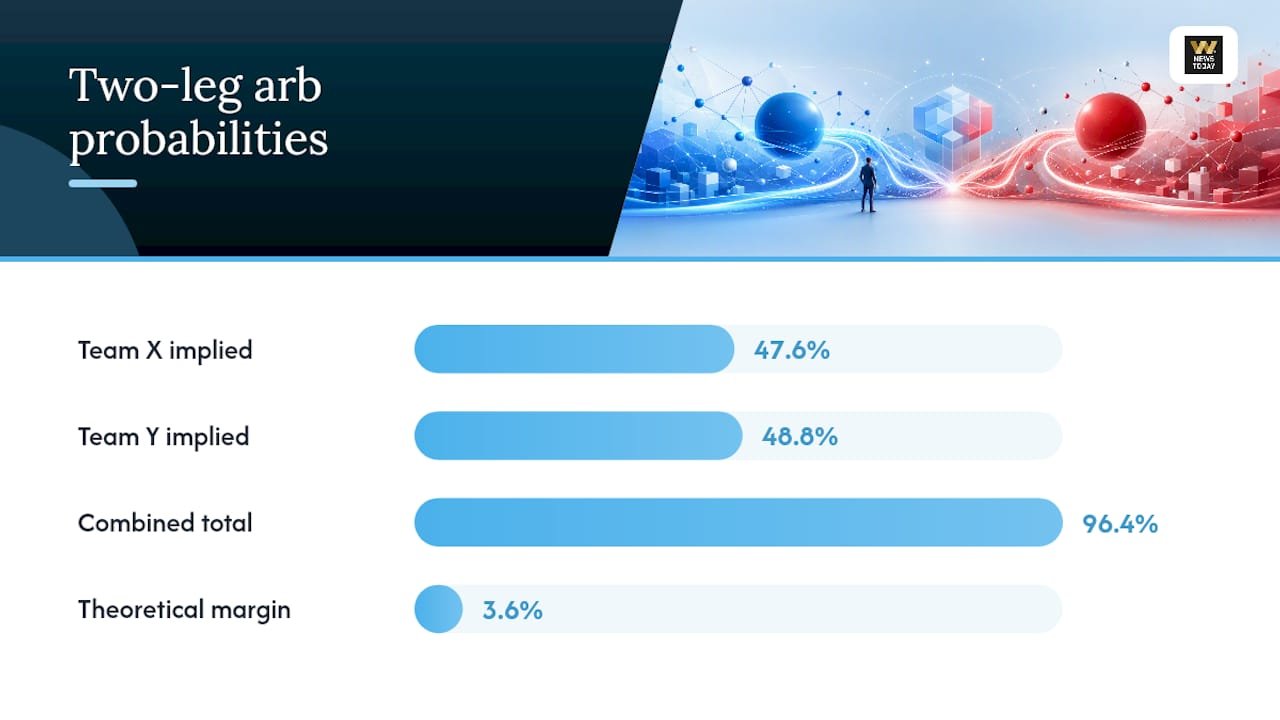
To size your stakes, allocate your total bankroll proportionally to each leg’s implied probability:
Before you place either bet, round those stakes to less exact numbers, re-run your calculation with the rounded figures to confirm the margin still holds, and subtract any transaction fees to see your actual post-fee profit. A 3.6% margin on paper can shrink fast once fees and rounding are factored in.
The Mental Toll Nobody Warns You About
Arbitrage betting looks like spreadsheet work, but it doesn’t feel like spreadsheet work once real money is on the line. Watching a line move against you in the ten seconds between placing your first bet and trying to lock the second is genuinely stressful, and that stress compounds every time it happens.
The psychological grind comes from a few specific sources. First, there’s the constant vigilance: profitable arbs vanish fast, so serious arbers end up checking scanners and odds feeds obsessively, which can bleed into anxiety outside of betting hours entirely. Second, there’s the frustration of account limiting. Watching a sportsbook quietly cap your stakes to $5 after months of building that account feels like punishment for doing math correctly, and it’s demoralizing in a way that a straight betting loss usually isn’t.

Third, there’s decision fatigue. Evaluating dozens of potential arbs a day, cross-referencing odds across a dozen sportsbooks, and making split-second calls about which line to trust wears people down faster than most expect. Some arbers report feeling more like they’re running a small trading desk than enjoying a hobby, which is exactly the mindset shift this activity demands.
None of this means arbing is a bad way to spend your time. It means you should treat the emotional cost as a real cost, the same way you’d treat a transaction fee. If checking odds feeds is stealing your attention from work, family, or sleep, that’s a signal to scale back your volume, not a personal failing.
Taxes on Arbitrage Betting Profits
Winnings from arbitrage betting are still gambling winnings, and how they get taxed depends entirely on where you live and how your local tax authority classifies betting income. Some jurisdictions treat gambling winnings, including arb profits, as tax-free for casual bettors but taxable if your activity is frequent and organized enough to look like a business or trade. Others tax gambling winnings outright regardless of scale, with reporting thresholds that vary by country and sometimes by state or region.
Because arbing involves multiple sportsbooks and, often, cross-border platforms, keeping clean records matters more than it does for casual betting. Track every stake, every payout, and every fee across every account, because reconstructing that history months later during tax season is far harder than logging it as you go. If your arbing volume is significant enough that tax authorities might view it as a business activity rather than casual gambling, a conversation with a tax professional familiar with gambling income in your specific jurisdiction is worth the cost. Tax rules on gambling winnings differ enough between countries and even within them that no general guide can safely tell you your exact obligation. Treat this section as a prompt to check your local rules, not as a substitute for them.
Treat Arbing Like Trading, Not Gambling
Arbitrage betting works best when you approach it the way a trader approaches arbitrage in financial markets: with tight risk controls, realistic margin expectations, and total acceptance that some percentage of trades will lose money to execution error. The bettors who last the longest at this aren’t the ones chasing the biggest theoretical margins. They’re the ones who protect account longevity, keep a friction reserve, and treat every voided bet as a cost of doing business rather than a personal setback.
Our stance at W88news is straightforward: set conservative profit expectations from day one, follow disciplined bankroll management rules, and check your jurisdiction’s betting legality before scaling up. Responsible play matters here just as much as it does in any other form of betting, arbitrage included.
— jeff
Where These Numbers Come From
The arb-window and margin figures cited above come from OddsCipher’s operational breakdown of realized versus theoretical returns. Account-limiting behavior and escalation patterns are drawn from OddsShopper and Action Network’s coverage of sportsbook risk models, while the calculation formulas trace back to Smarkets’ help documentation.
This article is general information, not a substitute for advice from a qualified financial advisor. Consult a qualified financial professional about your own circumstances before acting on anything here.
Sources
- Arbitrage — risk-free sports betting math & operational tradecraft | OddsCipher Codex
- Will Sportsbooks Ban You for Arbitrage Betting? | OddsShopper
- Arbitrage betting explained — Sporting News
- How to calculate arbitrage betting | Smarkets Help
- Arbitrage education — Action Network
FAQ
How Risky Is Arbitrage Betting?
Arbitrage betting carries real operational risk despite the math guaranteeing profit on paper. Odds movement, bet voids, and account limits can turn a theoretical edge into an actual loss, especially for anyone new to executing bets fast across multiple books.
Is Arbitrage Betting Profitable?
It can be, but realized margins usually fall well below theoretical ones. A 1.5% arb often nets closer to 0.7% to 1.2% after fees, holds, and rounding, and profits shrink further once a sportsbook limits your stakes.
Is Betting Arbitrage Illegal?
Arbitrage betting is generally legal in most places since you’re placing legitimate bets with licensed operators. It’s typically against individual sportsbook terms of service, though, which is why the usual consequence is account limiting or closure rather than any legal penalty.
What Are the Risks of Arbitrage Betting Specifically?
The core risks are execution failure (odds moving before you lock both legs), bookmaker action (limits or closures once you’re flagged as sharp), and financial friction (fees, holds, and locked capital reducing your realized margin below what the math promised).