





Cash out lets you settle a live or pre-match bet before it finishes, locking in a payout smaller than your potential win but bigger than zero. The decision rule is simple: cashing out is usually a small negative-EV move, so use it mainly to lock in unavoidable certainty, cut a loss when new information turns against you, or take the offer only when a quick math check shows it sits at or above fair value. Everything else in this guide teaches you that math check.
TL;DR:
- Cash out offers are typically built around a 4 to 12 percent margin above the fair value, making many seemingly generous offers still below true worth.
- Using multiple bookmakers to average odds helps produce a more accurate implied probability, which improves decision-making on cash-out timing.
- Cash out is most justified when you need liquidity, when new information reduces your win probability, or when the offered amount matches or exceeds fair value based on your estimate.
- Partial cash out can be effective on multi-leg parlays to secure profit or reduce risk without losing remaining upside, especially during volatile live markets.
- Relying on cash out repeatedly at below fair value gradually erodes your long-term expected value and can encourage reckless betting behavior.
Table of Contents
- What Is Cash Out Betting and Where Does It Show Up?
- How Is a Cash-Out Amount Actually Calculated?
- When Should You Actually Cash Out?
- How Do You Cash Out on Desktop and Mobile?
- Which India-Available Sites Offer Solid Cash-Out Options?
- What Should You Check Before Trusting a Book’s Cash-Out Feature?
- How Does W88 News Today Test Cash-Out Behavior?
- What Are the Real Downsides of Using Cash Out?
- How Do Cash-Out Features Actually Differ Between Operators?
- Legal Considerations Around Cash Out Betting in India
- What Do Real Cash-Out Decisions Look Like in Practice?
- Balancing the Math With Real Bankroll Pressure
- Explore More Betting Guides and Tools on W88news
- Sources
- FAQ
What Is Cash Out Betting and Where Does It Show Up?
Cash out lets you end an unsettled bet early for a guaranteed return, agreed on the spot rather than waiting for the final whistle. The book (or exchange) calculates a live offer based on current odds, then pays you that amount immediately and closes your ticket.
You’ll run into two flavors on most Indian-facing platforms:
- Full cash out settles the entire stake at once, either for a profit or a reduced loss.
- Partial cash out lets you pull out a portion of your stake while leaving the rest riding to its natural conclusion.
Cash out typically appears on in-play singles, pre-match singles before kickoff, and increasingly on parlays (accumulators) once every leg is live or settled. A four-leg cricket parlay with three legs already won will often show a cash-out value reflecting near-certain profit on the settled legs, discounted by the risk still sitting in the final leg. One catch worth flagging early: bets placed with free-bet stakes or bonus funds frequently carry restricted or delayed cash-out eligibility, since operators treat that stake differently until it clears wagering conditions, a distinction operator help pages spell out for exchange-style products in particular.
How Is a Cash-Out Amount Actually Calculated?
Every cash-out offer starts from the same building block: the potential payout of your bet multiplied by the current implied probability of the remaining outcome, minus a margin the bookmaker adds for offering you the exit. Strip that margin out and you get the fair, or “no-vig,” value. That gap between fair value and the actual offer is what industry writers sometimes call the cash-out tax, and it’s the number that decides whether accepting is smart or expensive.
Here’s the repeatable check:
- Estimate the no-vig implied probability of your remaining bet winning (average two or three books’ live odds if you can, and remove their margin).
- Multiply that probability by your potential payout to get the fair cash-out value.
- Compare the bookmaker’s actual offer to that fair value.
- Accept only if the offer is close to or above fair value, or if your own honest win-probability estimate is lower than the break-even probability implied by the offer.
Statistic Callout: Research on live betting pricing pegs the typical hidden cash-out margin at roughly 4 to 12 percent above what a book already charges through the vig, meaning a “generous-looking” offer can still be a below-value trade. A cash-out calculator automates steps 1 through 3 and shows you the break-even probability in seconds, which beats doing implied-probability math on your phone while a wicket falls.
When Should You Actually Cash Out?
Three scenarios make cashing out a defensible move rather than an emotional reflex.
- Forced liquidity. You need the funds now, your bankroll rules demand you free up exposure, or you’re closing a position before traveling or logging off for a stretch.
- Fresh information. A key batsman retires hurt, weather turns, or a red card materially worsens your side’s odds. Your updated probability estimate has genuinely dropped.
- Offer at or above fair value. Your break-even math (from the previous section) says the number on screen is a fair trade, not a discounted one.
Outside those three, cashing out winners routinely just because you’re nervous tends to cost money over a season. You’re paying the book’s margin every time, and doing it repeatedly compounds into a real drag on long-run returns, even if any single cash-out feels smart in isolation.
Partial cash out gives you a middle path worth using more often than most bettors do. Pull out enough stake to guarantee a profit or eliminate your original risk, then let the remainder ride at the original odds. This works especially well on multi-leg cricket or football parlays where one leg has already gone your way and you want to bank something without killing the whole ticket’s upside.
Pro Tip: Before tapping cash out under pressure, ask one question: “If I couldn’t see this offer, would I still bet this outcome at these odds right now?” If the answer is yes, you’re probably leaving value on the table by cashing out.
Bankroll size matters here too. A bettor running a tight bankroll has more reason to take a certain, smaller win than someone with room to absorb variance. Cash out isn’t just a math problem. It’s also a psychological tool for managing tilt, and using it that way occasionally is fine as long as you know you’re paying for it.
How Do You Cash Out on Desktop and Mobile?
The mechanics are nearly identical across most sportsbooks, with small interface differences between apps and desktop sites.
- Open your bet slip or “my bets” section and locate the live bet showing a cash-out value.
- Tap or click “Cash Out” to see the current full offer.
- If partial cash out is supported, drag the slider to choose what percentage of your stake to pull.
- Confirm the transaction before the price refreshes, since live cash-out values update every few seconds during in-play markets.
Exchange-style products calculate cash out slightly differently, pricing the offer directly from live back and lay prices rather than a house formula, according to Betfair’s exchange support documentation.
Cash out sometimes fails to appear or grays out. Common causes include a suspended market during a goal or wicket review, prices moving too fast for the system to quote safely, or a free-bet stake that hasn’t cleared eligibility rules. Sportsbook support pages generally list these exact scenarios in their cash-out FAQs. If it fails, refresh the app, wait for the market to resume, or check your bet slip’s terms for stake restrictions. Cashed funds typically post to your balance within seconds to a couple of minutes; a rare mis-priced cash out can occasionally be reversed by the operator’s risk team.
Which India-Available Sites Offer Solid Cash-Out Options?
Aggregated rankings of cash-out betting sites available to Indian bettors tend to group the same five names, each with a slightly different strength.
- Stake — Built around fast, low-latency in-play markets and a smooth mobile-first interface, which matters when cash-out prices refresh every few seconds.
- 1xBet — Covers a wide spread of markets, including niche live options, with multiple cash-out configurations across sports.
- Parimatch — Known for strong partial cash-out mechanics and solid cricket in-play coverage, useful for multi-leg cricket tickets.
- 4Rabet — Focused on the Indian market specifically, with partial cash out and localized promo integration worth checking against your preferred payment method.
- Puntit — A smaller operator that keeps cash-out presentation simple on the bet slip, appealing if you want fewer clicks and less clutter.
Before relying on any of these for cash out, check three things directly on the operator’s site: whether partial cash out is actually supported for your bet type, how deep their cricket in-play coverage runs, and whether your specific promo or bonus stake excludes cash-out eligibility. Availability and terms shift, so confirm local access, supported withdrawal methods, and the current T&Cs before you commit real money.
What Should You Check Before Trusting a Book’s Cash-Out Feature?
Run through this short checklist before you lean on any operator’s cash-out button in a live match.
- Does the book offer full cash out, partial cash out, or both?
- How deep is its sports coverage, and does that include strong cricket in-play markets?
- How fast does the cash-out price update and settle during volatile in-play swings?
- How stable is the mobile app when a market gets busy right after a goal or wicket?
- Do the terms and conditions exclude free bets, bonus stakes, or certain bet types from cash out?
- What’s the operator’s stated policy on reversing a mis-priced or glitched cash-out transaction?
Most of these answers live in the operator’s help center or T&Cs page rather than the marketing copy, so it’s worth a five-minute read before your first live bet. If you want a sharper edge on your fair-value estimate, check odds across two or three books for the same live market and average their no-vig implied probabilities. That average is usually closer to the true probability than any single book’s number, since each operator’s margin skews slightly differently.
How Does W88 News Today Test Cash-Out Behavior?
An editorial team reviews cash-out features by tracking live-price timing, app stability during volatile in-play swings, and sample offers against calculated fair value across multiple sports. That process shapes the guidance in this article and in a broader betting guides collection, which includes worked examples and calculators for parlay expected value alongside cash-out math. This piece was written by jeff, drawing on that testing framework alongside published operator documentation and industry pricing research.
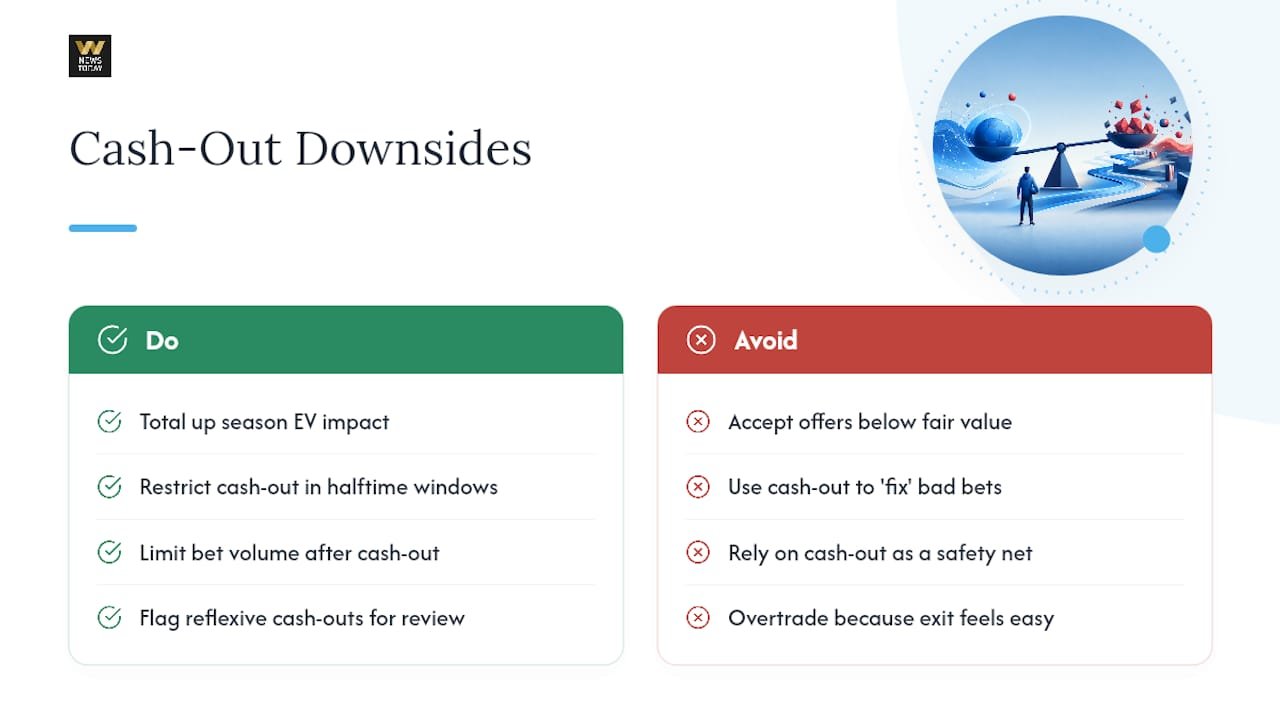
What Are the Real Downsides of Using Cash Out?
The biggest downside is invisible until you total up a season: every cash-out transaction you accept below fair value chips away at your overall expected value, even when each individual decision feels safe. A bettor who cashes out ten winning bets a month at a typical 4 to 12 percent margin below fair value is effectively handing back a slice of every edge they worked to build.
Cash out also changes your betting behavior in subtler ways. Knowing an exit is always available can make you place looser bets upfront, on the assumption you can bail if things wobble. That safety net encourages more volume and, over time, more exposure to the book’s built-in margin. It’s a similar mechanism to why casual traders overtrade when stop-losses feel too easy to hit.
There’s a timing risk too. Live cash-out prices during high-margin windows, such as halftime, are among the worst value moments to accept an offer, since the book knows demand for certainty spikes right when emotions run highest. Accepting there compounds the cost.
Finally, cash out can mask a genuinely bad original bet. If you took a poor price to begin with, a cash-out offer partway through doesn’t fix that mistake. It just lets you exit at a smaller loss than the bet deserved, which can create a false sense of having “managed” a wager that should have been avoided in the first place. Responsible-gambling resources like BeGambleAware specifically flag reflexive cash-out use as a pattern worth watching, since it can quietly increase both the frequency and size of losses over time.
How Do Cash-Out Features Actually Differ Between Operators?
The mechanics look similar across apps, but the fine print separates a genuinely useful cash-out feature from a frustrating one.
Timing is the first differentiator. Some operators settle cash-out transactions in seconds; others introduce a short delay while their risk engine reprices the market, which matters when you’re trying to exit before a wicket falls. Fee structure differs too, though it’s rarely a visible line item. Instead, it’s baked into the offer itself as the hidden margin discussed earlier, and that margin varies by operator, sport, and even how close the match is to a settling event.
Restrictions vary the most. Some books block cash out entirely on certain parlay combinations or on any bet touched by a free bet or bonus stake, an issue covered in more detail in our guide on sticky versus non-sticky bonus terms. Others allow full cash out but disable partial cash out on specific markets like outright winners or long-term futures. Mobile app stability during high-traffic moments, think a last-over run chase, also separates operators in practice even when their published features look identical on paper. An app that lags or freezes at exactly the moment you want to lock in a price effectively removes the feature when you need it most.
None of this shows up clearly in promotional material, so the checklist from the earlier section (availability, speed, restrictions, reversal policy) remains the fastest way to compare two operators honestly before you commit stake to either one.
Legal Considerations Around Cash Out Betting in India
Sports betting regulation in India is fragmented and state-specific, with no single national framework governing online sportsbooks the way some countries regulate gambling centrally. Most operators offering cash-out features to Indian bettors are licensed offshore, commonly in jurisdictions like Curacao or Malta, rather than under an Indian gambling license, since India has no unified central licensing body for online sports betting.
Cash out itself isn’t a separately regulated product. It’s a feature within a betting platform, so its legal standing follows whatever framework governs the underlying betting activity in a bettor’s specific state. Some Indian states have explicit laws restricting betting and gaming activity, while others have no clear statute addressing online sports betting at all. That patchwork means the legal picture can differ meaningfully depending on where you’re physically located when you place a bet, not just which operator you use.
This isn’t legal advice, and this guide isn’t positioned to tell you what’s permitted in your specific state. If you’re unsure whether online sports betting is lawful where you live, checking your state’s current gaming statutes or speaking with a legal professional is the only reliable path, since operator marketing pages routinely oversimplify or omit this nuance entirely.
What Do Real Cash-Out Decisions Look Like in Practice?
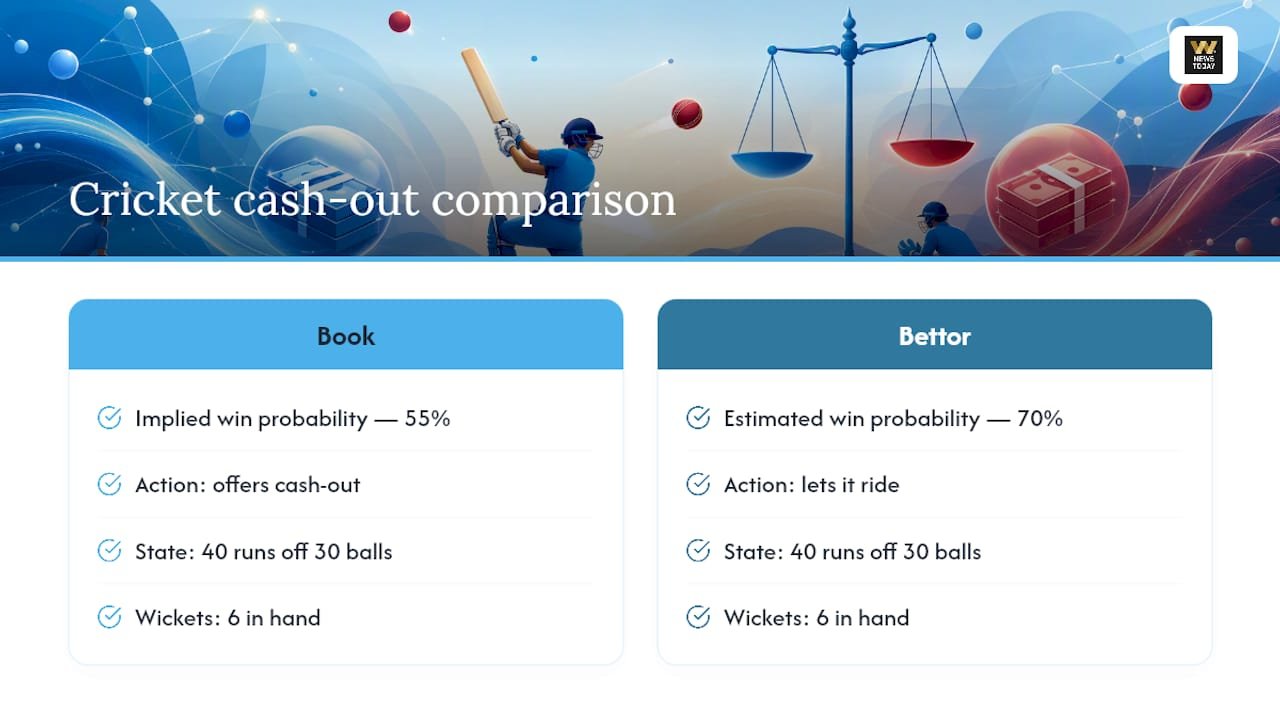
A four-leg cricket parlay with three legs settled and one live remaining shows a common pattern. Say the final leg is a team needing 40 runs off 30 balls with six wickets in hand. The book might offer a cash out reflecting roughly a 55 percent implied win probability for that side. If your own honest read of the situation puts their chances closer to 70 percent given the batting lineup still available, the math favors letting it ride. Taking the cash out here means accepting a worse price than the bet is actually worth.
Compare that to a scenario where a key bowler goes off the field with what looks like an injury mid-over. That’s fresh information genuinely worsening your side’s prospects. A cash-out offer that looked unattractive five minutes earlier can suddenly represent fair or even generous value, and taking it fits squarely into the “new information” scenario from earlier in this guide.
A third case involves partial cash out on a same-game multi late in a football match. With your side up 2 to 0 in the 85th minute on a two-leg bet where one leg has already settled, pulling out enough stake to guarantee a small profit while leaving a modest amount riding on the final leg lets you bank certainty without fully capping your upside. That’s the partial cash-out tactic working exactly as intended, applied at a moment where the math and the situation actually align.
Balancing the Math With Real Bankroll Pressure
The break-even rule should govern most cash-out calls, but bankroll strain and emotional fatigue are real constraints, not excuses to ignore. Use the checklist and a calculator before you decide, not your gut in the moment.
— jeff
Explore More Betting Guides and Tools on W88news
This resource gives you something most cash-out explainers don’t: a testing-backed approach to reading live betting features instead of just a definition and a shrug. If the fair-value math in this guide clicked for you, the next logical step is applying it with the right supporting tools already sitting in one place.

Our betting guides hub covers everything from parlay expected value to bankroll structuring, and we keep adding fresh coverage as new game releases and sportsbook features roll out across the operators we track. If cash out sparked your interest in edge-hunting more broadly, our breakdown of value betting and closing line value is the natural next read, and our hedging guide walks through the closest cousin to cash out for situations where the feature isn’t available. Start with the guide closest to your current bet type, run the numbers, and make your next cash-out decision with a calculator open instead of a thumb hovering over the confirm button.
Sources
This guide drew on cash-out margin research from The Best Bet on Sports, fair-value explainers from OddsShopper, the cash-out calculator methodology, exchange mechanics from Betfair support, and responsible-gambling guidance from BeGambleAware.
- Live Betting Cash-Out Feature Math in May 2026: When Sportsbook Cash-Out Offers Are Positive EV and When They’re a Trap | The Best Bet on Sports
- Cash Out Calculator: Should You Cash Out Your Bet? (2026)
- Cash Out On Exchange
- BeGambleAware
FAQ
What Is Cash Out in Betting?
Cash out lets you settle an unfinished bet early for a guaranteed payout, agreed at the current live price instead of waiting for the final result. It can apply to the full stake or just a portion, depending on the platform and bet type.
What Happens if I Cash Out on a Bet?
Your ticket closes immediately at the offered amount, and that amount is credited to your balance, typically within seconds to a couple of minutes. The original bet no longer runs to its natural conclusion, so you give up any further upside in exchange for certainty.
Is Cashing Out Bets a Good Idea?
It depends entirely on whether the offer is close to fair value or you have a genuine reason for certainty, such as fresh information that worsens your odds or a bankroll need. Cashing out winners reflexively, without checking the math, tends to cost money over time because of the hidden 4 to 12 percent margin built into most offers.
How Is Cash Out Calculated?
The bookmaker multiplies your potential payout by the current no-vig implied probability of your bet winning, then subtracts its own margin from that figure to arrive at the offer shown on screen. A cash-out calculator automates this so you can compare the offer against your own probability estimate before deciding.