




The Kelly Criterion tells you the fraction of your bankroll to stake that maximizes long-run geometric growth. It only recommends a stake when you have a genuine positive edge, and a negative result simply means you sit that bet out. Because your probability estimates are never perfect, most bettors apply a fractional Kelly, often half or quarter strength, to smooth out the ride.
TL;DR:
- Kelly advises using fractional stakes, typically half or quarter Kelly, to reduce volatility and drawdowns, especially when estimates are uncertain.
- The formula relies on accurate probability estimates and should be adjusted downward in real markets for correlation, errors, and multiple open bets.
- Full Kelly can be overly aggressive and may lead to large losses, making fractional Kelly safer for most bettors without extensive model validation.
- Estimating true edge requires accounting for bookmaker margins, sample size, and dependencies between bets to avoid overestimating your advantage.
- Kelly is most effective in repeatable, well-understood bets with reliable data; it is less suitable for one-off wagers or highly uncertain situations.
Table of Contents
- What is the Kelly Criterion and where does the formula come from?
- How to calculate a Kelly stake step by step
- Adjusting Kelly for real markets, correlated bets, and error
- Where Kelly breaks down and the mistakes bettors make
- Decision checklist: should you use Kelly on this bet?
- Why you can trust this staking guide
- Our take: why we lean conservative on Kelly
- Sources
- FAQ
What is the Kelly Criterion and where does the formula come from?
The Kelly Criterion is a staking formula built to answer one question: given a bet where you believe you hold an edge, what fraction of your bankroll should you risk growing your wealth as fast as possible over many repeated bets? The goal is not to maximize your winnings on a single wager. It is to maximize the expected value of the logarithm of your wealth, a subtle but important difference explained by the Stanford treatment of the Kelly Criterion.
Log wealth matters because betting is multiplicative, not additive. Win a bet and your bankroll gets multiplied by a factor above 1. Lose one and it gets multiplied by a factor below 1.
The classic single-bet formula, in edge or odds form, is:
f = (bp – q) / b*
Here, p is your estimated probability of winning, q is the probability of losing (1 minus p), and b is the net odds you are being paid (decimal odds minus 1). The formula, named for the researcher who introduced it in 1956, essentially converts your edge into a proportion of bankroll: the bigger your edge relative to the odds, the larger the recommended stake. When the formula spits out a negative number, that means the odds you are being offered are worse than your estimated probability justifies, and the correct move is to stake nothing at all, per the Stanford Kelly Criterion analysis.
Kelly does not manufacture an edge out of thin air. It only tells you how to size a bet once you already believe, with some justification, that you have one.
How to calculate a Kelly stake step by step
Working out your Kelly stake is arithmetic you can do on your phone between matches. Here is the process, followed by a full worked example.
- Convert the bookmaker’s odds to decimal format if they are not already, then find the implied probability by dividing 1 by the decimal odds.
- Estimate your own probability, p, for the outcome using form, statistics, or a model you trust.
- Subtract the implied probability from your estimate to find your edge.
- Plug your numbers into f* = (bp – q) / b to get the recommended fraction of bankroll.
- Multiply that fraction by your fractional Kelly setting (full, half, or quarter) and then by your bankroll to get your actual stake.
Here, b = 1.00 (decimal odds minus 1), p = 0.60, and q = 0.40.
f* = (1.00 × 0.60 − 0.40) / 1.00 = 0.20
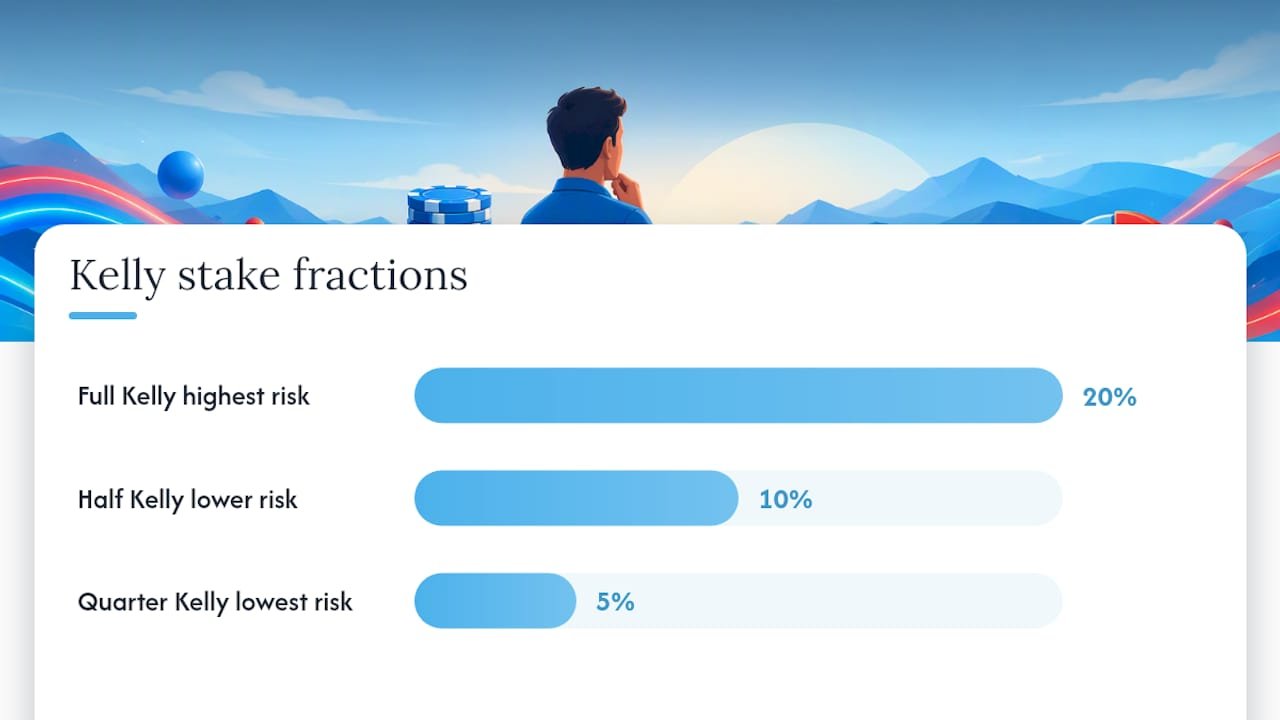
Full Kelly recommends staking a significant fraction of your bankroll on this bet. That is an aggressive number for a single wager, which is exactly why practitioners rarely use it at full strength.
Half-Kelly and quarter-Kelly represent smaller fractions of bankroll, used to reduce volatility and drawdown risk. Halving the stake roughly halves the long-run growth rate advantage that full Kelly targets, but it cuts volatility and drawdown risk far more than proportionally, a trade-off documented in practitioner literature on staking, including Edward O. Thorp’s writing on Kelly.
On a modest bankroll, full Kelly here means a large stake, with half-Kelly and quarter-Kelly accordingly lower. That spread shows why the fractional choice matters as much as the formula itself.
Adjusting Kelly for real markets, correlated bets, and error
Full Kelly assumes you know the true probability of an outcome with certainty and that you are placing one bet at a time with no overlap. Neither assumption holds up well in real betting markets. Your estimate of p carries error, odds move, and you are often juggling several open positions across a single day of sports. Research reviewing sports betting strategy found that Kelly is mathematically optimal only under these restrictive conditions, and that an adaptive fractional Kelly performs more robustly once estimation error and simultaneous bets enter the picture, per an experimental review of sports betting strategies.
Pro Tip: Treat your probability estimate as a range, not a point value, and size your stake off the conservative end of that range.
A few practical adjustments keep Kelly workable outside the classroom:
- Use half-Kelly or quarter-Kelly as your default, reserving full Kelly for situations where your probability model has a long, tested track record.
- Cap total daily exposure across all open bets so a cluster of favorable-looking wagers cannot combine into an oversized risk to your bankroll.
- Re-scale every individual stake proportionally whenever the sum of your Kelly fractions across simultaneous bets would exceed a sensible ceiling of total bankroll.
- Treat bets on related outcomes, such as two markets from the same match, as correlated rather than independent, since research on sports gambling shows that computing Kelly separately for each one can overstate your real exposure, as outlined in work on sports gambling issues.
Thorp’s own practitioner writing recommends downward adjustments from full Kelly precisely because variance, payoff shapes, and the reality of waiting on multiple bets at once make the full formula too aggressive for most people managing a real bankroll, according to Thorp’s analysis of Kelly across blackjack, sports betting, and the stock market. If you want a deeper framework for how staking rules like this fit into your overall bankroll strategy, our bankroll management playbook walks through sizing and caps in more detail.
Where Kelly breaks down and the mistakes bettors make
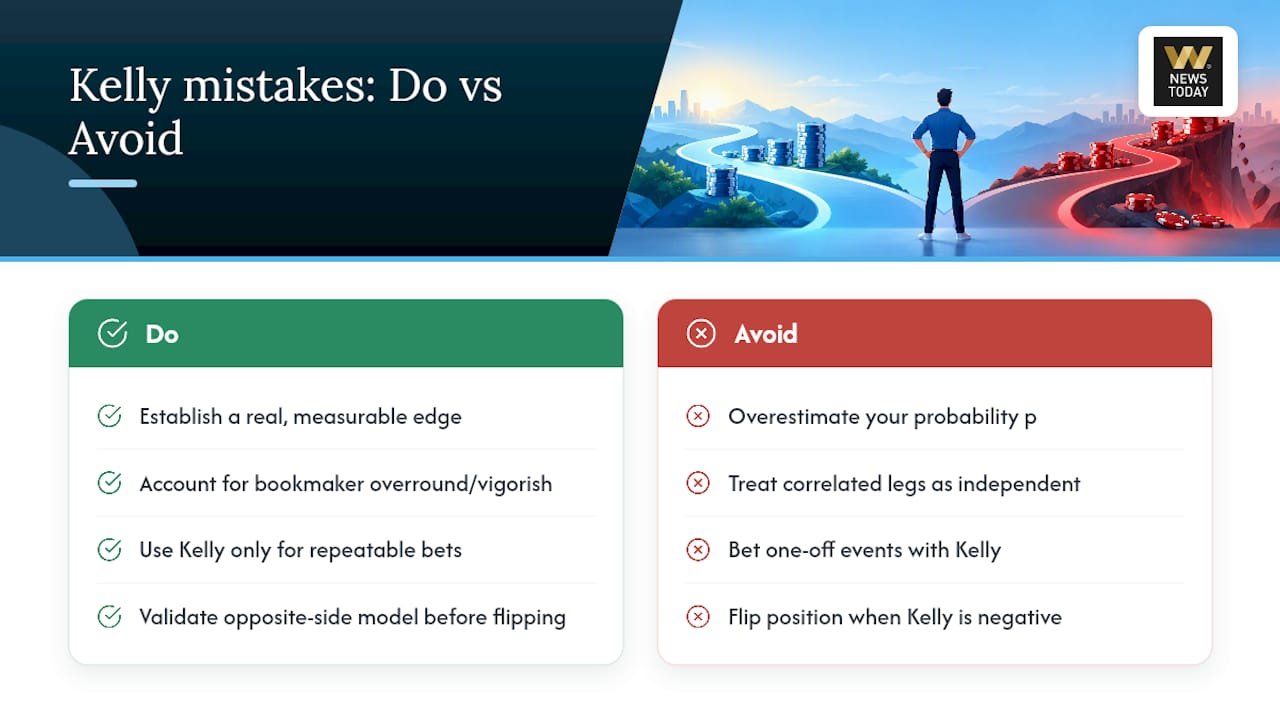
Kelly is only as good as the probability estimate you feed it. If your estimate of p is optimistic, guessed, or based on a small sample, the formula will confidently recommend a stake built on a foundation that is not there. It also assumes repeatable opportunities: a one-off bet you will never see again does not benefit from a growth formula designed around many repeated plays.
A few mistakes show up again and again:
Bettors frequently overestimate their own edge, feeding the formula a p that flatters their read on a match rather than reflecting a properly tested model. Many also forget to account for the bookmaker’s built-in margin, known as the overround or vigorish, which quietly shrinks the true payout below what the headline odds suggest. Establishing a real, measurable edge before sizing anything is the actual hard part of this process, something we cover in our guide to proving your edge with closing line value.
Others ignore dependencies between bets entirely, treating a same-day parlay of correlated markets as if each leg were an independent coin flip.
One rule deserves its own line: if the Kelly formula returns a negative fraction, that is your signal to stake zero, not a cue to bet the other side. Flipping your position to bet against the market only makes sense if you have a separately validated model showing a real edge in that opposite direction, not just a negative number from your original estimate, according to the Stanford Kelly Criterion explanation.
Decision checklist: should you use Kelly on this bet?
Before you size anything with Kelly, run through a short gut check.
- Is this bet part of a repeatable pattern, or a one-off wager you are unlikely to see again?
- Is your probability estimate built on a large enough sample to trust, or is it closer to a hunch?
- Can you tolerate the drawdown that comes with your chosen fraction if a losing streak hits?
- Are any of your open bets correlated with each other, and have you adjusted your total exposure accordingly?
- Have you set a hard cap on combined daily stake as a percentage of bankroll?
Once you clear that checklist, picking your fractional multiplier comes down to confidence:
- Use quarter-Kelly if your probability model is new, untested, or based on a small sample.
- Use half-Kelly once your model has a track record and you are comfortable with moderate swings.
- Reserve near-full Kelly for rare cases where your edge estimate is well validated and drawdown tolerance is high.
The math scales, but your comfort with volatility should decide the fraction, not the size of the number.
Why you can trust this staking guide
This site covers bankroll management and betting analytics as a core part of its editorial focus, alongside casino reviews, sportsbook guides, and slot coverage. The worked example and formula in this guide follow the standard Kelly derivation used in academic and practitioner sources, cross-checked against the Stanford probability treatment and Thorp’s practitioner writing rather than assumed. The author covers betting strategy and staking mechanics, and every figure above traces back to a linked, checkable source rather than a rounded guess.
For readers who want to go further, our guide to value betting and closing line value covers how to establish the edge that Kelly sizing depends on, and our bankroll management playbook covers caps and portfolio rules in more depth.
Our take: why we lean conservative on Kelly
We favor fractional Kelly for most bettors, and half-Kelly specifically for anyone without a long, tested track record on their probability estimates. Full Kelly looks appealing on paper because it maximizes theoretical growth, but that growth comes bundled with drawdowns most people are not emotionally built to sit through. A string of losses at full Kelly stakes can shake your confidence enough that you abandon a genuinely good process at the worst possible moment.
Fractional Kelly trades some of that theoretical upside for a bankroll curve you can actually stick with, which matters more than the math suggests on a spreadsheet. Wherever you bet, follow your local laws and your platform’s advertising and eligibility rules before staking anything.
— jeff
Sources
The Stanford Kelly Criterion page covers the formal math and intuition behind log-wealth maximization. The sports betting strategy review examines real-world limitations and fractional Kelly performance. Thorp’s practitioner paper offers decades of applied adjustment history, and the Indian advisory on online betting outlines legal and advertising concerns worth understanding before you engage with any betting platform.
This article is general information, not a substitute for advice from a qualified financial advisor. Consult a qualified financial professional about your own circumstances before acting on anything here.
- Probability – The Kelly Criterion (Stanford)
- Optimal sports betting strategies in practice: an experimental review
- The Kelly Criterion in Blackjack Sports Betting, and the Stock Market (Thorp)
FAQ
What is the Kelly Criterion in betting?
The Kelly Criterion is a formula that calculates the fraction of your bankroll to stake on a bet with a positive edge, aimed at maximizing long-run growth. It uses your estimated win probability and the odds offered, and it recommends staking nothing when the calculation turns negative, per the Stanford Kelly Criterion treatment.
How accurate is the Kelly Criterion?
Kelly is mathematically sound under its own assumptions, meaning known true probabilities and repeatable betting opportunities, but real markets rarely meet those conditions perfectly. Research on sports betting found that adaptive fractional versions of Kelly tend to perform more reliably in practice than the full formula once estimation error is accounted for, according to a review of sports betting strategies.
Does the Kelly staking method work?
The Kelly method works as intended when your probability estimates are reasonably reliable and you are betting on repeatable opportunities rather than one-off wagers. Practitioner literature recommends using a fraction of full Kelly, such as half or quarter strength, since Thorp’s writing on Kelly points to variance and estimation error as reasons full Kelly is often too aggressive for real bankrolls.
What is Kelly’s formula?
The core formula is f* = (bp – q) / b, where p is your estimated probability of winning, q is the probability of losing, and b is the net decimal odds offered. Solving that equation returns the fraction of your bankroll to stake, and a negative result means the correct action is to skip the bet entirely, as explained in the Stanford Kelly Criterion analysis.
Can I use the Kelly Criterion for casino games?
Kelly applies best to situations with a known, positive edge and repeatable structure, which describes very few standard casino games since most carry a built-in house edge against the player. It fits better in contexts like sports betting or advantage-play situations where you can estimate a genuine edge, and pairing it with a backtesting tool such as Backstedge can help validate whether an edge is real before you size anything against it.