




Craps is a dice game where players bet on the outcome of rolls made by one shooter using two six-sided dice. The one rule that governs everything: the first roll of a round (the come-out roll) either ends things instantly on a 7 or 11 win, or 2, 3, or 12 loss, or sets a “point” number that the shooter must roll again before a 7 shows up. For beginners, the smartest move at any table is a Pass Line bet backed by free odds, and everything else in this guide builds from that single fact.
TL;DR:
- Taking the maximum allowed odds behind a Pass Line bet significantly reduces the house edge from 1.41% to nearly zero, maximizing your expected value.
- The most advantageous bets for beginners are Pass Line and Don’t Pass, with the latter slightly better in some situations, especially when combined with maximum odds.
- Avoid one-roll proposition bets like Any Seven or Any Craps, which carry house edges above 11%, and steer clear of hardways due to similarly high odds disadvantages.
- Street craps involves informal rules and no official oversight, making trust and legal considerations critical before playing, especially with unfamiliar groups.
- Consistent bankroll management and sticking to low-risk bets on the table’s edges are key strategies that outperform complex betting systems for new players.
Table of Contents
- What Are the Basic Craps Rules for the Table Setup?
- How Does the Come-Out Roll and Point Cycle Work?
- What Are the Main Craps Betting Options?
- How Do Dice Probabilities and House Edge Actually Work?
- How Do You Play Your First Round of Craps?
- What’s the Difference Between Street Craps and Casino Craps?
- What’s a Smart Beginner Strategy for Craps?
- Why Trust This Craps Guide?
- What Beginners Get Wrong About Craps Strategy
- Sources
- FAQ
What Are the Basic Craps Rules for the Table Setup?
Before you can follow a single roll, you need to read the table. A standard casino craps layout looks intimidating, but it breaks down into a handful of zones that repeat on both ends of the table (craps tables are symmetrical so dealers can work either side).
Here’s what you’ll actually see painted on the felt:
- Pass Line and Don’t Pass Line: the two main betting strips running along the table’s edge, where most beginners start.
- Come and Don’t Come: mirror bets you can make after the point is established, working like a personal Pass Line that resets each time you use it.
- Field: a one-roll bet on the next number, located in the middle section closest to players.
- Place numbers (4, 5, 6, 8, 9, 10): boxes where you bet a specific number will hit before a 7.
- Odds area: the strip behind the Pass Line where you drop extra chips once a point is set.
- Center proposition bets: the high-edge one-roll wagers (Any Seven, Any Craps, Hardways) controlled by the stickman in the middle.
The puck is that small disc, usually black on one side and white on the other, that dealers flip to show the game state. When the white side reading ON faces up, a point has been set and the round is in its point phase. Flip to black, marked OFF, and you’re in the come-out phase waiting for a fresh point.
In a casino, the shooter rolls the dice, but the crew runs the math. The stickman controls the dice and calls the action, the boxman supervises chips and payouts, and one or two dealers handle bets on each side of the table. In street games, players usually split these jobs informally or skip them altogether.
Timing matters more than most beginners expect. You can add or increase most bets, including odds, only during the appropriate phase, and you generally can’t place, remove, or change a Pass Line bet once the point is established. Come bets and place bets are more flexible. You can add them mid point cycle, and place bets can typically be turned “on” or “off” or pulled down entirely between rolls. Learning this timing is half the battle of playing smoothly instead of holding up the table.
How Does the Come-Out Roll and Point Cycle Work?
Every round starts fresh with a come-out roll, and what happens next follows a strict sequence.
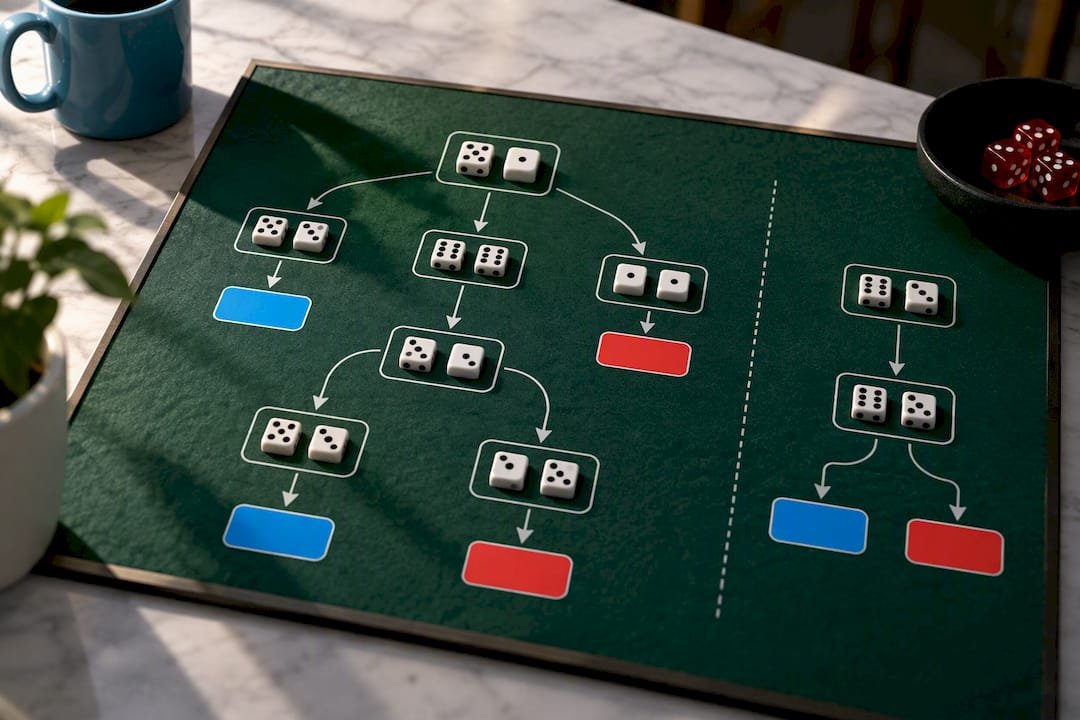
- The come-out roll happens. If the shooter rolls a 7 or 11, every Pass Line bet wins instantly. Roll a 2, 3, or 12 (collectively called “craps”), and Pass Line bets lose right there.
- Any other number becomes the point. Rolling a 4, 5, 6, 8, 9, or 10 sets that number as the point, the dealer moves the puck to that number and flips it to ON, and the round moves into its second phase.
- The shooter keeps rolling until the point repeats or a 7 shows. If the point number comes up again before a 7, Pass Line bets win. If a 7 lands first, that’s a “seven-out,” and Pass Line bets lose while the dice pass to the next shooter.
Don’t Pass works as the mirror image: it loses on come-out 7 or 11, wins on 3 or 2, and typically pushes (ties, with no money changing hands) on 12, though some tables use 2 as the push number instead. Once a point is set, Don’t Pass wins if a 7 shows before the point repeats.
Come bets follow the same rules as Pass Line but start fresh on any roll after the come-out, effectively creating a new mini come-out roll for that specific wager. Don’t Come mirrors Don’t Pass the same way.
Picture a fast round: come-out lands on 11, Pass Line wins immediately, and the same shooter starts a new come-out. Now picture a longer one: come-out sets a point of 6, the shooter rolls a 9, a 4, another 6 to win the point, then keeps rolling until a 7 finally appears and ends their turn. That stretch between point and seven-out is where odds bets and place bets do their real work.
What Are the Main Craps Betting Options?
Dozens of numbered boxes on a craps table layout can make the game look far more complicated than it is. In reality, nearly every bet fits into one of five families, and knowing which family you’re playing tells you almost everything about risk and payout.
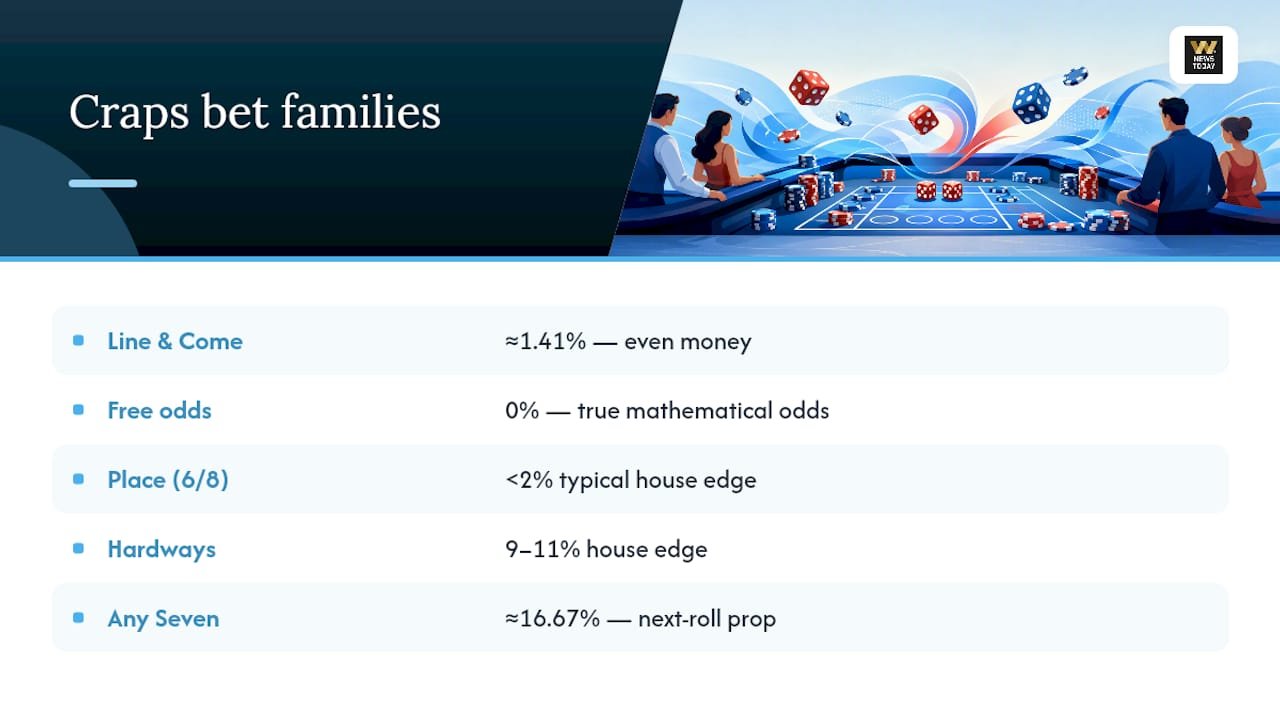
Line and come bets are the foundation. Pass Line, Don’t Pass, Come, and Don’t Come all resolve over multiple rolls following the come-out and point rules above. They carry the lowest house edge on the table, roughly 1.41% for Pass Line, and pay even money.
Free odds aren’t a standalone bet. They’re an add-on to your line bet once a point is set, and they pay true mathematical odds with no house edge at all. On a 4 or 10, odds pay 2:1; on 5 or 9, they pay 3:2; on 6 or 8, they pay 6:5. Odds are the single best value on the entire felt, and stacking them behind a Pass Line bet is the closest thing craps offers to a mathematically clean wager.
Place, buy, and lay bets let you bet directly on a number without going through the point cycle. Place bets pay slightly worse than true odds, buy bets pay true odds but charge a 5% commission, and lay bets (betting a number won’t repeat before a 7) work the opposite direction with their own commission structure. Place bets on 6 and 8 are popular because those numbers hit often and the house edge stays reasonable, generally well under 2%.
Hardways bet that a specific total (4, 6, 8, or 10) rolls as a pair (like 3 and 3 for hard 6) before it rolls the “easy” way or a 7 shows. They’re one-roll waits stretched across multiple rolls, and the house edge sits in the 9 to 11% range.
Field and proposition bets resolve on the very next roll. Field bets cover 2, 3, 4, 9, 10, 11, and 12 with modest payouts and a manageable edge. Proposition bets in the center (Any Seven, Any Craps, Horn bets, and similar) look tempting because of big posted payouts, but they carry some of the worst math in the casino.
One number worth remembering: Any Seven pays out at odds that mask a house edge of about 16.67%, more than ten times worse than a Pass Line bet with odds attached. That single statistic explains why experienced players almost never touch the center of the table.
For a beginner, the practical takeaway is simple: build your action around line bets and odds, add place bets on 6 and 8 if you want more action, and treat everything in the middle of the table as entertainment you pay extra for, not a real strategy.
How Do Dice Probabilities and House Edge Actually Work?
Two dice produce 36 possible ordered combinations, and that number is the entire foundation of craps math. Each combination is equally likely, but totals aren’t, because more combinations add up to some numbers than others.
| Total | Ways to roll it | Combinations |
|---|---|---|
| 2 | 1 | 1+1 |
| 3 | 2 | 1+2, 2+1 |
| 4 | 3 | 1+3, 3+1, 2+2 |
| 5 | 4 | 1+4, 4+1, 2+3, 3+2 |
| 6 | 5 | 1+5, 5+1, 2+4, 4+2, 3+3 |
| 7 | 6 | 1+6, 6+1, 2+5, 5+2, 3+4, 4+3 |
| 8 | 5 | 2+6, 6+2, 3+5, 5+3, 4+4 |
| 9 | 4 | 3+6, 6+3, 4+5, 5+4 |
| 10 | 3 | 4+6, 6+4, 5+5 |
| 11 | 2 | 5+6, 6+5 |
| 12 | 1 | 6+6 |
That pyramid shape, 1 through 6 and back down to 1, is why 7 shows up more than any other number and why 6 and 8 are noticeably easier to make than 4 or 10 during the point phase.
Here’s where the math gets useful. Place a 9:5 bet on the 10, and the casino is paying you slightly less than the true 2:1 odds a 10 actually deserves given it only has 3 ways to hit against 7’s 6 ways. Free odds bets close that gap entirely by paying the real ratio, which is why stacking odds behind your Pass Line bet is so much better than betting place numbers alone.
Run the full math on Pass Line and you get a win probability of 244/495, or about 49.29%, against a loss probability that works out to a house edge of roughly 1.41%. Add maximum odds and that edge on your total action drops even further, because the odds portion carries zero house advantage.
Pro Tip: Always take the maximum odds your table allows behind your Pass Line bet. It’s the single easiest way to lower the average cost of playing without changing anything else about your strategy.
How Do You Play Your First Round of Craps?
Walking up to a craps table cold is intimidating, but the actual sequence of actions is short and repeatable once you know it.
- Buy in at the table, not at the cashier’s cage. Set your cash on the felt (never hand chips directly to the dealer) and say “change only” or “chips please.” The dealer converts your cash to table chips.
- Check the table minimum, usually posted on a small placard. If it says $10, your Pass Line bet needs to be at least that amount.
- Place your Pass Line bet on the Pass Line before the come-out roll by setting chips in the Pass Line section directly in front of your position.
- Wait for the come-out roll. If it’s a 7 or 11, you win and can bet again. If it’s craps (2, 3, 12), you lose that bet and start over on the next come-out.
- Once a point is set, add odds by placing extra chips just behind your Pass Line bet, outside the line itself. Tell the dealer “odds” if you’re unsure where they go.
- Watch the shooter roll until the point repeats (you win) or a 7 shows (you lose). Dealers pay winning bets and collect losing ones automatically.
- Decide whether to stay or walk. There’s no rule forcing you to keep playing after any round. Color up (exchange chips for higher denominations or cash) whenever you’re ready to leave.
A quick walk-through: you buy in for $100, bet $10 on the Pass Line, and the come-out sets a point of 8. You add $10 in odds behind your bet. Three rolls later, the shooter hits an 8. Your Pass Line bet pays even money ($10), and your odds bet pays 6:5 ($12), for a $22 win off a $20 total stake.
Pro Tip: If a table intimidates you, stand back and watch two or three full rounds before buying in. Nobody at a craps table minds, and it’s the fastest way to learn table rhythm without risking a dollar.
What’s the Difference Between Street Craps and Casino Craps?
Street craps and casino craps share the same dice logic, but the resemblance often stops there. Street games are entirely player-run, with no dealers, no printed rulebook, and no house enforcing payouts. Whatever the group agrees on at the start of the game becomes the rule for that session, and that agreement can vary wildly from one game to the next.
Common variants you’ll run into on the street:
- “Fading” the shooter instead of using a Pass Line, where another player covers the shooter’s bet directly.
- Simplified point rules, sometimes dropping Come or Don’t Come bets entirely.
- Cash-only, no-receipt settlements, meaning disputes get resolved by the group, not a boxman.
- No standardized odds payouts, so a 4 or 10 might pay whatever the players decide instead of the true 2:1.
Street craps operates without the regulated oversight, licensed dealers, or fixed table limits that define casino play, which means payout disputes have no formal referee. On top of that, informal dice games for money are illegal in many jurisdictions regardless of the stakes, so check your local law before joining one. If you do play informally, agree on every rule out loud before the first roll, keep stakes small, and only play with people you trust to pay what they owe.
What’s a Smart Beginner Strategy for Craps?
The bet selection that actually reduces your expected loss is almost boring in its simplicity: stick to Pass Line or Don’t Pass, take the maximum odds your bankroll and the table allow, and if you want extra action, place bets on 6 and 8 rather than betting the Big 6 or Big 8 boxes (which pay even money on the same numbers that place bets pay better on).
Bankroll discipline matters as much as bet selection. A workable approach:
- Set your bet unit at 1 to 2% of your session bankroll, not a round number that feels comfortable.
- Decide your loss limit before you sit down and walk away when you hit it, no exceptions.
- Never increase your bet size to chase a losing streak. The dice have no memory of what just happened.
- Skip the center table entirely as a new player. The proposition bets there exist to fund big payouts that hit rarely.
Common mistakes worth correcting early: betting the Field thinking it’s a safe all-purpose wager (it isn’t, since the payout structure barely offsets its odds), betting Any Craps or Any Seven because the payout number looks big, and doubling bets after a loss hoping to “catch up.” None of these change the underlying math in your favor.
Here’s the expected-loss math in plain terms: Pass Line carries roughly a 1.41% house edge, while center proposition bets like Any Craps run north of 11%](https://www.artofcraps.com/craps-basics/craps-bets-explained/). On $10 flat bets over a long session, that’s the difference between losing a little over a dime per bet on average versus more than a dollar. If you want to understand how that expected-loss math applies beyond craps, the same logic drives value betting across casino games generally, and it’s worth reading if the concept of house edge is new to you.
Why Trust This Craps Guide?
W88 News Today built this guide by cross-checking every probability, payout ratio, and house-edge figure against established gaming-math references rather than repeating secondhand claims from other guides. The 36-combination dice table, the free odds payouts, and the house-edge percentages throughout this piece all trace back to sourced math, not rounded-off folklore.
One important caveat: individual casinos set their own odds limits (3x, 5x, 10x, or unlimited odds all exist), commission rules on buy and lay bets, and even their own version of the Don’t Pass 12 push. Always check the printed rules card at whatever table you’re playing before assuming a rule from this guide applies exactly as written. If you spot a rule variation we haven’t covered, or think we’ve gotten something wrong, we’d rather hear about it and fix it than leave you with bad information.
What Beginners Get Wrong About Craps Strategy
Most craps advice online oversells complexity. Betting systems, elaborate combinations of hardways and props, “hot table” theories — none of it changes the math sitting underneath the felt. The 36-combination table doesn’t care about your system, and neither does the shooter’s next roll.
What the research actually supports is almost anticlimactic: Pass Line with maximum odds is the strongest play a beginner can make, full stop. Everything else on the table is either a minor variation on that theme (place bets on 6 and 8) or a worse bet dressed up with a flashier payout number (nearly everything in the center). The conventional wisdom that “craps is too complicated to learn quickly” undersells beginners. You need maybe six rules and one table to play competently on your first visit.
Where most guides fall short is treating street craps as a footnote. It deserves more attention, because the legal and trust risks there are real and often ignored in the rush to explain payout math. If you’re going to play informally, know the rules and know the people. If you’re playing in a regulated room, know the table’s printed limits before you sit down. Priorities in that order will serve you better than memorizing every proposition bet’s exact percentage.
— jeff
Sources
For deeper number-crunching, CrapsPit.org’s dice math breakdown covers every probability calculation referenced here. Wild.io’s odds table guide expands on free odds payouts, and BeGambleAware offers responsible gambling resources worth bookmarking before any session.
- Crapspit
- Wild
- PokerNews — Casino terms and edge (street craps context)
- ArtOfCraps — Craps bets explained
FAQ
What Are the Basic Rules of Craps?
A round starts with a come-out roll. Rolling 7 or 11 wins Pass Line bets instantly, rolling 2, 3, or 12 loses them, and any other number becomes the “point,” which the shooter must repeat before rolling a 7 to win. That single cycle, come-out, point, resolution, governs every round at the table.
What Is the Smartest Bet in Craps?
The Pass Line bet backed by free odds is widely considered the strongest bet on the table, carrying a house edge of roughly 1.41% on the flat bet alone and even less once odds are added, since odds pay true mathematical ratios with no house edge. Don’t Pass with odds runs a close second.
What Is the 3-4-5x Rule in Craps?
The 3x, 4x, 5x rule refers to a common odds limit structure where casinos allow 3 times your bet in odds on the 4 and 10, 4 times on the 5 and 9, and 5 times on the 6 and 8. It’s designed to roughly equalize the maximum odds payout across all point numbers, and it varies by casino, so always check the table’s posted limit.
What Numbers Should You Avoid Betting in Craps?
Avoid the one-roll center proposition bets like Any Seven and Any Craps, which carry house edges of about 11% to 16.67%. Hardways bets on 4, 6, 8, and 10 also run a steep edge, typically 9 to 11%, making them poor choices compared to line bets or place bets on 6 and 8.
Ready to put what you’ve learned into practice? Browse W88 News Today’s honest casino reviews to find a trusted platform with live or online craps tables, clear posted odds limits, and responsible gambling tools built in. And keep checking back, new casino game releases and guides appear regularly, so there’s always something fresh to learn before your next session.