





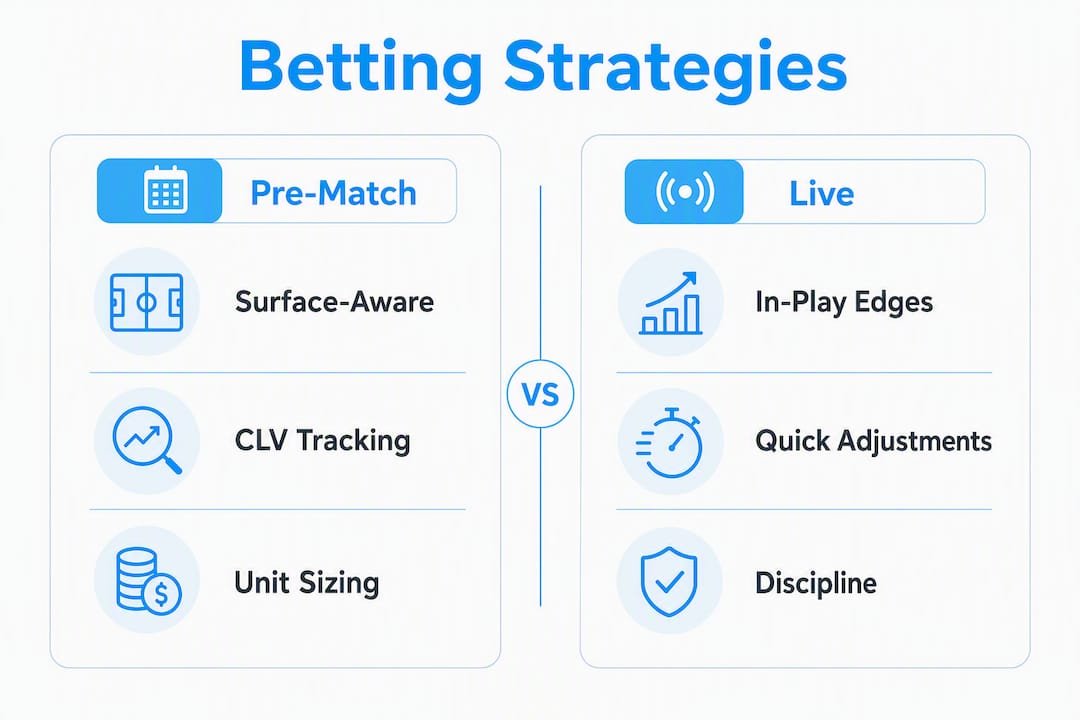
The highest-impact tennis betting strategy is value-first staking on surface- and situation-specific edges, combined with strict bankroll rules and Closing Line Value (CLV) tracking. That one sentence is the whole game. Everything else is execution.
Here are three moves you can act on right now:
- Bet set spreads, not moneylines, on heavy Grand Slam favorites. When a top player is priced very short on the match winner, the set spread (-1.5 sets) often carries far better value for the same directional bet.
- Hunt first-set underdog plays in early Slam rounds. Seeded players frequently drop a set before finding their rhythm, and books often underprice that probability.
- Trade momentum swings live. After a service break at 15-40, the market overreacts. Lay the leader, back the trailer, and exit when the score normalizes.
The three signals to watch immediately: CLV (did you beat the closing price?), surface-aware Elo versus ATP/WTA rank gaps, and your fractional Kelly stake size. CLV is the only mathematically verifiable indicator that you are finding genuine market inefficiencies rather than running hot. Surface-specific first-serve points won differ materially by court type: clay averages around 69%, while grass and hard courts average around 75%. That gap reshapes hold/break expectations and totals pricing across every match.
Set your unit size tonight. One unit equals 1–2% of your total bankroll. Use quarter-Kelly (0.25×) for model-backed bets and flat units for everything else.

Table of Contents
- How tennis markets work and where the real value hides
- How surface, format, and tournament level change your approach
- The player metrics that actually predict match outcomes
- Pre-match tactics that find positive expected value
- In-play strategies that give you a live edge
- How to size bets and protect your bankroll
- A compact model and pre-bet checklist you can run tonight
- Common mistakes that destroy tennis betting profits
- How men’s and women’s matches require different betting approaches
- How weather, altitude, and court type affect your bets
- The tools and databases that give you a real analytical edge
- Key Takeaways
- The disciplined approach is the only approach that lasts
- Useful sources and data tools
How tennis markets work and where the real value hides
Tennis offers more betting markets than most casual bettors realize, and the match winner (moneyline) is often the worst place to look for edge.
The primary markets you need to know:
- Set betting: — Predict the exact scoreline (e.g., 2-0 or 2-1 in best-of-3). Higher vig, but mispriced more often.
Converting odds to implied probability is the first mechanical skill you need. For decimal odds, divide 1 by the odds: odds of 2.50 imply a 40% probability. To strip the vig (overround), sum the implied probabilities for both sides and divide each by that total. If the two sides sum to 1.08, the book is running an 8% margin. Your model probability needs to clear that margin before a bet has positive expected value (+EV).
The table below shows typical vig profiles across platform types and the markets where each is most useful.
| Platform type | Typical match-winner vig | Typical live vig | Best use |
|---|---|---|---|
| Betting exchange | 2–4% (commission) | 3–5% | All markets; CLV benchmark |
| Sharp sportsbook | 4–6% | 6–9% | Pre-match moneyline, set spreads |
| Retail sportsbook | 8–12% | 10–15% | Bonuses only; avoid for serious play |
Live in-play markets carry higher vig than pre-match, often running 5–12% at retail books. That cost compounds fast if you are trading multiple games per session. Exchange platforms and sharp books provide tighter pricing and better long-term profitability, so use them as your primary line-check even when you place the actual bet elsewhere.
Pro Tip: Prefer markets where you can quantify a probability gap between your model and the book’s implied odds. Speculative narratives (“he looks motivated today”) are not edges. A number is.
How surface, format, and tournament level change your approach
Surface is the single biggest structural variable in tennis betting. Ignore it and you are pricing matches with the wrong baseline.
Surface mechanics in plain terms:
- Clay: Long rallies, lower first-serve effectiveness, higher break rates. First-serve points won average around 69%. Specialists like Rafa Nadal historically dominate here while big servers underperform their ranking.
- Grass: Short points, serve dominance, frequent tiebreaks. First-serve points won jump to around 75%. Big servers are overpriced on hard courts but correctly priced or even underpriced on grass.
- Hard courts: The middle ground. First-serve points won also average around 75%, but rally length sits between clay and grass. Most of the ATP and WTA calendar runs on hard, so books price it most efficiently.
Surface transition tournaments produce recurring mispricings because models and books overweight recent results on the previous surface. A player who just won a clay title arrives at the first grass event with inflated odds. Fade them, or back the grass specialist who quietly went 2-2 on clay.
Match format changes which markets you should target:
Best-of-5 (Grand Slams) compresses variance differently from best-of-3. Over five sets, the better player wins more often, so moneyline prices on heavy favorites get very short. The set spread (-1.5 sets) becomes the smarter vehicle. In best-of-3, a single bad service game can flip the match, so game totals and first-set markets carry more variance and more opportunity.
Tournament-level efficiency matters too. Grand Slams and Masters 1000 events attract sharp money early, so lines are generally tighter and harder to beat. ATP 250s, WTA events, and Challengers see less sharp action, which means set spreads and underdog plays at these levels often offer better value than the equivalent bet at a Slam.
| Tournament tier | Market efficiency | Best market angle |
|---|---|---|
| Grand Slams | High | Set spreads on heavy favorites |
| Masters 1000 / WTA Premier | Medium-high | Game totals, live trading |
| ATP 250 / WTA 250 | Medium | Underdog moneyline, first-set plays |
| Challengers / ITF | Low | Underdog value, surface-specific fades |
Quick rules to carry into every session:
- Use -1.5 set spreads at Slams when the favorite is priced below -300 on the moneyline.
- Hunt underdog value at ATP 250s and transition tournaments.
- Size live bets smaller at Challengers where data is thinner and line movement is less reliable.
The player metrics that actually predict match outcomes
Serve and return metrics plus hold/break rates are the sharpest predictive signals, far ahead of ATP/WTA rank. Here is the prioritized list.
Metrics to collect, in order of predictive weight:
- Hold rate (surface-specific): What percentage of service games does the player hold on this surface? Combine both players’ hold rates to estimate total games and break probability.
- Break rate: How often does the player break serve? High break rate on clay, lower on grass.
- First-serve points won: Baseline by surface (clay ~69%, grass/hard ~75%). A player running 10 points above baseline is serving at an elite level.
- Second-serve points won: The vulnerability metric. Below 48% on second serve is a red flag against strong returners.
- Return points won (first vs. second serve): Separates elite returners from average ones. The best returners win 40%+ of first-serve return points on clay.
- Breakpoint conversion rate: How often does the player convert break chances? Clutch metric, especially in tight matches.
- Average rally length: Predicts total games and surface fit. Long rallies favor clay specialists; short rallies favor big servers.
- Serve speed and ace rate: Useful on grass and fast hard courts; less predictive on clay.
Data sources and windows: Pull surface-specific stats from Tennis Abstract and cross-check with SofaScore or Flashscore for recent match logs. Use the last 5–10 matches on the same surface as your primary window. Anything older than 12 months on a given surface loses predictive weight fast.
Surface-specific Elo ratings outperform standard ATP/WTA rankings for match prediction because they isolate variance tied to surface traits and player specialization. A player ranked 40th overall but 15th on clay is systematically underpriced at clay events when books anchor to the global ranking.
| Metric | Clay benchmark | Grass/Hard benchmark |
|---|---|---|
| First-serve points won | ~69% | ~75% |
| Hold rate (top 50) | ~78% | ~85% |
| Return points won (1st serve) | ~35–38% | ~28–32% |
| Average rally length | 5–7 shots | 3–4 shots |
Pro Tip: Build a simple hold/break differential score: subtract the opponent’s hold rate from your player’s break rate. A positive differential on the correct surface is a concrete signal, not a feeling.
Pre-match tactics that find positive expected value
Value betting is the core discipline. You are not picking winners; you are finding prices where the book’s implied probability is lower than your model’s estimate.
Step-by-step pre-match strategies:
- Set spread on heavy Slam favorites. When a top-10 player is priced at -400 or shorter, the -1.5 set spread often sits at -150 to -180. If your model gives the favorite a 78% chance of winning in straight sets, that -150 price (implied 60%) is a clear +EV play.
- First-set underdog plays in early Slam rounds. Top seeds frequently drop the first set before locking in. Books price the first-set winner market closer to the match-winner price than the actual first-set probability warrants. A player with a 30% match-win probability often has a 40–45% chance of winning the first set.
- Fade top players at low-level events after long runs. A player coming off a deep run at a Masters event, then playing an ATP 250 the following week, is often underperforming physically. Books are slow to adjust for fatigue and motivation.
- Hunt underdog value at ATP 250 and 500 events. Thinner sharp action means retail books misprice these matches more often. A surface specialist ranked 60th playing a top-20 all-rounder on clay at an ATP 250 is frequently undervalued.
- Line-shop and time your entry. Take early prices on underdogs before public money pushes the favorite shorter. For favorites, wait for the line to move in your direction. Always check the exchange price as your closing-line benchmark.
Mini worked example: Your model gives Player A a 58% win probability. The book’s moneyline is +120 (implied 45.5%). Expected value per $100 staked: (0.58 × $120) − (0.42 × $100) = $69.60 − $42.00 = +$27.60 EV per $100 bet. That is a strong edge. Quarter-Kelly stake on a $1,000 bankroll: (0.58 − 0.42) / 1.20 × 0.25 × $1,000 = roughly $33 stake.
Pre-bet checklist:
- Surface match confirmed (player’s surface Elo vs. opponent’s)
- Recent form window (last 5–10 matches, same surface)
- Fatigue check (days since last match, travel distance)
- Head-to-head on this surface
- Book vig calculated and cleared by model edge
- Closing-line benchmark checked on exchange
Pro Tip: For early-round parlay plays, cap at two legs and use only heavy favorites (-200 or shorter per leg). Adding a third leg rarely increases EV; it mostly adds correlated variance.
In-play strategies that give you a live edge
Live betting is where discipline separates profitable bettors from everyone else. The market moves fast, vig is higher, and emotional decisions are expensive.

Why live is structurally different:
Live markets carry higher vig than pre-match, often 5–12% at retail books. Prices update within seconds of each point. The emotional pull to chase a losing pre-match bet through live action is one of the most common profit destroyers in tennis betting.
The 15-40 trading method:
When the server is down 15-40 (two break points against), the live market prices the server’s odds down sharply, often overreacting. Here is the setup:
- Condition: The server is a strong hold player (hold rate above 80% on this surface).
- Entry: Back the server at the inflated price; the market has overreacted to the break-point pressure.
- Exit: Cash out or lay back when the score reaches deuce or the game is held.
- Why it works: Strong servers save break points at a high rate. The market prices the worst-case scenario; reality regresses toward the server’s baseline hold rate.
This only works when you have a pre-match thesis confirming the server’s hold strength. Entering live with no pre-match hypothesis consistently loses money.
| Live technique | Entry trigger | Exit rule | Risk level |
|---|---|---|---|
| 15-40 server back | Strong server down 15-40 | Game held or deuce reached | Medium |
| Post-set overreaction fade | Set loser priced too long after set 1 | First break of set 2 | Medium-high |
| Game handicap scalp | Service break in game 3 or 4 | Handicap covered | High |
| Lay-to-back reversal | Momentum shift after break | Score normalizes | High |
Risk controls for in-play sessions:
- Cap live stakes at 50% of your pre-match session budget.
- Never exceed 1% of bankroll on a single live trade.
- Pre-define entry and exit prices before the match starts.
- Set a session loss limit: if you are down two units live, stop for the session.
Pro Tip: Build your live thesis during the pre-match research phase. Write down one or two specific in-play scenarios you will act on (e.g., “If Player B drops the first set, back them at +180 or better for the second”). Entering live with a written plan removes the emotional variable entirely.
How to size bets and protect your bankroll
Staking is where most bettors give back their edge. You can find value all day and still lose money with bad sizing.
The three main staking systems compared:
- Flat units: Bet the same amount every time (e.g., 1 unit = 1% of bankroll). Simple, low variance, and the right default for subjective or lower-confidence bets.
- Percentage staking: Bet a fixed percentage of your current bankroll. Adjusts naturally as the bankroll grows or shrinks, but can lead to oversizing on a hot streak.
- Full Kelly: Mathematically maximizes long-run growth but generates extreme volatility. A string of losing bets can wipe 30–40% of your bankroll before recovery. Professional bettors avoid full Kelly for exactly this reason.
- Fractional Kelly (quarter-Kelly): Multiply the Kelly fraction by 0.25. Quarter-Kelly retains most long-term growth benefits while materially reducing drawdown risk. This is the standard for model-backed bets.
Quarter-Kelly worked example:
- Bankroll: $2,000
- Model win probability: 60%
- Decimal odds: 2.10 (implied 47.6%)
- Kelly fraction: (0.60 − 0.40) / 1.10 = 0.182 (18.2% of bankroll)
- Quarter-Kelly stake: 0.182 × 0.25 × $2,000 = $91
That $91 stake on a $2,000 bankroll is 4.55% — still aggressive. If your confidence is lower or the edge is thinner, drop to flat 1–2 units instead.
Practical bankroll rules:
- Unit size: 1–2% of total bankroll per bet.
- Maximum single bet: 3% of bankroll (model-backed, high-confidence only).
- Daily session cap: 5 units maximum.
- Live session exposure: no more than 50% of daily budget.
- Single-tournament cap: 10 units total across all bets in one event.
Bankroll protection checklist:
- Never chase a loss with a larger bet.
- Stop the session after hitting your daily loss limit (3–5 units).
- Never bet more than 2% on a subjective pick with no model backing.
- Track every bet: date, market, odds, stake, result, and CLV.
- Review weekly, not daily, to avoid noise-driven decisions.
Stat to remember: Consistent positive CLV over a meaningful sample is the only mathematically verifiable sign you are finding real edges rather than running on variance.
A compact model and pre-bet checklist you can run tonight
You do not need a PhD to build a working tennis model. A spreadsheet with the right inputs beats gut feel every time.
Model blueprint:
Start with surface-specific Elo as your base probability. Then apply four adjustments:
- Recent form (last 5–10 matches, same surface): Add or subtract up to 3 Elo points per match above or below expected win rate.
- Days since last match: Penalize players with fewer than 2 days’ rest; reward players with 4+ days off after a long run.
- Head-to-head on this surface: Weight the last 3–5 H2H matches on the same surface more heavily than the overall H2H record.
- Hold/break differential: Compute each player’s hold rate minus the opponent’s break rate. A positive differential favors the server; negative favors the returner.
Convert the adjusted Elo difference to a win probability using the standard Elo formula: P(A wins) = 1 / (1 + 10^((Elo_B − Elo_A) / 400)). Plug that probability into the EV formula and the quarter-Kelly formula from the staking section.
Sample backtest instructions:
Gather 200–500 matches from the same surface and tournament tier. For each match, record: your model’s win probability, the opening line, and the closing line. Measure three things:
- CLV: Did your taken price beat the closing price? Consistent +CLV over 200+ matches confirms edge.
- ROI: Total profit divided by total stakes. Positive ROI over 200 matches is meaningful; over 500 it is statistically significant.
- Hit rate vs. expected: If your model says 55% and you are hitting 52%, the model is slightly overconfident. Recalibrate.
A reliable edge requires tracking at least 200 matches for meaningful model evaluation; 500+ to distinguish skill from noise.
Worked example:
| Input | Value |
|---|---|
| Model win probability | 55% |
| Book implied probability | 48% (odds: +108) |
| Edge | +7% |
| EV per $100 staked | (0.55 × $108) − (0.45 × $100) = +$14.40 |
| Quarter-Kelly stake ($1,000 bankroll) | ~$32 |
Pre-bet checklist (final gate):
- Model edge exceeds book vig? (Minimum +3% net edge)
- Stake within unit limits? (Max 2% flat, max quarter-Kelly for model bets)
- Market vig checked and acceptable? (Below 8% pre-match)
- Injury or fatigue flag? (Check ATP/WTA injury reports and match schedule)
- Surface fit confirmed? (Surface Elo, not global rank)
Pro Tip: Run this checklist in a shared spreadsheet with a timestamp column. After 50 bets, sort by CLV. The bets that passed all five gates will outperform the ones that skipped even one.
Common mistakes that destroy tennis betting profits
Most bettors lose not because they pick wrong, but because they repeat the same structural errors.
- Relying solely on ATP/WTA rankings. Global rank ignores surface specialization entirely. Treating betting as value hunting requires surface-aware analysis, not global ranking shortcuts. A clay specialist ranked 50th is not a 50th-ranked player on clay.
- Backing short-priced favorites without a model. Betting a -500 favorite because “they always win” is not a strategy. The favorite-longshot bias means short prices are often overpriced by casual money. Without a model confirming the edge, you are paying the vig for no expected return.
- Chasing losses through live betting. You lose a pre-match bet, then jump into live action to “get it back.” Live vig is higher, your emotional state is compromised, and you have no pre-match thesis. This is the fastest way to turn a bad session into a catastrophic one.
- Ignoring vig and closing-line benchmarks. A bet that looks profitable at +110 is a losing bet if the closing line is +140. Consistently taking the worst of the number is a slow bleed. Always check the exchange price before placing.
- Overusing parlays. Two-leg parlays on heavy favorites can be +EV if both legs are independently priced with edge. Three-leg or longer parlays almost never are. The vig compounds with each leg, and correlated outcomes (both players from the same tournament) reduce the diversification benefit.
- Betting without tracking. You cannot improve what you do not measure. Every bet needs a record: market, odds, stake, result, and CLV. Without tracking, you are flying blind on whether your edge is real or imaginary.
- Ignoring fatigue and motivation. A top player defending a title at a 250 event the week after a Slam exit is often mentally checked out. Books are slow to price motivation correctly, especially mid-season.
- Betting every match on the card. Selectivity is a skill. The best bettors pass on 80% of available matches and concentrate stakes on the 20% where their model shows a clear edge.
How men’s and women’s matches require different betting approaches
The structural differences between the ATP and WTA tours are real and they change which strategies work best.
Men’s matches (ATP):
Best-of-5 at Grand Slams means the better player wins more often over the long run, compressing moneyline value on favorites. Set spreads and game totals are the primary value markets. Serve dominance is higher on fast surfaces, so tiebreak props and total games unders are frequently mispriced at grass events. The depth of the ATP tour is also greater, meaning fewer “soft” matches where a top player is heavily underpriced.
Women’s matches (WTA):
Best-of-3 across all events, including Slams. Serve is less dominant overall, break rates are higher, and matches are more volatile. That volatility creates more first-set underdog value and makes game totals overs more attractive. The WTA also has more pronounced form streaks and surface specialization gaps, so surface-specific Elo carries even more predictive weight than on the ATP tour. Depth is thinner at the lower end of the rankings, which means a top-10 WTA player at a 250 event is often a safer set-spread play than the equivalent ATP matchup.
Practical differences in market selection:
- WTA matches: prioritize first-set markets, game totals overs, and surface-specialist underdog plays.
- ATP best-of-3 (250/500 events): game totals and first-set plays work well; set spreads are less reliable with only two sets available.
- ATP best-of-5 (Slams): set spreads on heavy favorites and live trading after set 1 are the primary tools.
One consistent edge across both tours: the first tournament after a surface switch. WTA players show this mispricing at least as strongly as ATP players, partly because the WTA calendar compresses surface transitions more tightly.
How weather, altitude, and court type affect your bets
External conditions are systematically underpriced by books and overlooked by most bettors.
Wind: Strong wind at outdoor events (common at Indian Wells, the Australian Open in Melbourne’s summer heat, and clay events in Europe) disrupts serve timing and flattens the advantage of big servers. When wind is forecast above 20 mph, back the better baseliner over the serve-and-volley or big-server type, and lean toward game totals unders (more errors, shorter rallies on serve).
Altitude: Mexico City (Acapulco) and Bogotá sit above 7,000 feet. The ball travels faster and bounces higher at altitude, which inflates aces, reduces rally length, and pushes total games down. Books frequently use standard hard-court baselines for these events. Unders on total games and tiebreak props are historically underpriced at high-altitude hard-court events.
Indoor vs. outdoor: Indoor courts eliminate wind and control humidity, which generally favors big servers and produces faster, lower-bouncing conditions. Serve dominance increases indoors, so total games unders and tiebreak props gain value. Outdoor clay in humid conditions (Roland Garros in wet weather) slows the ball further, increases rally length, and pushes total games higher.
Temperature and humidity: Extreme heat (Australian Open heat policy matches) slows the ball on hard courts and physically drains players. In best-of-5, the fitter player gains a structural advantage in sets 4 and 5. Live betting on the underdog after they survive a grueling third set in heat conditions is a specific, repeatable angle.
Practical rule: Check the forecast for every outdoor match. A 15 mph wind difference or a 20-degree temperature swing is a material pricing input that most retail books do not adjust for in real time.
The tools and databases that give you a real analytical edge
Good data is the foundation of every edge. Here is what to use and how.
Tennis Abstract (tennisabstract.com) is the gold standard for surface-specific serve and return metrics, hold/break rates, and match-level stats going back years. Pull your primary metrics here. The site also hosts surface-specific Elo ratings, which are the most reliable public model baseline available.
SofaScore and Flashscore give you real-time match logs, head-to-head records, and recent form data. Use them to cross-check recent results and flag fatigue (back-to-back matches, travel schedules).
ATP and WTA official sites publish draw sheets, match schedules, and injury reports. Check these the morning of any match you are considering. A retirement risk or a player who played a three-hour match 18 hours ago is a material pricing input.
Betting exchanges (where available to US bettors) serve as your closing-line benchmark. The exchange closing price is the sharpest available signal of true market probability. If you consistently beat it, your edge is real.
Spreadsheet model: Google Sheets or Excel is all you need to build the surface-adjusted Elo model described in Section 8. Store every bet with date, market, odds taken, closing odds, stake, and result. Calculate CLV on every row. After 200 bets, you will know whether your process is working.
Odds comparison tools: Use sports betting tips and odds comparison resources to line-shop across books before placing. A half-point or 5-cent difference in odds compounds significantly over hundreds of bets.
For sportsbook selection, check W88news’s latest sports reviews to find books that offer competitive tennis markets, including set spreads and game totals, with reasonable vig profiles.
Key Takeaways
A profitable tennis betting strategy runs on surface-aware value identification, CLV tracking, and conservative staking, not on picking winners by rank or intuition.
| Point | Details |
|---|---|
| Surface-first analysis | Use surface-specific Elo and hold/break rates, not ATP/WTA rank, to price every match. |
| CLV is your scorecard | Track whether you beat the closing line; consistent positive CLV confirms real edge over time. |
| Quarter-Kelly staking | Use 0.25× Kelly for model-backed bets; flat 1–2% units for all subjective picks. |
| Live betting requires a thesis | Build your in-play scenarios pre-match; never enter live without a defined entry and exit plan. |
| Sample size before trust | Backtest over at least 200 same-surface matches before scaling stakes on any model or system. |
The disciplined approach is the only approach that lasts
There is a version of tennis betting that looks exciting on paper: big parlays, live trading every point, chasing the underdog upset. That version bleeds money slowly and then all at once.
The version that actually works is quieter. You build a surface-specific model in a spreadsheet, run it against 200 historical matches, confirm positive CLV, and then bet 1–2% of your bankroll on the plays that clear your checklist. You track every bet. You review weekly. You adjust the model when the data tells you to, not when your gut does.
The most underrated insight in this guide is the surface transition angle. Books are systematically slow to reprice players moving from clay to grass or hard to clay. That inefficiency recurs every season, at every level of the tour. You do not need a sophisticated model to exploit it. You need a list of the first grass events after Roland Garros, a surface Elo lookup, and the discipline to act on the number rather than the narrative.
CLV tracking is the other habit most bettors skip because it feels like homework. It is not homework. It is the only honest answer to the question “Am I actually good at this?” If your CLV is consistently positive over 200+ bets, you are. If it is not, no amount of confidence in your picks changes that math.
Start with one unit size, one surface, and one market type. Master that before expanding. The bettors who try to cover every market on every surface from day one are the ones who never build a real edge.
W88news covers the full range of sportsbook options, bonus structures, and responsible gambling resources to help you build a sustainable betting practice. Before you place your first model-backed bet, set your unit size, open a tracking spreadsheet, and review W88news’s responsible gambling resources. Betting should be engaging and disciplined, not a financial stress.
This article is general information, not financial or gambling advice. Confirm current rules and odds with your sportsbook and consult a qualified professional if needed. If gambling is causing you harm, contact 800gambler.org or BeGambleAware for support.
Useful sources and data tools
| Resource | What it gives you | How to use it |
|---|---|---|
| Tennis Abstract | Surface-specific serve/return stats, hold/break rates, surface Elo | Primary metrics source; pull last 10 matches per surface |
| SofaScore | Real-time match logs, H2H records, recent form | Cross-check fatigue and recent results before betting |
| Flashscore | Live scores, match history, draw results | Track live match progress and verify schedule data |
| ATP official site | Draw sheets, rankings, injury reports | Check match schedule and injury status morning of event |
| WTA official site | WTA draws, rankings, player news | Same as ATP; essential for WTA surface-transition research |
| SportsgGambler tennis tips | Daily tennis predictions and odds analysis | Use as a secondary line-check and market-awareness tool |
| 800gambler.org | US problem gambling helpline | Responsible gambling resource for US bettors |
| BeGambleAware | Responsible gambling support and tools | Self-assessment tools and support resources |
| algamus.org | Guide on stopping loss-chasing behavior | Read before your first live betting session |