



An each way bet is really two separate wagers rolled into one ticket: a win bet and a place bet, sitting side by side. That means your stated stake gets doubled, and your returns depend on both halves of the bet landing, with the place portion paying out at a fraction of your win odds.
TL;DR:
- Each way bets require doubling your stake because they combine separate win and place wagers, with returns depending on both outcomes.
- The standard place fraction is usually one quarter of the win odds for a top-three finish, with variations based on race size and bookmaker promotions.
- Calculations show that a typical $10 each way bet at 10/1 with 1/4 place terms yields a total payout of $145 if the horse wins, but only $35 if it places.
- If the race has fewer than five runners, the place part of the bet cancels out, turning the wager into a win-only bet, and non-runners may trigger stake refunds.
- Be aware that bookmaker margins are higher on longshot odds, which can diminish expected value, especially when place terms are less favorable or the selection’s top-three chance is overestimated.
Table of Contents
- How each way bets work: mechanics and reading the odds
- Standard place terms by field size
- Worked calculations: win returns, place returns, and total payout
- Settlement and edge cases you should know about
- Is each way betting good value? Margin and overround explained
- Practical tips and common mistakes to avoid
- Why you can trust this guide and where to learn more
- When each way betting actually makes sense
- Sources
- FAQ
How each way bets work: mechanics and reading the odds
Think of an each way bet as buying two tickets for the price of one, not two. You’re backing your selection to win, and at the same time backing it to simply finish in a paying position, whether that’s second, third, or sometimes fourth. Both bets share the same odds, but they pay out under different rules.
Here’s the part that trips up a lot of new bettors: if you say “£10 each way,” you’re not spending £10. You’re spending £20, because you’ve placed a £10 win bet and a £10 place bet together. Sportsbooks are clear that each-way betting doubles your total stake since it’s structurally two independent bets, not one bet with a bonus attached.
Odds get quoted in two formats, and you’ll want to be comfortable with both:
- Fractional odds like 10/1 mean you win $10 for every $1 staked, plus your stake back.
- Decimal odds like 11.00 already bake in your stake, so a $1 bet at 11.00 returns $11 total.
Converting between them is simple: take the fraction, divide the first number by the second, then add 1. So 10/1 becomes 11.00 in decimal. Our odds explainer walks through more conversion examples if you want extra practice before doing your own math.
You’ll usually see each way bets written in shorthand on a betting slip, something like “EW 1/4 1-2-3.” That tells you the place fraction is one quarter of the win odds, and the top three finishers get paid. The place fraction and the number of paying positions aren’t random. They’re set by standard industry rules tied to how many runners are in the race, which is exactly what the next section breaks down.
Standard place terms by field size
Bookmakers don’t just pick place terms out of thin air. Most follow a standard framework tied to the number of runners, based on rules set by the Tattersalls Committee, the body that governs UK betting disputes and settlement standards.
Handicap races, where horses carry different weights to level the field, tend to have larger fields, which is why they often get extra paying places compared to non-handicap races with similar runner counts. When a race has fewer than five runners, your each way bet effectively becomes a win-only bet, since there’s no place market to pay out on.
Plenty of bookmakers layer their own promotions on top of these standard terms. You’ll see “each way extra” offers that pay an additional place, or bump the fraction from 1/5 up to 1/4, especially around major race meetings. Those enhancements can genuinely shift the value of a bet, which is worth checking before you assume you’re only getting the baseline terms.
Worked calculations: win returns, place returns, and total payout
The math behind each way betting isn’t complicated once you separate the two halves. Here’s the formula for each part:
- Win return = stake times decimal odds (this includes your stake back).
- Place return = stake times the place fraction applied to the win odds, converted to decimal, also including stake back.
Let’s run a concrete example using Wikipedia’s each-way framework): a $10 each way bet on a horse at 10/1, with 1/4 odds for the place part. Your total stake is $20, split into $10 win and $10 place.
If the horse wins, both bets pay. The win part returns $110 ($10 stake times 11.00 decimal odds). The place part pays at a quarter of 10/1, which works out to roughly 2.5/1, or 3.50 in decimal, giving a place return of $35. Add them together and your total payout is $145.
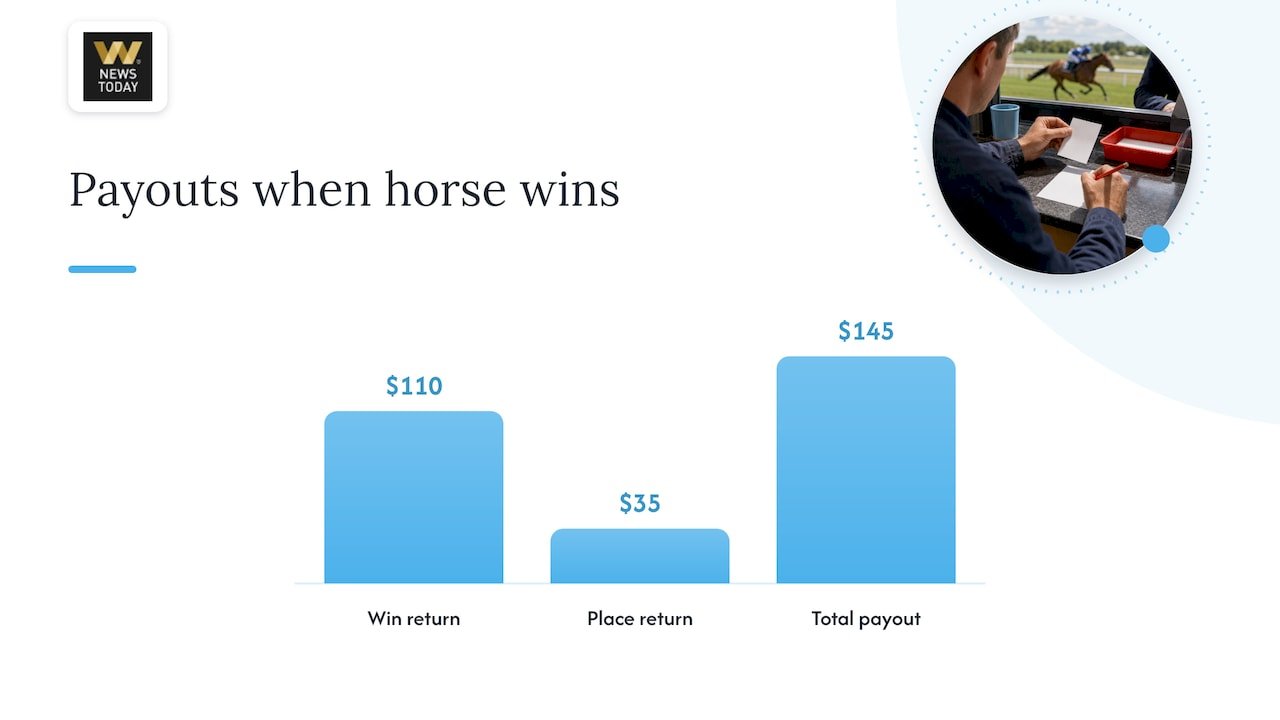
A $10 each way bet at 10/1 with 1/4 place terms returns $145 total if the horse wins, according to Wikipedia’s worked example format. That single number captures why each way betting appeals to cautious bettors: even a placed finish, not just a win, puts money back in your pocket.
If the horse finishes second or third instead of winning, only the place part pays: $35, against your $20 total stake, for a $15 profit. If it finishes outside the paying positions entirely, both parts lose and you’re down the full $20.
The same math works cleanly in decimal odds if you’d rather skip fractional conversions. Multiply your place stake by the decimal equivalent of the fractional place odds, and you’ll land on identical numbers. A spreadsheet or phone calculator handles this in seconds once you know the formula.
Multiples complicate things further. An each way treble, for example, is really two separate trebles bundled together: one tracking wins across three legs, one tracking places. Our guide to parlay and multiple betting covers how stakes compound across legs, which matters a lot once you’re combining each way bets across multiple races.
Settlement and edge cases you should know about
Real races don’t always cooperate with tidy math, so it helps to know how bookmakers handle the messy scenarios.
- Place terms are normally set by the actual number of starters, not the number of horses originally declared, unless the bookmaker states otherwise on the slip.
- Races with fewer than five runners settle as win only, meaning your place stake gets refunded since there’s no place market to bet into.
- A non-runner before the race triggers a stake adjustment or refund for that selection, depending on the bookmaker’s specific rules.
- Each way extra promotions add a paying place or improve the fraction, but they usually apply only to specified races, so check the terms before assuming they cover your bet.
Multiples create their own wrinkles. If one leg of an each way treble gets reduced to win-only because its field dropped below five runners, the place portion of that leg simply doesn’t apply, and the place treble calculation adjusts to reflect that missing leg. It’s a detail easy to miss until it affects a payout you were expecting.
Is each way betting good value? Margin and overround explained
Every bookmaker builds a profit margin into its odds, known as the overround. If you add up the implied probabilities of every runner in a race, the total will exceed 100%, and that excess is the bookmaker’s built-in edge.
Bookmaker margins and market inefficiencies such as favorite-longshot bias can make average realized loss rates higher than conventional overround calculations imply.
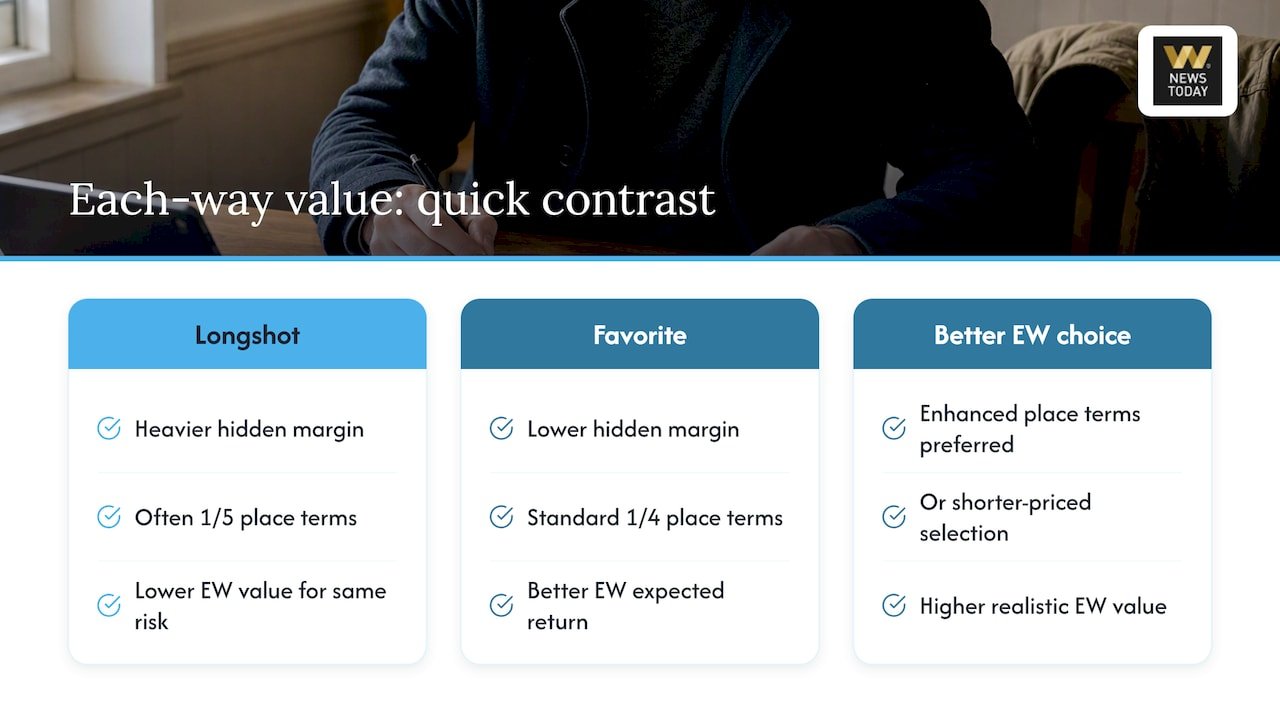
That finding, from an academic analysis of bookmaker margins, matters directly for each way betting. Longshots, the horses with big odds that each way betting attracts many casual bettors toward, tend to carry a heavier hidden margin than favorites. In plain terms, the juicier the odds, the more the bookmaker’s cut typically eats into your realistic expected return.
A simple value check helps here: compare the implied probability from the win odds against the place-fraction-adjusted payout for a top-three finish. If a horse looks like a reasonable each way shot by public form but the place fraction only pays 1/5 instead of 1/4, you’re accepting worse terms for the same risk. Enhanced place terms, or a shorter-priced selection with a realistic top-three chance, tend to be where each way betting holds up best against the built-in margin.
Practical tips and common mistakes to avoid
Most each way mistakes come down to not checking the fine print before you place the bet.
- Always confirm the advertised place terms match the standard rules for that field size before assuming you’re getting a fair deal.
- Budget for the doubled stake up front. If you plan to bet $10 each way, you need $20 available, not $10.
- Resist placing each way bets on huge longshots automatically. Check whether the place fraction actually justifies the extra cost.
- Handle multiples carefully. Hedging or cashing out one leg can affect the whole ticket’s place calculation in ways that surprise casual bettors.
Pro Tip: Before confirming any each way bet, do the full-stake math first (win stake plus place stake) so you know your real cost, not just the number you typed into the stake box.
If you’re building bigger tickets across multiple legs, our hedging and cash-out guide breaks down how to lock in profit or cap losses without misreading how the place portion behaves.
Why you can trust this guide and where to learn more
This guide draws on established industry rules, including the Tattersalls Committee’s standard place-term framework and widely cited worked examples for calculating each way returns. W88 News Today covers sportsbook mechanics, odds, and bonus structures as part of its ongoing betting coverage, aimed at helping readers understand the numbers before they wager. For deeper reading on how odds convert and compound, see our odds explainer and hedging guide. Betting carries financial risk, so treat every stake as money you can afford to lose, and use responsible-gaming resources when needed.
When each way betting actually makes sense
Each way betting earns its place in your toolkit when the place terms are genuinely favorable and your selection has a realistic shot at finishing in the top three, not just when the odds look tempting. I’d use it on a mid-priced horse in a well-covered field with enhanced place terms, and skip it on a 50/1 outsider where the place fraction barely softens the blow of a near-certain loss. The one-line rule: each way is a hedge against a narrow miss, not a discount ticket on a long shot.
— jeff
This article is general information, not a substitute for advice from a qualified financial advisor. Consult a qualified financial professional about your own circumstances before acting on anything here.
Sources
- Tattersalls Committee Rules on Betting FINAL 280310
- Calculating The Bookmaker’s Margin: Why Bets Lose More On Average Than You Are Warned
- What is an each-way bet? — Sporting Life
FAQ
How does each way betting work?
An each way bet splits your stake into two equal parts: one bet on your selection to win, and one bet on it to place, meaning finish within the paying positions. If it wins, both parts pay; if it only places, just the place part pays, and if it finishes outside the places, both parts lose.
Is each way betting profitable?
Profitability depends heavily on the place terms offered and the bookmaker’s built-in margin, which tends to be higher on longshots according to academic research on betting margins. Each way betting can offer reasonable value on mid-priced selections with strong place terms, but it often works against you on big-priced outsiders where the hidden margin is steeper.
What is the most successful betting strategy for each way bets?
There’s no guaranteed strategy, but checking that the advertised place fraction matches standard industry terms and favoring selections with a realistic top-three chance tends to produce better outcomes than chasing longshots automatically. Comparing implied win probability against the place-adjusted payout before betting helps you spot genuinely favorable terms.
What happens if my horse wins an each way bet?
If your horse wins, both the win portion and the place portion of your bet pay out, since a win automatically counts as a placed finish too. Using the standard worked example of a $10 each way bet at 10/1 with 1/4 place terms, a win returns $145 total across both parts.
What’s the difference between each way and place-only betting?
An each way bet combines a win bet and a place bet into one ticket at double the stake, while a place-only bet backs just the place outcome for a single stake. Place-only betting costs less upfront but forfeits the larger payout you’d get from a win under an each way structure.