




Your best move is simple: chase closing line value, lean on situational edges like back-to-backs and injury-driven minutes swings, and stake with strict bankroll rules instead of gut feel. Start tonight by opening accounts with two or three sportsbooks so you can shop lines, log every closing line against the number you bet, and only fire when your own projection is clearly off from the market.
TL;DR:
- Betting on totals and player props offers more market inefficiencies because they receive less sharp scrutiny than spreads or moneylines.
- Focusing on game situations like back-to-backs, travel fatigue, and late injury reports can reveal predictable value when markets underadjust for fatigue or rotation changes.
- Strict bankroll management, including capping bets at 5% of your bankroll and tracking all wagers, is crucial to maintaining a long-term betting edge.
- Building a simple projection model based on possessions, points per possession, and minutes helps identify significant discrepancies between expected and posted lines.
- Monitoring closing line value, betting quickly on injury news, and avoiding high-profile live bets enhance the chances of capturing market inefficiencies over time.
Table of Contents
- Which NBA betting markets should you focus on?
- Situational edges that actually move NBA lines
- Bankroll management and staking that actually protects you
- How to build your own projection before you bet
- Closing line value, line shopping, and reading market movement
- Totals and player props: where the real value hides
- Live betting: disciplined in-play tactics that hold up
- Understanding and exploiting market biases and inefficiencies
- Strategies for line movement prediction and interpretation
- How coaching decisions and team dynamics shape betting outcomes
- A five-step checklist and where the real edge comes from
- Building projections and tracking CLV takes real work, and having the right resources on hand makes that work faster. Sports betting content can support the process outlined in this guide, from staking discipline to market analysis.
- Sources
- FAQ
Which NBA betting markets should you focus on?
Every NBA game gives you several ways to bet, and each one prices risk differently. The spread asks you to pick a team against a point handicap. The moneyline asks you to pick the winner outright. The total (over/under) asks whether combined points land above or below a number. Player props bet on individual stats like points, rebounds, or assists. Parlays combine multiple bets into one ticket for a bigger payout and a much lower hit rate. Live bets let you wager after tip-off as the game unfolds.
Settlement is straightforward for most of these: spreads and totals settle on final score, moneylines on the winner, and props on the box score stat you picked. Parlays need every leg to hit.
Here’s the part that matters for where you spend your time: not every market is priced with the same precision.
- Spreads and moneylines get the most betting volume and the sharpest attention from oddsmakers, so they tend to be tightly priced.
- Totals and player props see less scrutiny per line, especially in role-player markets, which is where possession and minutes projections create real openings.
- Parlays and same-game parlays carry the highest hold for the sportsbook, meaning the price built into the bet works against you before the game even starts.
For most bettors starting out, picking one or two markets to specialize in beats spreading bets across everything. Totals or player props are a sensible starting focus because they reward the kind of possession and minutes-based modeling covered later in this guide, and there are simply more of them to choose from on a given night.
Situational edges that actually move NBA lines
Some game situations create repeatable value, and you don’t need advanced modeling to spot most of them. You need a checklist and the discipline to run through it every night before you bet.
Statistic: teams playing the second night of a back-to-back lose against the spread roughly 53 to 57 percent of the time against rested opponents. That gap exists because fatigue shows up in legs and shot selection long before it shows up in the box score, and markets don’t always adjust the number enough to reflect it.
Home-court advantage is worth roughly 2 to 3 points on average, though the exact number varies by team and by arena. A few franchises with loud, sold-out buildings and strong home records push higher than that baseline, while struggling teams playing in half-empty arenas often push lower.
Run through these situational checks before you place a bet:
- Flag every team on the second night of a back-to-back and check how the market has adjusted the line.
- Identify teams deep into a road trip, especially ones crossing multiple time zones, since travel fatigue compounds late in a trip.
- Watch for load management patterns: teams that have rested healthy stars on similar schedule spots this season are likely to do it again.
- Cross-check the injury report an hour before tip, not the morning of, since late scratches move lines fast.
- Note which bench players are due for a minute bump when a starter sits, since that reshuffling creates value in props and totals that the market hasn’t fully priced yet.
That last point deserves emphasis. When a star gets scratched, the obvious move is fading that team’s total or backing the opponent. The sharper move is often in props: a backup point guard who jumps from 18 minutes to 32 minutes overnight is a mispriced assists and points line waiting to happen, especially in the hours right after the news breaks.
Bankroll management and staking that actually protects you
Your staking plan matters more than your pick quality in the long run, because even a real edge gets erased by bets sized too large for the bankroll behind them.
Three approaches show up most often among serious bettors. Flat unit betting puts the same 1% of your bankroll on every wager regardless of confidence. Practical variable staking lets you scale bets between 1% and 3% based on how strong your edge looks. Fractional Kelly staking ties bet size to your calculated edge and the odds, usually at a quarter or half of full Kelly to control swings.
That sample size is large enough to tell you something real about your process without risking meaningful money on a system you haven’t proven yet.
- Cap every single bet at 5% of your bankroll, full stop, with no exceptions for a “sure thing.”
- Reserve anything above your normal unit size for the rare instances when your projection and the market disagree by a wide, clearly identifiable margin.
- Track every bet with six fields: date, market, line taken, closing line, stake, and result.
- Review your log weekly for pattern recognition and monthly for a full accounting of your record.
A detailed staking framework can help you build these habits into a routine rather than a one-time resolution.
Pro Tip: Set your unit size once at the start of the month based on your bankroll that day, not after every win or loss, so a hot streak doesn’t tempt you into betting bigger than your edge supports.
How to build your own projection before you bet
You don’t need a data science degree to build a usable number. You need possessions, points per possession, and minutes, applied consistently game after game.
- Estimate tonight’s possessions. Pull each team’s pace over their last 10 games, average the two paces, and adjust slightly for any matchup tendencies, like one team pushing tempo after misses.
- Calculate expected points. Multiply each team’s projected possessions by their points-per-possession average from recent games, adjusted for the opponent’s defensive efficiency over the same stretch.
- Convert to a spread and total. Add both teams’ point projections for your total, and subtract one from the other for your spread, then compare both numbers to what’s posted.
- Require a real gap before betting. Only bet spreads when your number differs from the market by at least 1.5 to 2 points, and demand a larger gap on totals and props, where variance is higher.
- Project player minutes separately. Look at the injury report timeline, recent rotation patterns, and blowout risk, since a lopsided score changes bench minutes late.
Your inputs should come from the same handful of places every time: 10-game pace and efficiency averages, a player’s minutes over their last five games, and the injury report as of an hour before tip. Consistency in your inputs is what lets you trust your outputs.
This kind of possession-and-minutes framework is the backbone of most serious handicapping models, and it works whether you’re projecting a total, a spread, or a single player’s rebound number.
Closing line value, line shopping, and reading market movement
Closing line value, or CLV, measures the difference between the line you bet and the closing line right before tip-off. If you bet a team at plus 4 and the line closes at plus 2, you beat the closing number by two points, which means the market moved toward your side after you placed your bet.
CLV matters because it’s the cleanest way to check whether your process has an edge, independent of whether any single bet actually won. A study measuring NBA closing-line accuracy found that closing lines predict outcomes with roughly 48 to 49% accuracy against the spread and a mean absolute error near 9.8 points, which tells you how tightly the market has already priced most games by tip-off. Beating that closing number consistently is a real signal.
Statistic: positive CLV correlates with stronger long-term betting results, but only the top decile of CLV performers converts that edge into meaningful profit over thousands of bets. Small, occasional CLV wins are largely noise, so don’t celebrate beating the closing line by half a point on one bet and assume you’ve cracked the market.
- Keep active accounts at two to four sportsbooks so you can compare numbers before every bet.
- Bet fast on confirmed lineup news, since the value in an injury-driven line usually disappears within minutes.
- Watch for reverse line movement, where the number moves opposite to where the public money is going, since that often signals sharp action on the other side.
- Log the closing line for every bet you place, even the ones you’re confident about, so your CLV record stays complete.
Understanding value betting through CLV gives you a fuller picture of how to apply this metric across a full season of betting.
Totals and player props: where the real value hides
Totals are fundamentally a bet on possessions, not on two teams’ season scoring averages. A team that plays at a fast pace against another fast-paced team is going to generate more possessions than raw scoring averages suggest, and that possession count drives the total more than either team’s shooting percentage does on a given night.
Player props run on minutes even more directly. A player projected for 30 minutes who suddenly draws 38 because a teammate got scratched is a different bet entirely from the one the market priced the morning of. This is the second-order effect worth hunting for: the backup center whose blocks and rebounds prop jumps in value the moment the starter is ruled out, before the sportsbook has fully adjusted the number.
- Require a bigger edge on props and totals than you would on spreads, since these markets carry more game-to-game variance.
- Treat any same-game parlay with caution, since the combined hold on multiple legs from one game eats into whatever edge you found on the individual bets.
- Recheck your minutes projection right up until the injury report locks, since rotation news often lands late.
A closer look at how over/under markets are built can help you sharpen your total projections beyond the basic possession math.
Pro Tip: Build your props from a player’s last five games of minutes, not their season average, since a rotation change two weeks ago can make the season number meaningless.
Live betting: disciplined in-play tactics that hold up
Live markets move fast, and the edges that show up there are different from the ones you find before tip-off. Bettors and the market alike tend to overreact to a hot shooting stretch or a 10-point run, pushing live lines further than the underlying performance justifies. Line lag is another repeatable edge: when a key player picks up foul trouble or a rotation shift happens, live odds sometimes take a minute or two to catch up.
- Minimize latency by using a fast, reliable stream and app so you’re not reacting to plays that already happened 30 seconds ago.
- Set rule-based entry and exit conditions before the game starts, like only betting a live total if it moves at least 4 points from your pre-game number.
- Use a strict stop-loss for the game: if you’re down a set amount in live bets, you’re done for that game.
- Avoid live betting entirely on nationally televised or high-profile games, where the market reacts quickly and the crowded action leaves little room for an edge.
Live betting rewards preparation more than instinct. If you walked in with a solid pre-game projection, you already have a baseline to measure every in-game number against.
Understanding and exploiting market biases and inefficiencies
Betting markets are shaped by public perception as much as by pure probability, and that gap is where value lives. Popular teams and star players draw more betting volume, which can push their lines slightly off from what a clean probability model would produce, since sportsbooks adjust prices partly to balance action rather than purely to reflect win probability.
Recency bias is common among casual bettors, who overweight a team’s last game or two rather than a broader sample. A team that just lost by 20 often gets undervalued on the total or spread even when the underlying performance metrics haven’t actually shifted much.
Public teams with large national followings tend to see inflated moneyline and spread prices during nationally televised windows, since more casual money flows toward the recognizable name. Fading the popular side in these specific spots, when your own numbers disagree, is one of the more repeatable angles available to a disciplined bettor.
The key is patience: these biases don’t appear on every slate, and forcing a bet because you expect a bias to be there is a fast way to lose money. Wait for your projection to actually diverge from the line before acting on it.
Strategies for line movement prediction and interpretation
Line movement tells a story, but only if you know how to read it. A line that moves in the same direction as the betting public usually just reflects volume. A line that moves against the public, known as reverse line movement, often means a sportsbook is reacting to sharp money on the other side rather than to ticket count.
Watch the timing of a move as closely as the size of it. A half-point shift right after an injury report update is informational and expected. The same shift with no news attached, an hour before tip, is worth investigating, since it can mean insider information or heavy professional action moved first.
Steam moves, where a line jumps quickly across multiple sportsbooks at once, usually indicate a sharp signal spreading fast through the market. If you see a steam move and your own number already agreed with the pre-move line, that’s a strong confirmation of your projection rather than a reason to chase the new number.
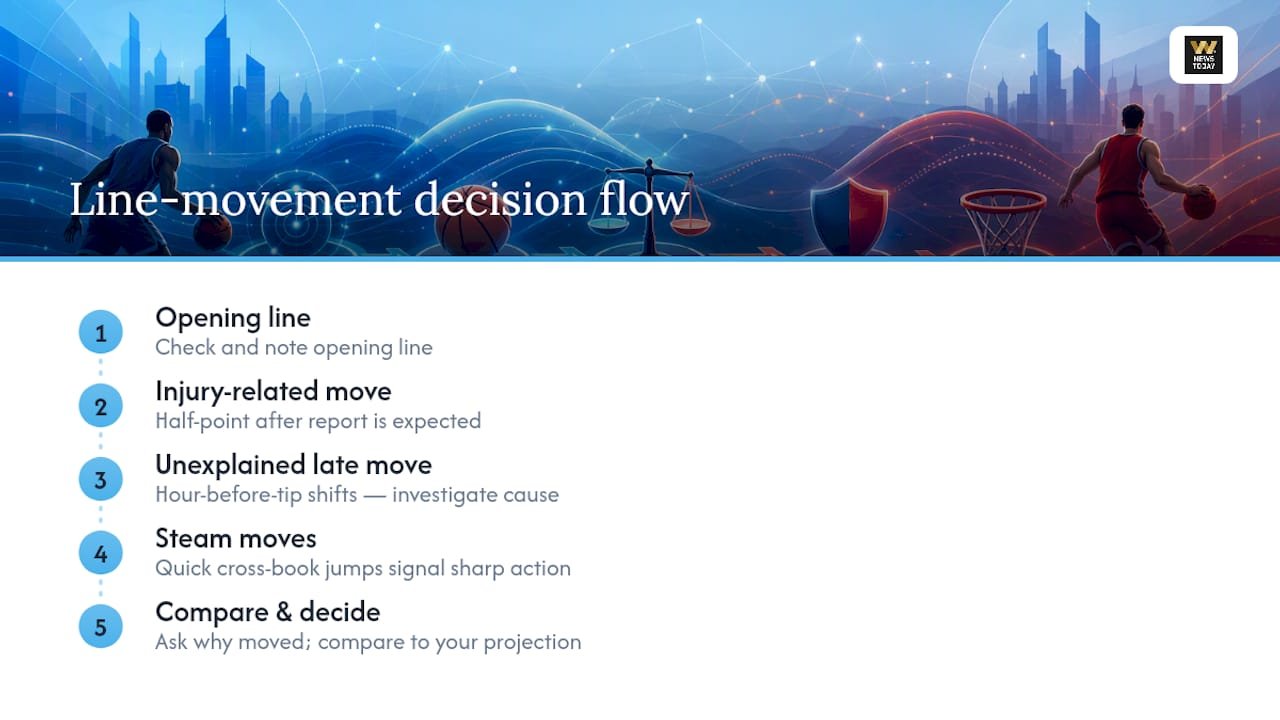
The practical habit here is simple: check the opening line, note any move by tip-off, and ask what caused it before you decide whether the current number still represents value.
How coaching decisions and team dynamics shape betting outcomes
Coaching choices ripple through betting markets in ways that box scores from previous games don’t fully capture. A coach who consistently benches starters in the fourth quarter of blowouts changes both the total and every prop tied to those players, regardless of what their season averages suggest.
Rotation philosophy matters just as much. Some coaches run tight eight-man rotations that make minutes highly predictable, which makes props in those games easier to project. Others rotate liberally through 10 or 11 players, which adds noise to every individual stat line and should push you toward smaller bet sizes or away from props in those specific games.
Team chemistry and locker room dynamics are harder to quantify but show up indirectly through effort metrics like defensive rebounding rate and transition defense, both of which respond to how connected a team looks on a given night. A team on the second half of a back-to-back with reported internal tension is a candidate for the kind of situational fade covered earlier in this guide, layered on top of the fatigue factor rather than replacing it.
None of this needs to be modeled precisely to be useful. Watching a handful of recent games for rotation patterns and effort level gives you context that pure statistical averages miss.
A five-step checklist and where the real edge comes from
A data-first stance on betting content values numbers over instinct, often paired with a responsible-gambling emphasis because no projection removes the risk of loss. The honest take: most bettors lose not because they lack access to stats, but because they skip the boring parts, like logging CLV and sizing bets consistently.
Before you bet tonight, run through this: pick your market, check rest and injury news, build a quick projection, require a real gap against the posted line, and set your unit size before you place the bet.
— jeff
Building projections and tracking CLV takes real work, and having the right resources on hand makes that work faster. Sports betting content can support the process outlined in this guide, from staking discipline to market analysis.
- Check sports betting tips for ongoing market analysis and situational angles as the season plays out.
- Use a bankroll management guide to set up a staking plan before your next bet.
- Browse sportsbook reviews to compare licensed operators and shop for the best lines before you commit a wager.
If you’re ready to put a real staking plan behind your projections, start with reviewed sportsbooks and build your line-shopping rotation from there.
Sources
- NBA betting strategy (Topend Sports)
- NBA gambling inefficiencies: a second look (The Sport Journal)
- NBA betting strategy: possessions and minutes framework (BettorEdge)
This article is general information, not a substitute for advice from a qualified financial advisor. Consult a qualified financial professional about your own circumstances before acting on anything here.
FAQ
What is the most successful betting strategy for NBA games?
There’s no single guaranteed strategy, but the approach with the best track record combines building your own projections from possessions and minutes, betting only when your number diverges from the market, and tracking closing line value to verify your process over time. Strict bankroll rules matter just as much as pick quality, since poor staking can erase a real edge.
What is the best strategy in basketball betting for beginners?
Beginners tend to do best focusing on one or two markets, like totals or player props, rather than spreading bets across everything. Learning to read back-to-back fatigue and home-court factors gives a new bettor a repeatable edge without needing complex modeling right away.
Can AI or data models predict basketball outcomes reliably?
Data-driven models can improve on gut instinct, but NBA markets are already priced efficiently, with closing lines showing accuracy around 48 to 49 percent against the spread according to one closing-line study. No model, AI-driven or otherwise, has been shown to reliably beat that closing number without disciplined tracking and a genuine statistical edge.
What is the 3-way betting strategy in basketball?
Three-way betting offers a bet on the home win, the away win, or a tie within regulation time, which is more common in soccer than in NBA betting since basketball games rarely end tied after overtime rules apply. In practice, most NBA bettors use standard moneyline, spread, and total markets rather than a three-way structure.
How do I track whether my basketball betting strategy is working?
Log every bet with the market, the line you took, the closing line, your stake, and the result, then review your closing line value on a weekly and monthly basis rather than judging results bet by bet. Consistent positive CLV over a large sample, not a short winning streak, is the clearest sign your process has a real edge, according to research on CLV and long-term returns.