



Both Teams to Score (BTTS) is a simple yes/no football market: back Yes if you expect each side to score at least once in 90 minutes plus stoppage time, or back No if you expect at least one side to keep a clean sheet. BTTS works best when you pair recent scoring and conceding data with lineup checks and, when possible, a Poisson-based model rather than gut instinct. IFAB governs how much duration counts toward settlement, and W88news covers the checklists that turn raw stats into a real edge.
TL;DR:
- Checking recent goals scored and conceded per match, especially over the last 6-10 games, provides a more accurate BTTS prediction than season averages.
- Confirming lineups, injuries, and market odds movement shortly before kickoff is crucial for selecting a value BTTS bet, as last-minute changes can significantly alter probabilities.
- Poisson models offer baseline BTTS probabilities but require adjustments based on team form, lineup confirmations, and game context due to their independence assumptions.
- A genuine value bet emerges when your estimated BTTS probability exceeds market odds by at least five percentage points, factoring in bookmaker margins and data certainty.
- In-play, events like red cards, substitutions, and shot counts should rapidly influence your BTTS odds, with reaction times being critical for successful live betting.
Table of Contents
- What Does Both Teams to Score Actually Settle On?
- What Stats Should You Check Before Betting BTTS?
- How Do Poisson Models Estimate BTTS Probability?
- What Counts as a Value Bet in the BTTS Market?
- What Should You Check Right Before Placing a BTTS Bet?
- How Should You Adjust BTTS Odds During the Match?
- What Mistakes Cost BTTS Bettors the Most Money?
- When We Prefer BTTS Bets Over Other Markets
- Find More BTTS Guides and Odds Explainers on W88news
- Sources
- FAQ
What Does Both Teams to Score Actually Settle On?
A BTTS bet cashes as Yes when both teams score anywhere during the 90 minutes plus stoppage time, and as No when one side is shut out. A 1-1 draw settles Yes. A 2-0 win settles No. A 1-0 win settles No even if the losing team hit the post four times, because BTTS only cares whether the ball crossed the line, not how close it came.
IFAB’s Law 7 defines a standard match as two 45 minute halves plus any time added by the referee for stoppages. That added time counts. Extra time and penalty shoot-outs in knockout competitions do not, unless a sportsbook explicitly states otherwise for a specific market. Smarkets confirms this settlement standard for standard BTTS markets, settling on regular time including stoppage minutes.
Where bettors get tripped up is market naming, not scoring logic. Always check the specific wording before you place a stake, because a handful of common variants change what actually counts:
- First-half BTTS: only goals scored before the halftime whistle count, no matter what happens in the second 45.
- BTTS and Over/Under combined markets: require both the scoring condition and a total-goals condition to hit simultaneously.
- Combined BTTS and result markets: pair the scoring outcome with a match winner, draw, or double chance, so a correct BTTS call alone won’t cash the bet.
The rule of thumb: if a sportsbook’s terms page does not explicitly mention extra time, assume it is excluded. Ambiguity almost always favors the house’s default reading, not yours.
What Stats Should You Check Before Betting BTTS?
Guessing on gut feeling is the fastest way to bleed your bankroll on BTTS. The market rewards bettors who check the right data in the right order, not the bettors who check the most data.
Here’s a ranked approach that works whether you’re evaluating a Premier League fixture or a lower-division midweek game:
- Goals scored and conceded per game, over the last 6-10 matches. Season-long averages hide form swings. A team that leaked goals in August but has tightened up since October tells a different story than the raw season number suggests.
- Clean-sheet rate, split by home and away. Some defenses are genuinely solid at home and porous on the road, which matters enormously for BTTS since it only takes one lapse.
- Head-to-head scoring history, though weighted lightly. Two teams with a history of high-scoring derbies can still produce a 0-0 if styles or personnel have shifted.
- Expected goals (xG) and expected goals against (xGA). These smooth out finishing variance. A team scoring 2.1 goals a game on 1.3 xG is running hot and due for a correction; a team on 0.4 goals against 1.4 xGA is due to concede more.
- Shots on target and big chances created, which help you sanity-check whether the xG numbers reflect genuine quality or a few fluky results.
Beyond the stat sheet, contextual filters can swing the probability meaningfully: fixture congestion (a team playing its third match in eight days often rests key attackers), injuries to a starting striker or first-choice center-back, tactical shifts under a new manager, weather that limits open play, and referee tendencies that affect how physical or stop-start a match becomes.
One trap catches even experienced bettors: double-counting overlapping signals. A team’s “BTTS in 7 of last 8 games” streak and its “Over 2.5 goals in 6 straight” streak are often the same underlying trend described two ways, not two independent pieces of evidence. Academic work on match-level determinants backs this up. Season-long BTTS percentage alone is not a reliable input; it needs cross-checking against home/away splits, lineups, and underlying shot data before it means anything.
Pro Tip: Weight home/away splits above head-to-head history every time. A team’s identity at home versus on the road tells you more about tonight’s match than what happened in their last five meetings, which might have come under completely different managers.
How Do Poisson Models Estimate BTTS Probability?
Poisson-based models treat each team’s goal-scoring as a random process driven by attacking strength against the opponent’s defensive strength, then calculate the probability distribution of final scores. From that distribution, you can extract exactly the number you want: the chance both teams score at least once.
The mechanics are straightforward once you see them laid out. Feed the model each team’s average goals scored and conceded, adjusted for opponent quality and home advantage, and it outputs probabilities for every scoreline from 0-0 up. Sum every scoreline where both teams register at least one goal, and you have your model’s BTTS probability.
The catch is the independence assumption baked into the math. Poisson models generally assume each team’s goal output is unrelated to the other’s, and unrelated to the score at any given moment. Real football does not work that way. Research published in PLOS ONE shows this independence assumption is often unrealistic because an early goal changes game-state and tactics almost immediately. A team that scores in the 10th minute often sits back and protects the lead, which suppresses its own further scoring and can lower or raise the opponent’s chances depending on how they respond.
That’s why raw model output should never be your final answer. Treat it as one input among several rather than a verdict:
- Use the model’s BTTS percentage as a baseline, then adjust up or down based on confirmed lineups.
- Discount the output when a team has a history of parking the bus after taking an early lead, since the model won’t know that tendency exists.
- Weight it more heavily for evenly matched fixtures, where the independence assumption breaks down less severely than in lopsided ones.
Newer approaches try to close this gap by feeding models controllable inputs like confirmed lineups and formations rather than relying purely on historical scoring averages. Research on football forecasting with controllable features found that non-rare match statistics, things like shots and crosses, improve both interpretability and forecasting performance compared to goals alone. If a tool or tipster shows you the inputs behind a BTTS number, that transparency is worth more than the number itself.
What Counts as a Value Bet in the BTTS Market?
A value bet exists when your estimated probability is meaningfully higher than what the odds imply, after accounting for the bookmaker’s built-in margin. Spotting that gap consistently, not picking more winners than losers on any single night, is what separates a profitable BTTS bettor from one running on hope.
Start with implied probability. Divide 1 by the decimal odds and multiply by 100. Odds of 1.80 on BTTS Yes imply a probability of roughly 55.6%. But that number includes the bookmaker’s margin, so the true “fair” probability is somewhat lower, often by 3 to 8 percentage points depending on the market and operator.
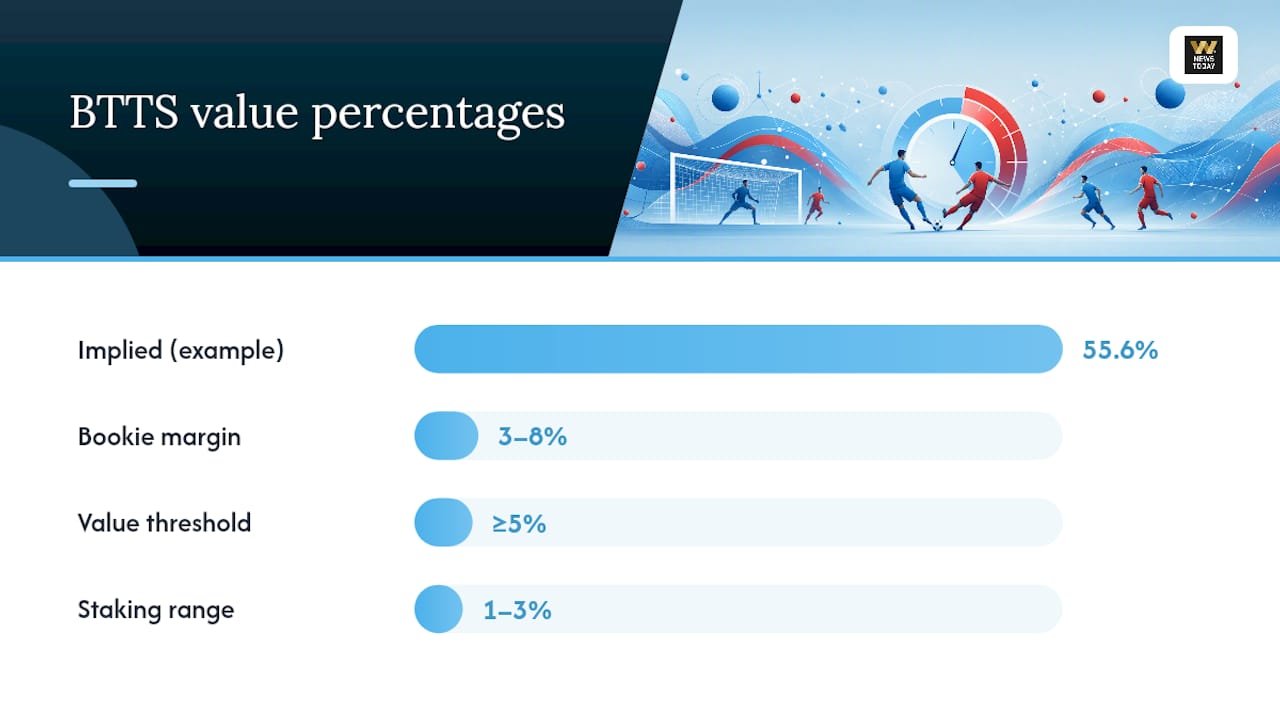
Research on value betting confirms the core method: estimate your own probability, compare it against the market-implied figure, and only act when your number meaningfully exceeds theirs. A one or two percentage point edge is usually noise. A gap of five points or more, backed by solid data rather than a hunch, is where value starts to look real. Our guide to value betting breaks down the full calculation with worked examples if you want to go deeper.
Once you’ve identified a genuine edge, sizing the bet matters just as much as finding it:
- Fractional staking: risk a small, fixed percentage of your bankroll (commonly 1-3%) per bet rather than a flat dollar amount, so your stakes scale naturally as your bankroll grows or shrinks.
- Unit sizing: define one unit as a consistent percentage of your total bankroll, and size bets in units rather than arbitrary amounts, which keeps emotion out of stake decisions.
- Respect uncertainty: your probability estimate carries error too. Stake more conservatively on markets where your data is thin (lower leagues, early season) than where it’s deep (top-flight fixtures with years of history).
Our beginner’s guide to betting odds is worth a read if implied probability and margin still feel fuzzy.
What Should You Check Right Before Placing a BTTS Bet?
Run this sequence in the 30 to 60 minutes before kickoff, when the information is freshest and closest to what will actually happen on the pitch:
- Confirm the starting lineups the moment they’re released. A last-minute change to the goalkeeper or a center-back pairing shifts BTTS probability more than almost any pre-match stat you’ve gathered, and it should override your earlier read rather than get treated as noise.
- Check suspensions and injuries for attackers and key defenders. A team missing its top striker to a knock might still start the same formation, but the goal threat behind it is materially weaker.
- Track odds movement and market consensus. If BTTS Yes odds are shortening fast in the hour before kickoff, sharp money is likely reacting to team news you haven’t seen yet.
- Ask whether the fixture has structural reasons to favor Yes or No. A heated local derby often produces open, end-to-end football that favors Yes. A tactical mismatch where one side parks defensively against a stronger opponent often favors No, regardless of what the season averages say.
Pro Tip: If you can only check one thing before kickoff, make it the lineup sheet. A backup goalkeeper starting his first match in six weeks is worth more to your BTTS decision than three months of clean-sheet data on the regular starter.
How Should You Adjust BTTS Odds During the Match?
Live betting on BTTS rewards bettors who react faster to on-field events than the market does, but the adjustments aren’t always intuitive.
A red card’s effect depends heavily on timing and which side loses the player. A red card to the team already trailing, especially one shown late, often pushes that side into a more chaotic, attack-everything mode, which can raise BTTS probability if they haven’t scored yet. An early red card to the more attacking side, by contrast, can shut down their scoring threat entirely and lower the chance they find a goal at all. Research on match outcome determinants supports leaning on shot data over scoreline alone when reassessing probability mid-match.
A few more in-play rules worth knowing:
- Substitutions signal intent. A manager bringing on a second striker while trailing at 60 minutes is chasing the equalizer, which raises BTTS Yes value if their side hasn’t scored yet.
- A leading team switching to a five-man defense often means they’re settling for a clean sheet, which should lower your BTTS Yes estimate even if the scoreline hasn’t changed.
- Live xG and shot counts update faster than the scoreline. A 0-0 game with eight shots on target and a 2.1 combined xG is a very different BTTS proposition than a 0-0 game with two shots total.
- The best in-play windows tend to fall right after a stoppage in play, a red card, or a substitution wave around the 60 to 70 minute mark, when the market hasn’t fully repriced yet.
What Mistakes Cost BTTS Bettors the Most Money?
Most BTTS losses trace back to a handful of repeatable errors rather than genuine bad luck. Catching these patterns in your own betting is worth more than any single tip:
- Double-counting correlated signals. Treating a team’s BTTS streak and its Over 2.5 streak as two separate pieces of confirming evidence, when they’re usually driven by the same underlying scoring trend.
- Overfitting to small samples. Drawing conclusions from a team’s last three matches, especially against weak opposition, and projecting that form onto a much tougher fixture.
- Ignoring opponent quality entirely. A striker’s goals-per-game average against relegation-threatened defenses tells you very little about how they’ll fare against a top-four back line.
- Chasing bet builders that stack correlated legs. Combining BTTS with related outcomes in a single slip can trim your effective payout, as our bet builder breakdown explains in more detail.
Bankroll discipline is what keeps a good long-term strategy alive through the inevitable rough patches:
- Fix your unit size at 1 to 3% of total bankroll and don’t deviate bet to bet, no matter how confident you feel.
- Set a maximum daily exposure, for example five units, and stop once you hit it regardless of results.
- Keep a simple record of every bet, including the odds taken and your pre-match probability estimate.
Track your edge with closing-line value, meaning whether you consistently beat the odds available right before kickoff, rather than just watching your win rate. Short-term variance will make even a genuinely profitable approach look bad over any given week or month, and that’s expected, not a sign to abandon the method.
When We Prefer BTTS Bets Over Other Markets
BTTS earns its place in a betting strategy when the checklist and the model output actually agree. A high modeled BTTS probability backed by confirmed attacking lineups and a defense missing its starting center-back is a far stronger position than a high number sitting alone on a spreadsheet.
Where this guide pushes back on common practice is the habit of treating a single BTTS percentage as gospel. The number is a starting point, not a conclusion, and the readers who do best treat it that way.
Bet within your means, keep records, and treat variance as the cost of doing business rather than proof something’s broken. We’re always glad to hear which parts of the checklist help you most.
— jeff
Find More BTTS Guides and Odds Explainers on W88news
This site offers checklist-first breakdowns this guide just walked through, minus the guesswork: odds explainers, bonus roundups, and match-level guides built for bettors who want a repeatable process rather than a hot tip.

Beyond BTTS, it tracks fresh casino and sportsbook coverage too, including new game releases as they land, so readers stay updated on what’s worth trying next. Our football hub rounds up match previews and league-specific angles if you bet across more than one competition, and our odds explainer is the natural next stop if implied probability still feels shaky.
Heads up: some links on W88news are affiliate links, meaning we may earn a commission if you sign up through them, at no extra cost to you. That never affects which operators or guides we recommend. If betting stops being fun, GambleAware has free, confidential support. Head to W88news to browse the full library of guides and see what’s new this week.
Sources
Every BTTS tip starts from the same base layer: public match statistics, expected goals (xG) feeds, and confirmed team news pulled as close to kickoff as available. That raw data feeds a Poisson-style model to generate a baseline probability, but the model’s number is never the final word.
Human review sits on top of every model output:
- Law 7 – The Duration of the Match | IFAB
- Poisson model limitations in football forecasting (PLOS ONE)
- Football match forecasting with controllable features (PMC)
The editorial team reviews methodology and sourcing on a rolling basis to keep the process aligned with how the sport actually evolves season to season.
FAQ
What Does Both Teams to Score Mean?
Both Teams to Score (BTTS) is a betting market where you predict whether both teams will score at least one goal during the match. It settles Yes if both sides find the net within 90 minutes plus stoppage time, per IFAB’s standard match duration rules, and No if either team is held scoreless.
Which Team Is Most Likely to Score in Both Teams to Score Bets?
There’s no single team type that guarantees a BTTS Yes; it depends on the specific matchup. Teams with strong recent scoring form playing against defenses with a low clean-sheet rate, especially in their weaker home or away split, tend to produce the highest BTTS Yes probability.
Is GG the Same as BTTS?
Yes, “GG” (short for “Good Game” in some regions, though it’s used as shorthand for “Goal Goal”) is an informal alternative name for the BTTS market. Both terms describe the identical bet: both teams scoring at least once in the match.
How Do You Win a Both Teams to Score Bet?
You win a BTTS Yes bet when both teams score at least one goal within 90 minutes plus stoppage time, and a BTTS No bet when at least one team is shut out. Improving your odds of winning consistently comes down to checking recent scoring and conceding form, confirmed lineups, and head-to-head context before you stake, rather than betting on reputation alone.
How Does a Red Card Affect a BTTS Bet That’s Already Placed?
A red card doesn’t change a bet that’s already settled, but it does change the live probability if you’re considering an in-play BTTS wager. The effect depends on timing and which team loses the player, since a late red to a trailing side often opens up the game, while an early red to the attacking side can shut down their scoring threat.