





Correct score betting rewards patience and math more than gut feeling, and the honest verdict is this: it’s a high-variance market you should approach with small stakes, real data, and a clear statistical edge, not a hunch. The two things that separate winners from donors here are expected goals (xG) combined with Poisson modeling, and disciplined bankroll control. Skip either one and you’re just donating to the bookmaker’s overround. Stick around and you’ll get the model walkthrough, the practical filters, and the staking rules that make this market survivable.
TL;DR:
- Correct score markets are high-variance and require small stakes, a statistical edge based on expected goals and Poisson modeling, and strict bankroll control.
- Conversion from expected goals to score probabilities relies on Poisson distribution, with most likely outcomes having a 10-13% chance, making accuracy vital for profit.
- Filters such as low combined xG, strong defensive stats, lineup confirmation, and head-to-head history improve match selection and reduce wasted effort.
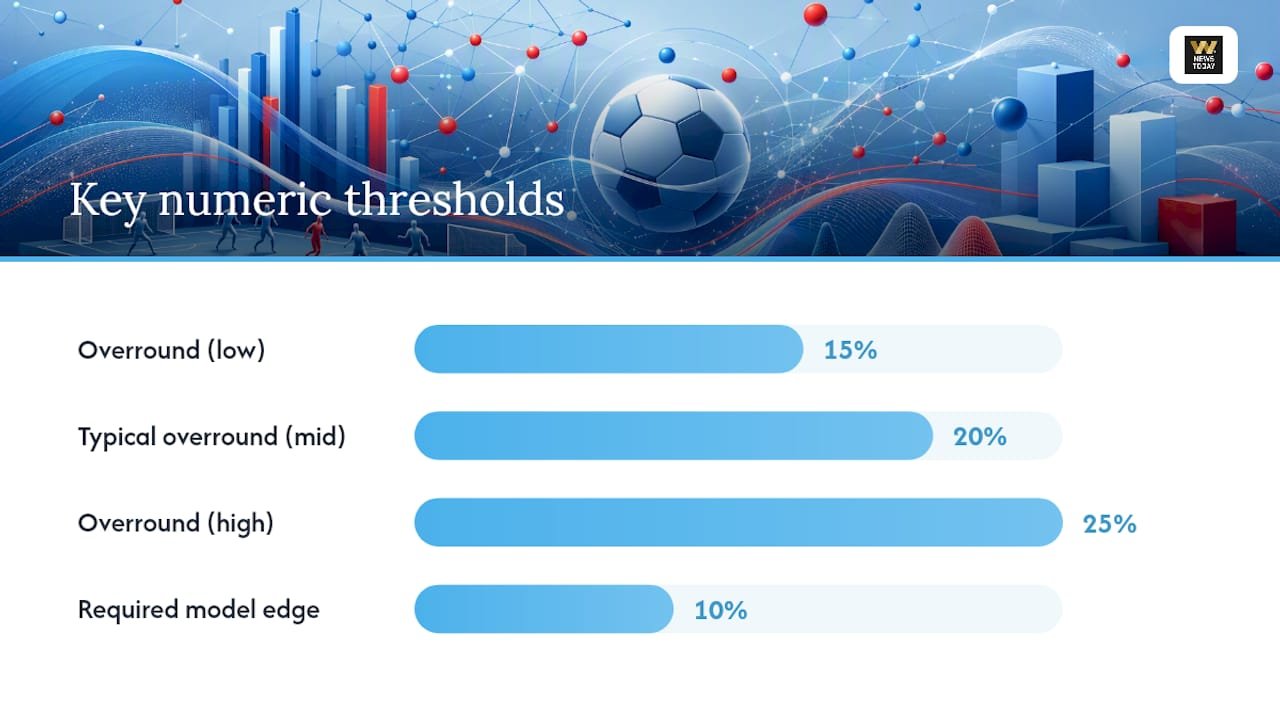
- The overround in correct score betting often exceeds 15%, meaning only bets with at least a 10% edge over implied odds are worth pursuing.
- Use free bets and limit stakes to manage the market’s long-shot nature, treating it as a sporadic side project rather than a reliable income source.
Table of Contents
- What Is Correct Score Betting and How Does It Settle?
- How Do You Turn xG Into Score Probabilities?
- Building a Match Selection Filter Before You Stake Anything
- A Worked Example: Modeling a Fixture From Scratch
- Finding and Placing the Bet Without Getting Burned
- Bankroll Rules for a Market Built on Long Shots
- Why W88news Takes a Data-First Approach to This Market
- An Editorial Take on Realistic Correct Score Expectations
- Explore More Betting Guides and Tools at W88news
- Sources
- FAQ
What Is Correct Score Betting and How Does It Settle?
Correct score betting means predicting the exact final score of a match, not just who wins or whether it’s over or under a goal total. Get the number right on both sides and you cash the ticket. Miss by even one goal on either team and you lose, regardless of how close you were.
Settlement runs on 90 minutes plus stoppage time only. Extra time and penalty shootouts do not count toward a correct score result unless the sportsbook explicitly lists a separate market for the full match duration, according to ThatsAGoal’s betting guide. That single rule trips up more bettors than any statistical mistake ever will. A cup match that finishes 1-1 after 90 minutes and then goes to extra time still settles as 1-1 for standard correct score purposes.
The market itself isn’t one bet type. It’s a family of related markets, and knowing which one you’re actually placing matters:
- Full-time correct score — the final score after 90 minutes plus stoppage time, the most commonly traded version.
- Half-time correct score — the score at the break, a smaller and often less liquid market.
- Half-time/full-time (HT/FT) — you predict both the score at halftime and at full time, which multiplies the outcome space dramatically.
- Any Other — a catch-all bucket covering every scoreline not individually listed, usually higher-scoring or unusual results.
- Grouped or “score range” markets — some sportsbooks bundle several low-probability scorelines together to shorten the odds and simplify the bet slip.
Here’s why bookmakers love this market: a standard match-result bet has three outcomes (home win, draw, away win). A correct score market for a typical fixture might list 20 to 30 individual scorelines plus an “Any Other” bucket. More outcomes means more room to bake in margin, and correct score markets typically carry a notably higher overround than simpler markets, often estimated between 15% and 25%, according to SoccerNews’s analysis. That margin is the tax you pay just to play, and it’s the first number every serious correct score strategy has to beat.
How Do You Turn xG Into Score Probabilities?
Expected goals, or xG, measures the quality of scoring chances a team creates, weighing shot location, angle, and type to estimate how many goals a team “should” score based on those chances. It’s become the backbone of modern football analytics, and it’s also the raw material for any serious correct score strategy.
Here’s the piece that surprises a lot of bettors: xG alone doesn’t give you a scoreline. You need to convert it into a probability distribution across every possible result, and the standard tool for that job is the Poisson distribution, a statistical model built for counting rare, independent events over a fixed period, which happens to describe goal scoring in football remarkably well. Feed a team’s expected goals into a Poisson formula and it spits out the probability of that team scoring exactly 0, 1, 2, 3, or more goals. Multiply the home team’s probability for a given goal count by the away team’s probability for their goal count, and you get the probability of that exact scoreline.
This method is standard practice among serious analysts and bettors, not a fringe theory, according to Toolsgambling’s breakdown of correct score math. It’s reproducible, it’s transparent, and it gives you a number you can actually compare against the price on the board.
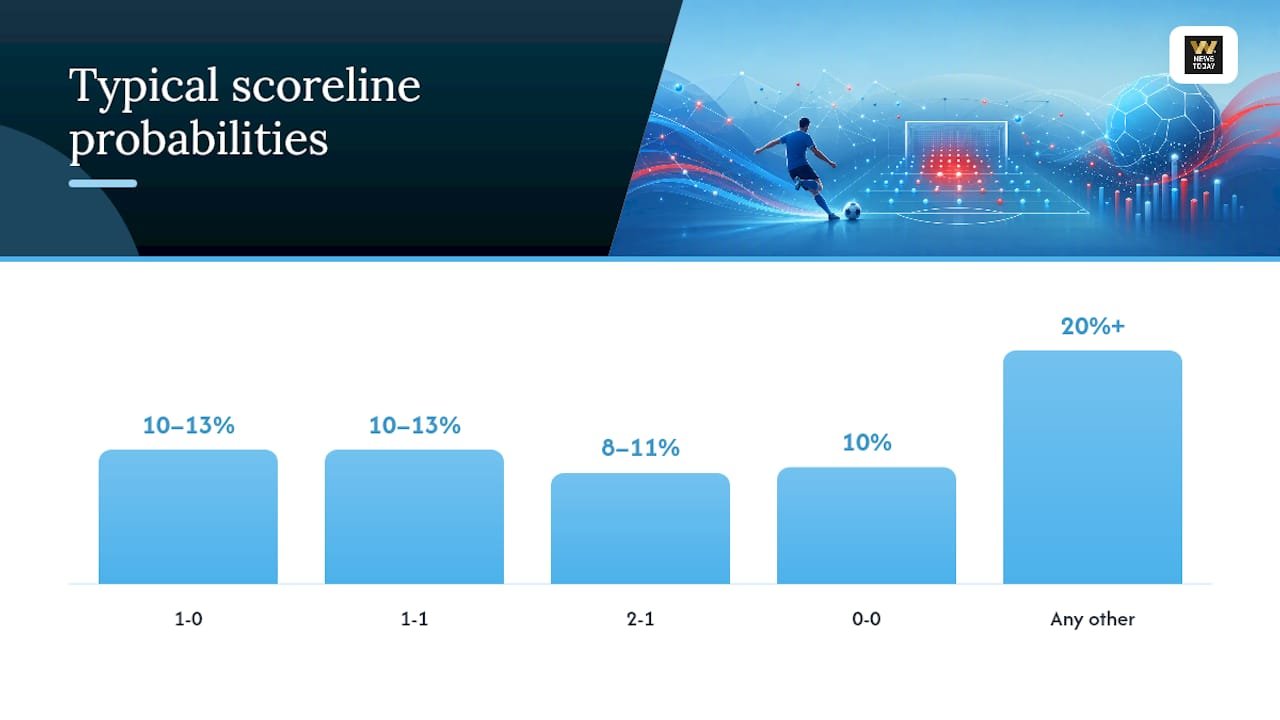
The scoreline frequency reality check: even the single most likely score in a typical professional fixture rarely climbs above a low-mid teens percentage, and in standard Premier League matches the favorite scoreline usually lands in a range around 10 to 13 percent, according to Verdecto’s scoreline probability analysis. That means even your best, most confident pick is still a long shot in absolute terms. This is not a market where you expect to be right often. It’s a market where you expect your calculated probability to beat the bookmaker’s implied probability often enough, over enough bets, to come out ahead.
Here’s a rough illustration of how probability mass typically spreads across common scorelines in a fairly even match between two mid-table sides, using a hypothetical home xG of 1.4 and away xG of 1.1:
| Scoreline | Approximate Probability Range |
|---|---|
| 1-0 | 10% to 13% |
| 1-1 | 10% to 13% |
| 2-1 | 8% to 11% |
| 0-0 | 10% |
| 2-0 | 6% |
| 0-1 | 6% to 8% |
| 1-2 | 7% |
| Any Other | 20%+ combined |
Pro Tip: Never compare your model’s probability directly to a bookmaker’s decimal odds without converting first. Odds of 6.00 imply a 16.67% probability once you strip out the vig. Use a tool like the betting odds explainer to get comfortable converting odds to implied probability before you start hunting for edges.
The gap between implied probability and fair probability is where the overround lives. A sportsbook doesn’t offer 6.00 on a scoreline with a true 16.67% chance. It shades the price to bake in margin, so you might see 5.50 or 5.00 instead, dropping the implied probability the bet needs to hit to 18% or 20%. That shaded price is the wall your model needs to climb over.
Building a Match Selection Filter Before You Stake Anything
The biggest mistake in correct score betting isn’t bad math. It’s betting on the wrong matches in the first place. Some fixtures are simply better suited to this market than others, and a smart filter cuts your workload dramatically before you ever touch a Poisson calculation.
Start with matches where the outcome space is naturally compressed. Low-scoring environments concentrate probability into fewer scorelines, which is exactly what you want when you’re trying to beat a market spread across 20-plus outcomes. Guides that specialize in correct score picks consistently point bettors toward low-scoring matches and strong defensive statistics as the starting filter, according to MightyTips, and that advice holds up under the math. When both teams have modest attacking output, the probability mass clusters around 0-0, 1-0, and 1-1, making those scorelines easier to price with confidence.
Here’s a practical sequence for shortlisting fixtures worth modeling:
- Screen for low combined xG. Look for matchups where both teams’ rolling average xG sits below roughly 2.5 combined. High-scoring, chaotic fixtures spread probability too thin across too many scorelines to find a reliable edge.
- Check defensive stability, not just attacking numbers. A team conceding under one xG against per game recently is a strong signal that clean sheets and single-goal margins are live outcomes, tightening your target scorelines.
- Confirm lineup news before kickoff. A missing striker, a suspended center back, or a rotated goalkeeper can shift a team’s effective xG by 20% or more in a single match. Never lock in a model built on last week’s personnel.
- Look at head-to-head scoring patterns, cautiously. Two teams with a history of tight, low-scoring meetings can reinforce a defensive read, but treat this as a supporting signal, never a primary one. Small sample sizes lie easily.
- Cross-reference at least two sportsbooks’ lines. If one book prices a scoreline noticeably shorter than another, that discrepancy often flags where the market disagrees with itself, and disagreement is where value sometimes hides.
Once you’ve got your shortlist, the next question is whether your model actually clears the bookmaker’s margin. Remember that correct score markets often run a substantial overround in the range of roughly 15% to 25%, so a modest edge on paper may disappear after accounting for the vig. A workable rule of thumb from bettors who take this seriously: after estimating your fair probability, only proceed if your calculated edge exceeds roughly 10% above what the market price implies, according to the Verdecto guide’s approach. Anything thinner than that is basically betting on noise once the margin eats into it.
Watch the market itself for signals, too. A scoreline whose price shortens sharply in the hours before kickoff, especially on thin liquidity, often reflects sharp money or team news you haven’t seen yet. A price that barely moves despite a shortlisted xG edge might mean your model is missing something the market already knows, like an injury doubt or a tactical change.
On staking: correct score bets should represent some of the smallest individual wagers in your entire betting portfolio, given how concentrated the risk is on a single precise outcome. Many recreational bettors treat free bets and promotional credit as the ideal vehicle for correct score plays specifically because the downside is already covered, letting you test a model’s real-world accuracy without risking your own bankroll on a market this unforgiving, an approach echoed by ThatsAGoal’s guidance. If you’re staking real money, keep it to a fraction of what you’d risk on a standard match-result bet.
A Worked Example: Modeling a Fixture From Scratch
Numbers convince better than theory, so here’s a full walkthrough using a realistic hypothetical fixture.
- Gather your xG inputs. Say Team A (home) has a rolling average xG for and against that suggests an expected 1.6 goals in this matchup, adjusted for opponent strength and home advantage. Team B (away) projects to 1.0 expected goals, adjusted downward slightly for their recent defensive form.
- Run the Poisson calculation for each team, goal by goal. For Team A at an average of 1.6 goals, the Poisson formula gives you roughly: 0 goals at 20%, 1 goal at 32%, 2 goals at 26%, 3 goals at 14%, and 4-plus goals making up the remainder. For Team B at 1.0 expected goals: 0 goals at 37%, 1 goal at 37%, 2 goals at 18%, 3 goals at 6%, and 4-plus goals filling the rest.
- Multiply across the grid. The probability of a specific scoreline is Team A’s probability for their goal count multiplied by Team B’s probability for theirs. A 1-0 result, for instance, comes from Team A scoring 1 (32%) times Team B scoring 0 (37%), landing around 11.8%. A 1-1 result comes from Team A at 1 goal (32%) times Team B at 1 goal (37%), also close to 11.8%.
- Bucket the low-probability tail. Every combination beyond four goals for either side gets rolled into an “Any Other” category rather than priced individually, since chasing precision on a 5-3 scoreline isn’t worth the modeling effort.
Here’s how the grid shakes out for the most probable results in this hypothetical matchup:
To get fair decimal odds, divide 1 by the probability as a decimal. A modeled 11.8% chance becomes 1 divided by 0.118, which rounds to roughly 8.47.
Now compare that fair price against the actual board. If a sportsbook offers 10.00 on that 1-0 scoreline against your fair-odds estimate of 8.47, you’ve found a gap.
The single most important gut-check in this entire process is sensitivity analysis. Bump Team A’s xG input from 1.6 to 1.8, a change well within normal week-to-week variance, and that 1-0 probability drops while 2-0 and 2-1 climb. If it evaporates under a modest nudge, it was never a real edge, just a rounding artifact.
Finding and Placing the Bet Without Getting Burned
Most sportsbook apps and desktop sites list correct score under a “Match Result” or “Goals” tab rather than as its own standalone category, so you may need to expand a “More Markets” or “All Markets” link on the fixture page to find it. Once you’re there, scorelines are typically arranged in a grid, home goals down one axis and away goals across the other, with an “Any Other Home Win,” “Any Other Draw,” and “Any Other Away Win” grouping the long tail.
A few settlement details catch bettors out repeatedly:
- “Any Other” bets settle broadly. If you back “Any Other Home Win” and the match finishes 4-1, that bet wins even though 4-1 wasn’t individually listed, as long as it falls in the correct category (home win, draw, or away win).
- Extra time never counts unless stated otherwise. A cup tie that’s 1-1 after 90 minutes and finishes 3-1 after extra time still settles as 1-1 for standard correct score purposes, consistent with the 90-minute rule from ThatsAGoal.
- HT/FT bets require both legs to land. Getting the halftime score right but missing the full-time score (or vice versa) loses the entire bet. There’s no partial credit.
- Doubles and accumulators multiply the difficulty. Combining two correct score picks into a double doesn’t just multiply the odds, it multiplies how wrong you can be. Consider how correlated selections affect payouts before stacking multiple correct score legs, an issue covered well in this bet builder breakdown.
- Free bets pair naturally with correct score longshots. Using a free bet on a well-modeled but low-probability scoreline lets you chase the bigger payout without risking your own cash on a bet this unlikely to land on any single attempt.
Bankroll Rules for a Market Built on Long Shots
Correct score betting demands the tightest staking discipline of any football market, precisely because your hit rate will be low even when your model is good. Treat every individual scoreline bet as a small, speculative slice of your overall betting activity, not a centerpiece wager.
A few concrete rules worth adopting:
- Cap single correct score stakes at a small fraction of your total bankroll, well below what you’d risk on a straightforward match-result bet, given how concentrated the risk is on one exact outcome.
- Limit how many correct score legs you’ll stack into a single accumulator. Two is manageable for occasional fun; beyond that, your realistic win probability drops toward negligible even with a genuine model edge.
- Use free bets as your primary testing ground. Running your model against real fixtures using promotional credit lets you validate accuracy over dozens of matches before committing real money.
- Track every bet, win or lose. A spreadsheet showing your modeled probability, the price you took, and the actual result over 50-plus bets tells you far more about whether your process works than any single win or loss.
If betting stops feeling like an occasional, research-led hobby and starts feeling like something you can’t step away from, that’s a signal worth taking seriously. BeGambleAware and GambleAware both offer free, confidential support for anyone concerned about their gambling habits, and W88news’s own responsible gambling guidance walks through practical limit-setting tools alongside a deeper bankroll management playbook for structuring stakes across your whole betting activity.
Why W88news Takes a Data-First Approach to This Market
W88news covers correct score betting the same way it covers every other corner of sports betting and iGaming: with a commitment to accurate, easy-to-understand reporting rather than hype. The xG and Poisson methods walked through in this piece aren’t proprietary tricks. They’re standard, widely used statistical tools among professional analysts, and our job is explaining them clearly rather than dressing them up as secret formulas.
If you want to build your own edge instead of trusting someone else’s guarantee, start with the fundamentals: our betting odds explainer covers implied probability from the ground up, and our sports betting tips guide rounds out the match-prep habits that feed into any scoreline model.
An Editorial Take on Realistic Correct Score Expectations
Correct score betting works best as an occasional, research-heavy side project, not a core income strategy, and the math in this article explains exactly why. That means losing streaks of ten, fifteen, even twenty bets in a row are entirely consistent with a model that’s working correctly. If you can’t stomach that variance emotionally, this market will wear you down long before bad luck ever proves your math wrong.
The bettors who get the most out of this market treat it as a supplement, pairing a handful of well-modeled correct score picks each week with steadier markets like match result or over/under, where variance is gentler and edges compound more predictably. Correct score is the spice, not the meal. Go in expecting to be wrong most of the time, size your stakes accordingly, and let the occasional 8.00 winner be a pleasant surprise rather than an expectation you’re chasing.
— jeff
Explore More Betting Guides and Tools at W88news
W88news gives football bettors a clear, no-nonsense alternative to scattered forum tips and guesswork spreadsheets: a single place with odds explainers, bankroll calculators, and bonus roundups built around the same data-first thinking covered in this guide.

Beyond correct score markets, our library covers everything from converting odds into implied probability to structuring a staking plan that survives a rough month, plus regular coverage of sportsbook bonus updates and industry news as it breaks. If you’re refining how you stake correct score picks specifically, our bankroll management playbook breaks staking percentages down by bet type, and our sports betting tips guide covers the broader match-prep habits worth building alongside any scoreline model. Head to the W88news homepage to browse the full library of guides, calculators, and the latest game releases and bonus offers as they land.
Sources
Beyond this guide, a short list of resources worth bookmarking:
- BeGambleAware
- Correct score betting explained — Veredicto
- Correct score betting explained – ThatsAGoal
- Correct score betting: How it works and whether it is worth it (SoccerNews)
FAQ
What Is the Correct Score in Betting?
The correct score in betting is the exact final result of a match that a bettor predicts before or during a game, such as 2-1 or 0-0. The bet only wins if both teams’ goal totals match your prediction precisely, settled on 90 minutes plus stoppage time under standard rules, according to ThatsAGoal.
What Is the Best Correct Score Bet?
There’s no single “best” correct score bet, since the right pick depends entirely on the specific fixture’s xG profile and defensive form. The strongest approach is building your own probability estimate using xG and a Poisson model, then only backing scorelines where your calculated edge clears the bookmaker’s typical 15% to 25% overround, as outlined by SoccerNews.
Is Correct Score Full Time?
Correct score typically refers to the full-time result unless a sportsbook specifically labels it a half-time correct score or HT/FT market. Standard full-time correct score bets settle on the score after 90 minutes plus stoppage time, with extra time and penalties excluded unless a separate market covers them.
What Does a “3-0 Correct Score” Bet Mean in Betting?
A “3-0 correct score” bet wins only if the specific team you backed to win 3-0 does exactly that after 90 minutes plus stoppage time. Even a 3-1 or 4-0 result, despite being close, loses the bet entirely, since correct score markets require an exact match with no partial credit for near misses.
Why Is the Overround So High on Correct Score Markets?
Correct score markets list dozens of individual scorelines instead of the two or three outcomes on a standard match-result bet, giving bookmakers far more room to build in margin across the full grid. That typically pushes the overround to somewhere between 15% and 25%, well above simpler markets, according to SoccerNews’s analysis.