





Bonus abuse is the deliberate exploitation of casino or sportsbook promotions in ways the operator’s terms and conditions do not permit, from running multiple accounts to grinding out low-risk wagers designed to strip free money with almost no real gambling risk. The immediate fallout is marketing leakage that operators pass on through stingier offers and tighter rules for everyone else. This guide breaks down how the schemes actually run, how operators catch them, and what you can do to keep your own bonuses safe.
TL;DR:
- Players should be cautious of exceeding max-bet limits, as wagers over the maximum triggers bonus voiding and risk detection.
- Using low-variance, high-RTP games or sudden activity shifts during wagering can reveal abuse attempts to operator monitoring systems.
- Multi-accounting, synthetic identities, and payment method inconsistencies are common signals that operators track to identify abuse behaviors.
- Operators rely on technical signals like device fingerprints, behavior analysis, and rapid withdrawal requests within 24 to 72 hours for effective detection.
- Clear, written terms and a fair appeals process reduce legal risks for operators, while vague conditions often lead to disputes and regulatory scrutiny.
Table of Contents
- What Bonus Abuse Actually Means
- The Main Types of Bonus Abuse Operators Track
- How a Bonus-Abuse Scheme Actually Runs
- How Operators Detect and Prevent Bonus Abuse
- What Regulators Expect From Fair Enforcement
- The Real Cost of Bonus Abuse
- How to Avoid Accidental Bonus Abuse as a Player
- Why Trust W88 News Today on Bonus Abuse
- An Editorial Take on Where This Is Headed
- Sources
- FAQ
What Bonus Abuse Actually Means
Bonus abuse, sometimes called promo abuse or bonus hunting, describes any attempt to extract value from a promotional offer in a way its terms were never built to allow. Multi-accounting, where one person opens several profiles to claim the same welcome offer repeatedly, is the most common variant. The boundary isn’t abstract morality. It’s whatever the operator’s terms and conditions actually say.
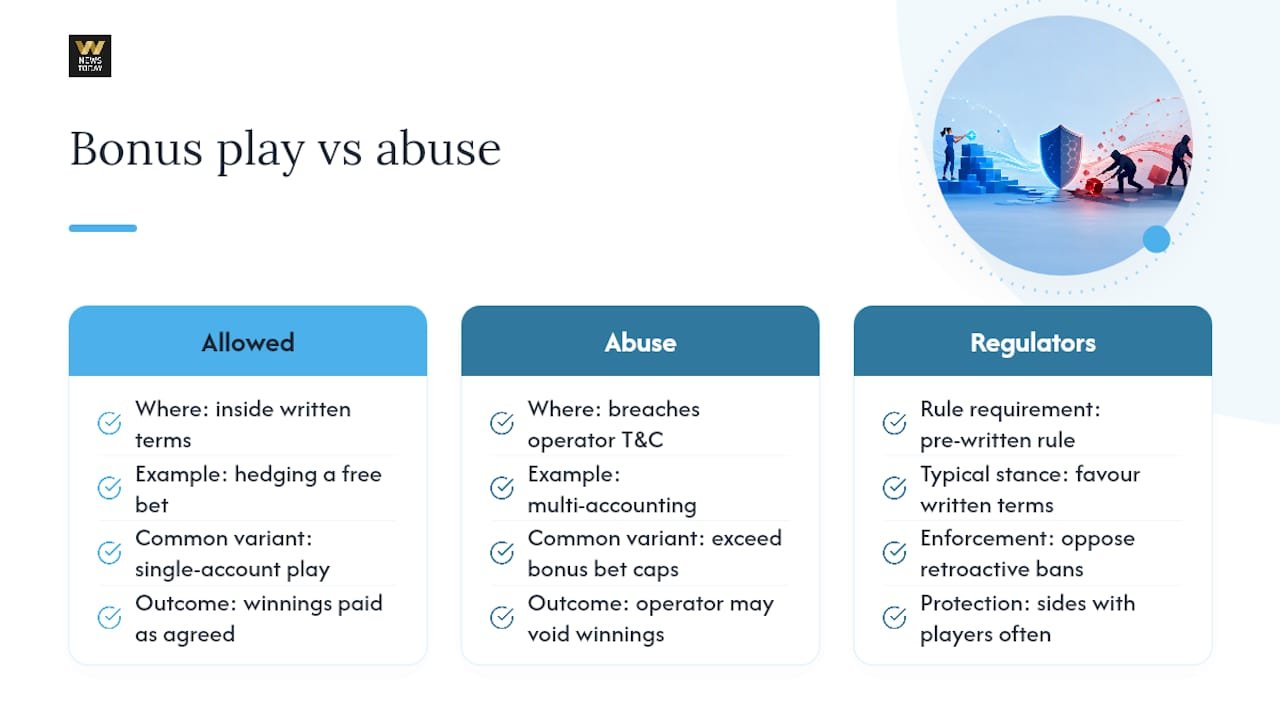
Here’s the distinction that trips people up: advantage play inside the rules isn’t abuse. If a sportsbook’s terms allow hedging a free bet across two outcomes and you do exactly that, you’re playing smart, not cheating. But if those same terms cap max bet at $5 on bonus funds and you place $50 wagers to clear it fast, you’ve crossed into abuse territory even if no one told you directly.
Regulators have made clear this cuts both ways. Directorates like the MGA and UKGC consistently side against operators who invoke vague, undocumented anti-abuse clauses after the fact. If a casino wants to void your winnings, the specific rule you broke needs to exist in writing before you played, not invented retroactively to avoid a payout.
The Main Types of Bonus Abuse Operators Track
Fraud and compliance teams sort bonus abuse into recognizable categories, each with its own signature. Understanding them helps you spot which behaviors will get flagged even if you never intended harm.
- Multi-accounting and synthetic identities: One person or crime ring opens dozens of accounts using fake or stolen details to farm welcome bonuses repeatedly.
- Bonus hunting: Players target promotions with mathematically favorable clearing paths, often using low-variance games that barely move the house edge.
- Wagering circumvention: Betting patterns designed to satisfy a turnover requirement while minimizing actual risk, frequently by exploiting games with unusually low weighting.
- Welcome-offer chaining: Signing up under different emails, devices, or households to claim the same “new player” deal over and over.
- Referral and affiliate manipulation: Faking referrals or self-referring through secondary accounts to trigger payouts never meant for genuine recruits.
- Chargebacks and cashout scams: Depositing, wagering with bonus funds, cashing out, then disputing the original deposit with the card issuer.
How a Bonus-Abuse Scheme Actually Runs
Every scheme follows a similar lifecycle: deposit, wager, withdraw. The abuser funds an account, uses the bonus and often the deposit itself to satisfy wagering requirements as fast as possible, then pulls the funds before anyone reviews the activity. Speed is the whole point, and operators know it. The highest-signal window for catching abuse sits in the first 24 to 72 hours after a bonus clears, because that’s when patterns still look distinct from ordinary play.
Wagering volume relative to the stated requirement is one of the clearest tells. Legitimate players tend to wager close to what’s required, maybe a bit over. Abusers frequently show volume just above the minimum threshold, indicating just clearing the requirement with minimal excess exposure. That precision is hard to fake convincingly.
Game weighting and max-bet behavior tell a similar story. A player who suddenly shifts all activity to a 99% RTP blackjack variant or a low-volatility slot the moment a bonus lands is doing exactly what game-weighting rules exist to prevent.
Beyond gameplay, technical signals round out the picture:
- Device fingerprints matching across supposedly unrelated accounts.
- Payment methods that don’t match the account holder’s stated location or history.
- Rapid withdrawal requests filed within minutes of a wagering requirement being met.
- IP addresses or VPN indicators suggesting the same person or network behind multiple logins.
How Operators Detect and Prevent Bonus Abuse
Operators fight bonus abuse on two fronts: how the bonus is designed, and how it’s monitored after launch. Neither works well alone.
On the design side, six adjustments do most of the heavy lifting:
- Game weighting that reduces or zeroes out contribution from low-house-edge titles.
- Max-bet caps on bonus funds, often $5 to $10 per spin or hand.
- Account-lifetime minimums requiring a real deposit history before bonuses unlock.
- Cashable vs. non-cashable structuring, where non-cashable bonuses remove the incentive to grind and run.
- Wagering applied to deposit plus bonus, not the bonus alone, which cuts the mathematical edge available to hunters.
- Explicit forfeiture clauses spelling out exactly which actions void winnings.
On the technical side, device intelligence and multi-signal detection combining device, payment, behavioral, and network data consistently outperform single-rule checks and produce fewer false positives against genuine players. Duplicate-account checks, behavior scoring, and fraud network mapping all feed into that stack.
Operationally, mature teams run tiered thresholds: soft flags trigger monitoring, manual review handles gray areas, and hard blocks require a documented appeals path before any payout reversal. Payment-method asymmetry, where deposits and cashouts don’t logically match, often gets routed straight to anti-money-laundering compliance rather than treated as simple promo abuse.
Pro Tip: If you’re evaluating which casinos treat players fairly, check whether their terms spell out excluded games and max-bet limits in plain language before you claim any bonus. Vague terms are often the first sign an operator enforces rules inconsistently.
The tradeoff is real. Tighter detection catches more abuse but risks flagging legitimate high-volume players, which is why tracking false-positive rates matters as much as catch rates.
What Regulators Expect From Fair Enforcement
Regulatory bodies don’t require operators to tolerate abuse, but they do require documentation. Guidance tied to bodies like the MGA and UKGC consistently emphasizes that promotional terms must be clear and accessible before a player accepts an offer, not clarified after a dispute arises.
An operator that voids winnings citing “suspicious activity” without naming the specific clause breached is asking for a complaint, and regulators have ruled against exactly that pattern. Enforcement without explicit, pre-stated rules creates legal exposure regardless of whether the underlying suspicion was correct.
A defensible appeals workflow generally includes three things: a written explanation of which term was broken, the evidence behind that determination, and a review process independent of whoever made the initial call. Casinos that build this into their operations from the start face fewer regulatory headaches and fewer public disputes that damage trust with legitimate players browsing welcome bonus offers.

The Real Cost of Bonus Abuse
Bonus abuse is a genuine drain on operator margins, not just a compliance headache. Operators without dedicated detection logic report losses between 4 and 11 percent of bonus-funded gross gaming revenue, and immature setups can lose 15 to 30 percent of bonus spend outright.
That leakage doesn’t stay contained to a line item. It pushes operators toward smaller welcome offers, stricter wagering multiples, and lower max-bet caps for everyone, penalizing honest players for abuse they had no part in. Manual review queues, chargeback disputes, and affiliate clawbacks add operational overhead that eats into the very promotional budgets meant to attract new players in the first place.
How to Avoid Accidental Bonus Abuse as a Player
Most players who get flagged never intended to cheat. They just didn’t read the fine print, and the most common accidental violations involve max-bet limits, excluded games, and payment restrictions buried in the terms.
- Check the max-bet cap on bonus funds before you play. A single oversized wager can void the entire bonus.
- Confirm which games are excluded from wagering contribution. Many slots and table games are weighted at 0% specifically to prevent grinding.
- Use one account tied to your real identity and one verified payment method, matching your name and location.
- Avoid hedging or near-zero-variance betting patterns on bonus money. It’s the single fastest way to trigger a review.
- Understand whether your bonus is sticky or non-sticky, since that determines whether the bonus itself is ever cashable.
If your account gets flagged, request the specific clause you allegedly broke along with the evidence behind the decision. Work through the operator’s appeals process before escalating to a regulator. Most disputes resolve faster once both sides can point to the actual written term in question.
Why Trust W88 News Today on Bonus Abuse
W88 News Today covers casino reviews, bonus breakdowns, and industry news daily, which means we track how operator terms and enforcement practices actually shift over time. This guide synthesizes publicly documented operator playbooks and industry fraud research rather than guesswork. For more on claiming offers safely, browse our responsible gambling resources alongside our latest welcome bonus roundups, and keep an eye on new slot and table game releases as operators refresh their promotional lineups throughout 2026.
An Editorial Take on Where This Is Headed
Operators who still rely on static, one-time account checks are already behind. The real fix is continuous lifecycle monitoring paired with terms written in plain language before a single dollar is wagered, not legal cover invented after a payout dispute. As synthetic identities and AI-generated account farms get cheaper to run, expect identity-graph sharing across operators to become the next serious battleground, not a nice-to-have feature buried in a compliance deck.
— jeff
Sources
- Bonus Abuse Detection: 2026 iGaming Operator Playbook
- In-depth guide to preventing iGaming bonus abuse: 2026 edition | Sumsub
FAQ
What is a bonus in online gambling, and what does it mean to abuse one?
A bonus is promotional funds or free spins an operator credits to encourage signups or continued play. Abusing it means using tactics outside the stated terms, like multi-accounting or wagering circumvention, to extract value the offer wasn’t designed to give.
What are some examples of unauthorized gambling transactions tied to bonus abuse?
Common examples include chargebacks filed after cashing out bonus winnings, deposits made with payment methods that don’t match the account holder, and rapid withdrawal requests filed the moment a wagering requirement clears.
Do bonus bets actually pay out?
Yes, bonus bets pay out when players follow the stated terms, including max-bet limits and excluded games. Payouts get denied or reversed specifically when wagering patterns match documented abuse signatures like circumvention or multi-accounting.
Is bonus abuse illegal?
Bonus abuse typically violates an operator’s terms of service rather than criminal law, though schemes involving stolen identities, chargebacks, or organized fraud rings can cross into illegal territory and trigger law enforcement involvement.
How fast do operators usually catch bonus abuse?
The highest-detection window falls within 24 to 72 hours after a bonus clears, when recovery rates run far higher than catching abuse after payout has already occurred.