





Value betting is placing wagers with positive expected value, meaning you back outcomes whose true probability you estimate as higher than the bookmaker’s implied probability. The action rule is simple: only bet when your estimated edge is big enough to survive your own estimation error, not just big enough to look exciting. The real proof isn’t one big win. It’s a track record of positive closing line value across hundreds of bets.
TL;DR:
- Most profitable long-term betting hinges on consistently identifying and exploiting small value edges, often just a few percentage points.
- Proper probability estimation requires stripping the bookmaker’s margin and comparing your adjusted view to consensus or sharp lines, not just trusting posted odds.
- Discipline in bet sizing, using fractional Kelly or flat stakes and avoiding overbetting, is crucial to prevent bankroll destruction fromvariance.
- Tracking and analyzing closing line value over hundreds of bets provides the clearest indicator of a sustainable edge, rather than short-term results.
- Targeting low-liquidity markets and comparing prices across multiple sportsbooks can yield additional opportunities to find exploitable mispricings.
Table of Contents
- What Is Value Betting and How Do Odds Hide the House Edge?
- How Do You Calculate Edge and Expected Value?
- How Do You Estimate the True Probability of an Outcome?
- How Should You Size Bets and Manage Your Bankroll?
- Where Do You Actually Find Value Bets?
- What Mistakes Wreck a Value Betting Strategy?
- How to Build a Disciplined Practice
- What Sustained Value Betting Actually Feels Like
- Ready for More Betting Guides and Game Releases?
- Sources
- FAQ
What Is Value Betting and How Do Odds Hide the House Edge?
Every price a bookmaker posts contains two layers: their honest read on the probability, and a built-in profit margin called the “vig” or “overround.” You need to strip out that margin before you can judge whether a price actually offers value.
Converting odds to implied probability is the first skill you need, and the formula changes slightly depending on the odds format you’re staring at.
- Decimal odds: Implied probability = 1 / decimal odds. Odds of 2.50 imply a 40% chance (1 / 2.50 = 0.40).
- Fractional odds: Implied probability = denominator / (numerator + denominator). Odds of 5/2 imply 2 / (5 + 2) = 28.6%.
- American odds (positive): Implied probability = 100 / (odds + 100). At +150, that’s 100 / 250 = 40%.
- American odds (negative): Implied probability = odds / (odds + 100), using the absolute value. At -150, that’s 150 / 250 = 60%.
Add up the implied probabilities on both sides of a two-way market and you’ll almost never land on exactly 100%. You’ll usually get something like 105% or 108%. That extra bookmaker margin, typically a few percentage points, is why you can’t just trust the raw number on the board.
To find the “fair” or margin-free probability, divide each outcome’s implied probability by the total. If two odds imply 52% and 55% (107% total), the fair probabilities become 52/107 = 48.6% and 55/107 = 51.4%.
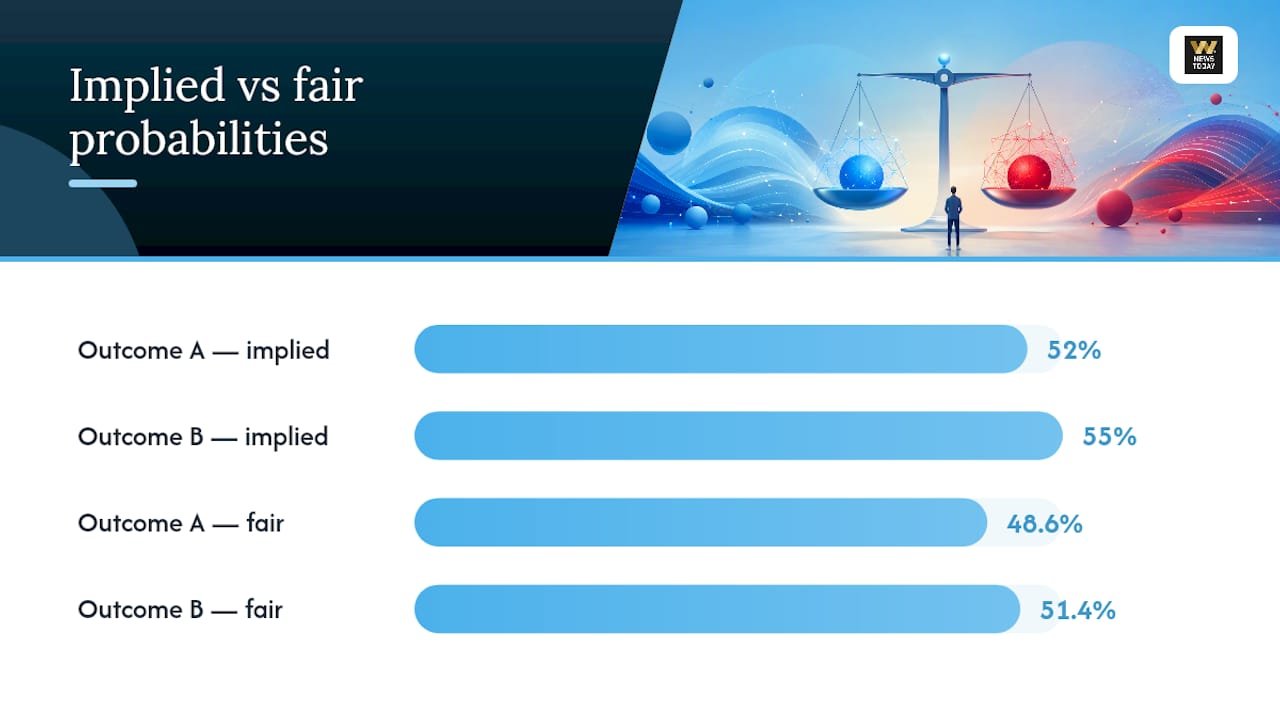
This matters more than most casual bettors realize. A pick that “feels right” intuitively can still be mathematically negative once you account for the vig. The FootyPulse guide on value betting frames this margin as the real opponent, not the team on the other side of the bet. Beat the margin consistently, and you’re doing something most bettors never manage.
How Do You Calculate Edge and Expected Value?
Once you know the fair probability, calculating your edge is arithmetic, not guesswork. Edge = your estimated true probability minus the bookmaker’s implied probability, expressed in percentage points.
Say a sportsbook offers 2.20 decimal odds on a team you believe has a 50% chance to win. The bookmaker’s implied probability at 2.20 is 1 / 2.20 = 45.5%.
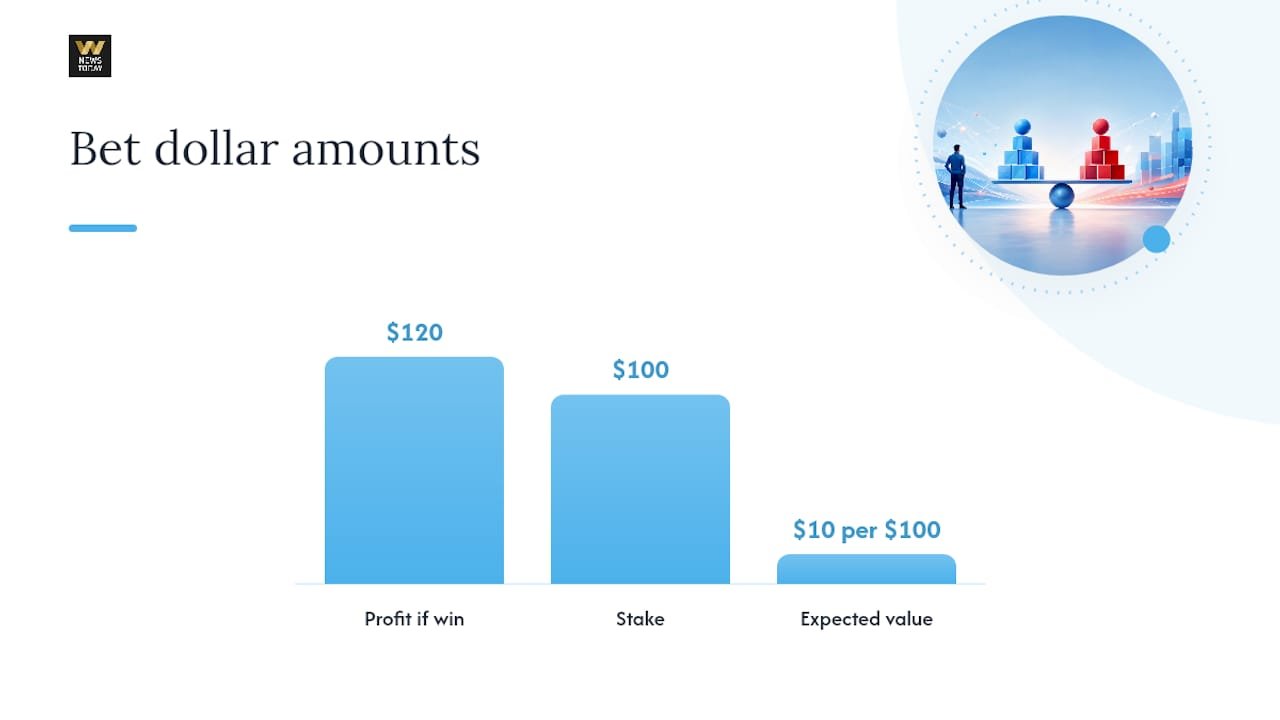
Expected value converts that edge into dollars. The formula from CalcMyBets is:
EV = (p × profit if win) − ((1 − p) × stake)
Here’s the same bet run through that formula on a $100 stake at 2.20 odds (profit of $120 on a win):
| Variable | Value |
|---|---|
| Your estimated probability (p) | 50% |
| Bookmaker implied probability | 45.5% |
| Edge | 2 to 8 percentage points |
| Stake | $100 |
| Profit if win | $120 |
| EV calculation | (0.455 × $120) − (0.545 × $100) |
| Expected value | $10 per $100 wagered |
That $10 figure isn’t a guaranteed profit on this specific bet. It’s your long-run average return if you make the same quality of decision hundreds of times over. A few things worth flagging before you replicate this on your own numbers:
- EV only means something if your probability estimate is accurate. Garbage input, garbage output.
- Small edges (under 3%) get wiped out easily by minor pricing errors or bad luck in the short run.
- The formula works identically for any odds format. Just convert to decimal first for clean math.
How Do You Estimate the True Probability of an Outcome?
The hardest part of value betting isn’t the math. It’s figuring out what “true probability” actually is, since nobody has access to the real answer before the event happens. A few validated methods get you closer than guessing.
- De-vig sharp closing lines. Sharp bookmakers with tight margins and high volume, the kind referenced in MarketMath’s breakdown of expected value, tend to price markets close to true probability by the time they close. Strip the margin from those lines using the same normalization from the odds section, and you get a strong benchmark to compare against softer books.
- Build or use a statistical model. Power ratings, adjusted for home advantage, recent form, and injuries, can generate independent probability estimates. The catch: a model is only as good as its calibration, meaning its predicted 60% outcomes should actually happen close to 60% of the time over a large sample.
- Check consensus and prediction markets. Averaging odds across several major books, or checking a prediction market price, gives you a sanity check against your own number. If your estimate is wildly out of step with the consensus, that’s usually a signal to double check your work rather than celebrate a huge edge.
Each method shines in different spots. De-vigging works best on mainstream markets with heavy liquidity. Models tend to add more value in smaller leagues or prop markets where fewer sharp eyes are watching. Consensus checks are most useful in live betting, where prices move fast and you need a quick gut check against your own read.
Pro Tip: If you can’t name two concrete tactical reasons your number should differ from the market’s, don’t bet it. Disagreeing with the market without a specific reason is usually just noise, not insight.
How Should You Size Bets and Manage Your Bankroll?
Finding an edge is only half the job. Sizing the bet correctly is what keeps a good process from blowing up your bankroll on a rough stretch.
The full Kelly Criterion formula is: Stake % = (edge / odds − 1), or more precisely, (bp − q) / b, where b is the decimal odds minus 1, p is your win probability, and q is 1 − p. Full Kelly maximizes long-run growth mathematically, but it’s brutal in practice because it assumes your probability estimate is perfect, and it never is.
That’s why most disciplined bettors use fractional Kelly instead, usually half or quarter Kelly, to cut volatility while keeping most of the growth benefit.
Simpler alternatives work too:
- Flat staking: Bet a fixed 1 to 3% of your bankroll per wager, regardless of edge size.
- Minimum edge thresholds: Many practitioners won’t bet under a 2 to 8% estimated edge, since smaller margins get eaten alive by estimation error.
- Bankroll segmentation: Keep betting funds separate from spending money, full stop.
None of this proves anything on a small sample. Variance dominates over 20 or 50 bets, so validating an edge requires 200 to 1,000-plus wagers before you can trust your win rate over luck.
The single most reliable signal that your process works isn’t your win rate or short-term ROI. It’s consistent positive closing line value across a large sample. If you’re consistently beating the closing price, your pre-game number was sharper than the market’s, and that skill compounds over time even when individual bets don’t fall your way. A tool like Backstedge can help you backtest a staking approach before committing real money to it. Our own bankroll management playbook walks through staking plans in more depth if you want the fuller version.
Where Do You Actually Find Value Bets?
Theory is one thing. Finding real, exploitable pricing gaps day to day is another, and it comes down to habits more than genius.
Line shopping, comparing the same market across several sportsbooks before betting, is the simplest and most repeatable edge available. That habit alone has been estimated to add roughly 2 to 4% average uplift to your long-run returns, purely from grabbing the best number instead of whatever price loads first.
Beyond shopping the same line, a few tactics consistently produce real inefficiencies:
- Target low-liquidity markets. Niche leagues, smaller props, and lower-profile competitions get less sharp attention, which means pricing errors survive longer before the market corrects.
- Watch live betting windows. In-play models can lag real events like substitutions or injuries by 30 to 90 seconds, creating brief windows where the posted price hasn’t caught up yet.
- Calculate promo EV explicitly. Odds boosts and free bets can create guaranteed or near-guaranteed positive EV without needing a probability estimate at all. Run the numbers on the actual offer terms before assuming it’s free money.
- Run multiple sportsbook accounts. You can’t shop lines you don’t have access to.
- Use price alerts and quick EV calculators. Speed matters most in live and low-liquidity markets where windows close fast.
Building these into a routine, rather than treating value betting as a one-off hunt, is what separates a hobby from a sustainable process.
What Mistakes Wreck a Value Betting Strategy?
Most losing “value bettors” aren’t bad at math. They’re bad at discipline. A few errors show up over and over.
- Forming your probability after seeing the odds. This anchors your judgment to the bookmaker’s number instead of an independent read, which defeats the entire point.
- Chasing losses with bigger stakes. Variance is normal over any short sample; doubling down to “catch up” turns a sound long-term strategy into gambling.
- Ignoring the margin. A pick that beats your gut but not the vig-adjusted price is still a losing bet.
- Overstaking relative to your edge. Betting like you’re certain when you’re only slightly favored invites ruin on a bad run.
Before placing any bet, run through a short checklist: Where did my probability estimate come from? What’s my minimum edge threshold? Am I getting the best available price? What does my staking rule say to bet here?
Pro Tip: Log every bet with your estimated probability, the closing line, and the result. Review it every 100 to 200 bets. If your closing line value trends negative, your process needs fixing before your bankroll does.
How to Build a Disciplined Practice
This site covers sports betting, casino reviews, and bonus comparisons with an eye toward helping bettors make informed, safer decisions, not just chase the next hot tip. The editorial focus extends to breaking down odds mechanics, bankroll rules, and the game releases and promotions worth actually paying attention to.
A few resources worth bookmarking as you put this into practice:
- A betting odds explained guide covering format conversions in more detail than a quick refresher allows.
- A bankroll management playbook expanding on staking rules and survival math.
- A sports betting hub tracking odds insights and match analysis as new events come up.
Test small, track everything, and don’t trust a hot streak or cold run under a few hundred bets. The math rewards patience far more than confidence.
What Sustained Value Betting Actually Feels Like
The math is the easy part. Sitting through a losing month while your closing line value stays positive is the hard part, and it’s where most people quit right before the process would have paid off.
Tracking CLV changed how I think about results entirely. A losing week with good closing numbers is fine. A winning week with poor closing numbers is a warning sign. That reframing takes the emotional sting out of variance because you stop grading yourself on outcomes you can’t control and start grading the quality of your estimates instead.
Conservative thresholds and constant re-evaluation aren’t cautious for caution’s sake. They’re what keeps you in the game long enough for the edge to show up in the numbers.
— jeff
Ready for More Betting Guides and Game Releases?
W88news gives you a faster path to smarter betting decisions than piecing together scattered forum advice and outdated odds primers. We break down odds mechanics, bankroll math, and bonus terms in plain language, and we cover new game releases as they land so you’re never behind on what’s worth trying.

If you’re building a value betting process, start with our tennis betting strategy guide to see model-based edges applied to a real sport, then head to the sports betting hub for ongoing odds coverage and the latest game and promo updates. Bookmark the W88news homepage and check back regularly. New guides, reviews, and releases get added often, and staying current is half the edge.
Sources
The claims and formulas in this guide draw on the following sources:
- What is value betting — the smart approach to sports wagering | FootyPulse
- Value Betting Explained: How to Find and Calculate Expected Value (EV) | MarketMath
FAQ
What Is the Most Profitable Betting Method?
There’s no single “most profitable” method, but disciplined value betting, backed by line shopping and validated with closing line value over hundreds of bets, is the approach most consistently associated with long-term profit rather than short-term luck.
How Do You Calculate Value Odds?
Convert the bookmaker’s odds to implied probability (1 / decimal odds), compare it against your own estimated probability, and if your number is higher, the edge equals the difference between the two, in percentage points.
What Is Closing Line Value and Why Does It Matter?
Closing line value measures whether you got a better price than the market’s final line before the event started. Consistent positive CLV across a large sample is considered the most reliable sign that your probability estimates are genuinely sharper than the market’s.
Should Beginners Use Full Kelly Staking?
No.