




KYC verification for casinos is the identity check that licensed operators run to confirm who you are, that you’re of legal age, where you live, and that your payment method actually belongs to you. Every regulated site requires it before you can withdraw. You’ll typically need three items: a government-issued ID, proof of address, and proof of payment. Get those right, and your account clears for full, unrestricted play.
TL;DR:
- Stricter KYC requirements are driven by the increasing volume of online gambling transactions and the risk of fraud and money laundering.
- Verified documents are typically a government ID, proof of address dated within three months, and proof of payment tied to your account.
- Automated systems usually verify documents within minutes, but manual reviews can take up to 48 hours if issues arise.
- Failing KYC often results from minor errors like mismatched names or poor-quality photos, which are easy to correct and resubmit.
- Choosing licensed casinos that enforce proper KYC protocols signals trustworthy operations committed to player safety and regulatory compliance.
Table of Contents
- What KYC Verification Means for Online Casino Accounts
- Why KYC Matters for Fraud Prevention and Player Safety
- What Documents Do You Need for Casino Account Verification?
- How Long Does Casino KYC Verification Take?
- What Technology Powers Casino Identity Verification?
- KYC vs AML: What Happens After Initial Verification?
- How KYC Data Supports Responsible Gambling Protections
- Quick Checklist: How to Pass Casino KYC on the First Try
- Why KYC Verification Signals a Casino You Can Trust
- Sources
- FAQ
What KYC Verification Means for Online Casino Accounts
KYC stands for “Know Your Customer,” and in gambling it functions as the front door of a bigger compliance system called customer due diligence, or CDD. Every licensed operator runs it, not as an optional courtesy, but as a condition of holding a gambling license at all.
The checks cover four things at once, and each one answers a different regulatory question:
- Identity: Are you really the person named on the account?
- Age: Are you old enough to gamble legally in your jurisdiction?
- Address: Does your stated residence match your documentation, and are you playing from a permitted region?
- Payment ownership: Does the card, e-wallet, or bank account you’re depositing from actually belong to you?
Regulators treat these checks as anti-money laundering (AML) and counter-financing-of-terrorism (CFT) obligations, not casino preference. A licensed operator that skips KYC risks fines, license suspension, or worse from its regulator. That’s the core reason “no-KYC” casinos advertise themselves as an alternative: they’re operating outside the systems that make regulated gambling safer for everyone involved.
For players, this means KYC isn’t a hoop the casino invented to slow down your withdrawal. It’s the same mechanism banks use when they ask for ID to open an account, applied to a betting site instead. Once you understand that framing, the paperwork feels less like a hurdle and more like the price of playing somewhere accountable.
Why KYC Matters for Fraud Prevention and Player Safety
KYC exists because the alternative is worse. Without it, stolen identities, laundered funds, and underage accounts flow through betting platforms with no friction at all.
Here’s what proper KYC checks actually prevent:
- Identity theft and account takeover: verified documents stop someone else from cashing out under your name.
- Money laundering: casinos are attractive vehicles for cleaning illicit funds because deposits and withdrawals look like normal gambling activity.
- Underage access: age verification blocks minors before they can fund an account, not after they’ve already lost money.
- Sanctions exposure: screening against sanctions and politically exposed person (PEP) lists keeps operators, and by extension their player pools, out of regulatory crosshairs.
The Scale Behind the Stakes: The global online casino market continues to expand at pace tracked by Statista, and that growth in transaction volume is exactly why regulators keep tightening identity checks. More money moving through more accounts means more surface area for fraud, which is why KYC requirements have only gotten stricter, not looser, as the industry has grown.
Operators that skip or fake KYC compliance don’t just risk a slap on the wrist. Regulators can suspend licenses outright, and payment processors often cut ties with flagged platforms entirely. That’s the real danger of “no-KYC” or “instant withdrawal, no verification” sites: they’re either unlicensed, hiding jurisdiction, or setting themselves up for a shutdown that leaves player balances stranded. If a site brags about skipping identity checks, treat that as a warning sign, not a perk.
What Documents Do You Need for Casino Account Verification?
Casino account verification runs on three document categories, and knowing them ahead of time turns a stressful process into a five-minute task.
- Government-issued ID: a passport, national ID card, or driver’s license with a clear photo, full name, and expiration date.
- Proof of address (PoA): a utility bill, bank statement, or government letter dated within the last three months, showing your name and current address.
- Proof of payment: a masked image of the card used to deposit, or a bank statement showing the transaction, confirming the payment method belongs to you.
The standard document set operators request rarely goes beyond these three, though some platforms add a selfie step for biometric matching.
The process itself follows a predictable sequence:
- You register and fill out your profile with your legal name, date of birth, and address.
- You upload document photos or scans through the account dashboard.
- Automated systems run optical character recognition (OCR) to extract and cross-check the data.
- If automation clears everything, verification completes immediately. If something looks inconsistent, a human reviewer steps in.
- You get a confirmation, or a request for a clearer image, a missing document, or additional proof.
Selfie and liveness checks usually appear when the automated system flags a mismatch, when a high-value withdrawal is being processed, or simply because the operator’s risk policy requires biometric confirmation for every account. You’re typically asked to hold your ID next to your face on camera, sometimes blinking or turning your head so the system can confirm you’re a live person and not a static photo.
A few practical rules keep things moving. Stick to JPEG or PNG files under the platform’s size limit. Documents older than three months for proof of address usually get rejected outright. If your ID isn’t in English, some operators accept it as-is while others require a certified translation, so check the casino’s help page before assuming either way.
Pro Tip: Photograph documents on a flat, dark surface in daylight rather than under a lamp. Glare on a laminated ID is the single most common reason automated OCR fails and kicks your file to manual review.
How Long Does Casino KYC Verification Take?
Verification triggers at predictable moments: when you register, when you make your first deposit, when you request a withdrawal, or when your account activity crosses a risk threshold the operator monitors automatically.
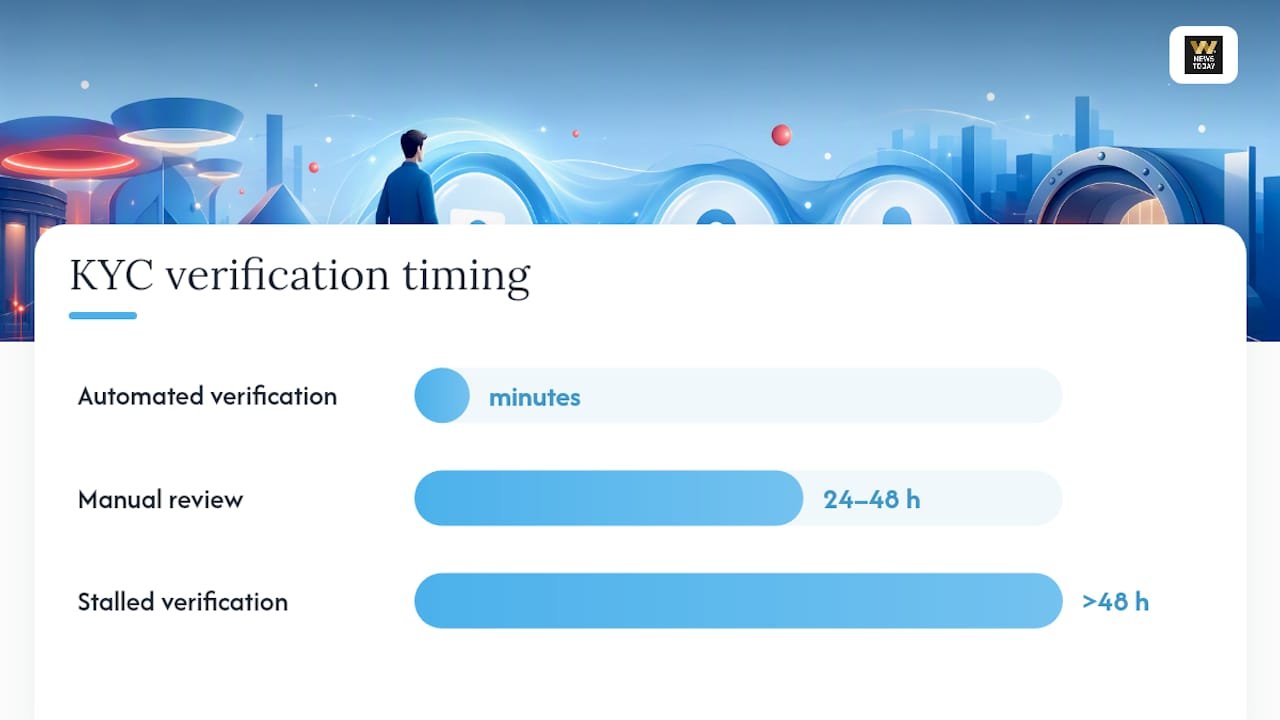
Timing depends entirely on which trigger you hit and how clean your documents are. Automated verification systems can clear a file in minutes when the images are sharp and the data matches across every document. Manual review, which kicks in when something looks inconsistent or when a large withdrawal demands a closer look, typically takes anywhere from a few hours up to 24 to 48 hours.
A few habits reliably speed things up:
- Submit legible, full-frame scans with no cropped edges or glare.
- Make sure your name and address match exactly across every document, down to spelling and abbreviations.
- Confirm the payment method you’re verifying is actually registered in your name before you upload it.
- Respond to follow-up requests the same day rather than letting the ticket sit.
Pro Tip: If a withdrawal request is what triggers your KYC check, have your proof of payment ready before you hit submit. Matching the payout method to a verified document in advance is the single biggest reason payouts stall for days instead of clearing in hours.
If your verification stalls past 48 hours with no update, check your account inbox and spam folder for a request you might have missed, then contact the casino’s support desk directly rather than waiting indefinitely. Most licensed operators list a dedicated compliance or verification contact separate from general support, and using it gets a faster answer.
What Technology Powers Casino Identity Verification?
Casino identity verification today runs on a stack of automated tools that work faster than any human reviewer, though people still handle the edge cases machines can’t confidently resolve.
- Document OCR and forgery detection: software reads the text on your ID and cross-checks security features like fonts, holograms, and layout templates against known formats to catch tampered or fake documents.
- Facial matching and biometric verification: your selfie gets compared against your ID photo to confirm the person opening the account matches the document.
- Liveness detection: the system checks for movement, texture, and depth cues to confirm you’re a real person on camera, not a printed photo or a video replay.
- Sanctions and PEP screening: your name gets checked against global sanctions lists and politically exposed person databases before your account is cleared.
- Continuous transaction monitoring: even after approval, unusual deposit or withdrawal patterns can re-flag your account for another look.
Onboarding flows that combine document checks with selfie-based biometrics and sanctions screening have become the industry standard rather than the exception. Automation handles the vast majority of straightforward cases in seconds, which is genuinely good news for players. But automation also has limits: unusual document formats, name changes, or joint accounts still need a human to make the final call. Document acceptance and available verification methods also vary by country, so what clears instantly in one market might need extra steps in another.
KYC vs AML: What Happens After Initial Verification?
KYC and AML get used interchangeably, but they answer different questions. KYC confirms who you are; AML governs the ongoing risk controls across your entire relationship with the operator, long after your first verification clears.
That distinction matters once you start playing seriously. A few triggers push you from basic KYC into enhanced due diligence (EDD):
- Large or unusual deposits that don’t match your typical betting pattern.
- Source-of-funds (SoF) or source-of-wealth (SoW) requests, where the operator asks you to prove where the money came from, usually through payslips, tax records, or bank statements.
- Behavioral anomalies, like rapid deposit-and-withdraw cycles that resemble laundering patterns rather than normal play.
Roughly one in a small percentage of flagged accounts escalates far enough that operators file a Suspicious Activity Report (SAR/STR) with national financial intelligence units. When that happens, expect account restrictions, a hold on withdrawals, or a request for extensive documentation while the report is processed.
Jurisdictions differ on when full CDD kicks in and what threshold triggers it, so the exact deposit amount that draws scrutiny in one market may not in another. What’s consistent across regulated markets is the shift toward “perpetual KYC,” meaning event-triggered reviews rather than fixed calendar refreshes. Instead of re-verifying every account every twelve months regardless of activity, operators now re-check accounts when behavior actually changes, which cuts down on redundant paperwork for players who aren’t doing anything unusual.
How KYC Data Supports Responsible Gambling Protections
The same data collected for identity verification doubles as an early-warning system for problem gambling, which is one of the more underappreciated uses of KYC.
Operators analyze deposit frequency, stake size, and account activity patterns using responsible gambling automation for operators to spot signs of vulnerability. Detecting unusual spending or escalating stakes through KYC data lets platforms intervene before a player spirals into serious losses, rather than after.
Common interventions include:
- Deposit limits that cap how much you can add to your account in a given period.
- Cooling-off periods, which temporarily lock your account for a set stretch of time.
- Self-exclusion programs, letting you shut yourself out entirely, sometimes across multiple operators at once.
- Referrals to support services when account activity suggests a genuine problem developing.
On the privacy side, licensed operators are expected to practice data minimization, meaning they only collect what’s needed for compliance and shouldn’t be holding onto documents indefinitely without purpose. If you’re unsure how your data is stored or shared, you’re entitled to ask the operator directly, and a legitimate site will have a clear answer ready.
Quick Checklist: How to Pass Casino KYC on the First Try
Most rejected KYC submissions fail for boring, fixable reasons, not because anything is actually wrong with the applicant.
- Confirm your ID hasn’t expired and your proof of address is dated within the last three months.
- Double check that your name appears identically across every document, including middle names and abbreviations.
- Photograph each document flat, in good light, with all four edges visible and no glare across the text.
- If you’re asked for source of funds, have payslips or bank statements ready before you’re prompted, not after.
Clear, high-resolution images with exact name matching resolve the overwhelming majority of rejections on resubmission. If your file gets bounced, don’t panic. Read the specific reason given, fix that one issue, and resend rather than uploading the same file again.
Pro Tip: Keep a folder of your ID, a recent utility bill, and a bank statement saved on your phone before you even sign up. Having them ready cuts your verification time down to whatever the automated check needs, instead of waiting on you to dig up paperwork.
Why KYC Verification Signals a Casino You Can Trust
A casino that takes KYC seriously is telling you something important before you’ve even deposited a dollar: it’s licensed, it’s accountable to a regulator, and it has something to lose if it cuts corners. That’s the mindset worth carrying into every new sign-up. Sites that skip verification or brag about “instant, no-KYC” withdrawals aren’t doing you a favor by removing friction. They’re removing the very safeguards that protect your money and your identity.
Proper verification is one of the clearest legitimacy signals a player can check before committing real funds. Our guide on how to verify a casino’s license status walks through exactly that, alongside our broader collection of certified casino reviews for players who want vetted options rather than guesswork. New game release coverage often highlights fresh slots and live tables, with a solid KYC process helping ensure winnings reach your account.
— jeff
Sources
For deeper reading on the mechanics covered here, Sumsub’s operator guide breaks down biometric onboarding in detail, while European Gaming’s compliance guide covers the regulatory distinctions between KYC and AML across jurisdictions.
This article is general information, not a substitute for advice from a qualified financial advisor. Consult a qualified financial professional about your own circumstances before acting on anything here.
- How long does KYC verification take? — Fourthline
- KYC in Gambling Explained: A Practical Operator Guide (2026) — Sumsub
FAQ
How Do I Verify My KYC for an Online Casino?
Upload a government-issued ID, a recent proof of address, and proof of payment through your account’s verification page. Automated checks confirm the details, and manual review steps in only if something needs a closer look.
How Do I Get KYC Verification Started at a Casino?
Verification usually starts automatically at registration or your first deposit and withdrawal request. You don’t need to request it separately; the platform will prompt you for documents at the relevant trigger point.
How Long Does It Take to Complete Casino KYC Verification?
Automated checks with clear documents can clear in minutes. Manual review, triggered by inconsistencies or large withdrawals, typically takes up to 24 to 48 hours.
How Do I Pass KYC Verification Without Delays?
Submit sharp, glare-free document photos, make sure your name and address match exactly across every file, and confirm your payment method is registered in your own name before uploading proof of it.