




The winning baccarat strategy is simple: bet Banker as your default, skip the Tie completely, and manage your bankroll tighter than you manage your bets. No progression system, no pattern, and no “hot streak” beats the math built into the game. The house edge is fixed, and every betting system just rearranges when you win and lose, not whether you come out ahead over time.
Here’s the three-step version you can use tonight:
- Default to Banker. It carries the lowest house edge of the three main bets in most games.
- Use flat bets or a mild positive progression. Save aggressive systems like Martingale for situations where you fully understand the risk.
- Set session limits before you sit down. A stop-loss and a stop-win number, decided in advance, matter more than any system you’ll read about below.
Pro Tip: Before you assume Banker is always the play, check the table’s payout rules. Some no-commission variants pay Banker wins on a 6 at only 50%, and that single rule change is enough to shift your best bet.
Key Takeaways
The Banker bet gives you the lowest house edge in baccarat, but only strict bankroll rules and skipping the Tie and most side bets protect that edge over time.
| Point | Details |
|---|---|
| Favor Banker by default | Banker runs about a 1.06% house edge versus roughly 1.24% for Player, per Sportsline. |
| Skip the Tie and most side bets | Tie and bets like Dragon 7 or Panda 8 carry far higher house edges despite tempting payouts. |
| Systems change variance, not odds | Flat betting, Martingale, Paroli, Fibonacci, Labouchere, and 1-3-2-4 all leave the house edge untouched. |
| Set stop-loss and stop-win before playing | Use 1% to 2% of bankroll per unit and decide your limits before the first hand. |
| Check variant rules first | No-commission tables often pay Banker 6 at half rate, which can flip your best bet. |
| Use W88News.Today for updated guides | W88News.Today tracks new baccarat releases, variant rule changes, and responsible-gambling tools. |
Table of Contents
- What Are the Core Baccarat Rules You Need to Know?
- Which Betting Systems Actually Hold Up at the Table?
- How Should You Manage Your Bankroll and Sessions?
- Which Baccarat Variants and Side Bets Should You Watch For?
- What Do the Actual Odds Tell You About Winning?
- What Mistakes Should You Avoid at the Table?
- How Was This Baccarat Strategy Guide Put Together?
- Which System Actually Fits Your Style?
- Where W88News.Today Fits Into Your Baccarat Game Plan
- Sources
- FAQ
What Are the Core Baccarat Rules You Need to Know?
Baccarat runs on a shoe of three, six, or eight standard 52-card decks, and the whole game boils down to one question: will the Banker hand or the Player hand land closer to nine? Cards from 2 through 9 count at face value, tens and face cards count as zero, and aces count as one. When a hand’s total goes into double digits, only the last digit counts, according to Britannica’s breakdown of the game.
Here’s a quick example: if your hand shows a 7 and an 8, that’s 15, but only the “5” matters. If a third card is drawn and it’s a 9, your total becomes 24, which counts as 4.
Both Banker and Player start with two cards. A total of 8 or 9 on either side is a “natural,” and no more cards get drawn. Below that, fixed drawing rules (not player choice) decide whether a third card comes out, which is part of why baccarat plays fast and needs no real skill at the table.
The three main wagers work like this:
- Banker bet: Wins most often, but usually carries a 5% commission on winnings at standard tables.
- Player bet: No commission, but wins slightly less often than Banker.
- Tie bet: Pays big (typically 8:1 or 9:1) but happens rarely enough that it’s a bad long-term bet.
Quick math check: that 5% commission on Banker wins exists because Banker wins more often than Player. Casinos built the commission into the game specifically to keep both bets close to fair, and the numbers below show just how close they got it.
Which Betting Systems Actually Hold Up at the Table?
Every baccarat betting system falls into one of two camps: systems that change your bet size based on wins and losses (progressions), and flat betting, where your wager never moves. None of them change the underlying odds. What they change is your variance, meaning how wild your swings look on the way to that same long-term expectation. Progression systems change the shape of your session, not the math and behind it, according to Chips & Truths’ banker-strategy analysis.
Here’s how the major systems actually play out with real numbers.
1. Flat betting
You bet the same amount every hand. Say your bankroll is $500 and you bet $10 per hand on Banker. Win or lose, the next bet stays $10. This is the safest structural choice because your bankroll drains at a predictable, slow rate tied directly to the house edge rather than to a losing streak that snowballs.
- Pros: Simple, low-risk of rapid ruin, easy to track.
- Cons: Slower recovery from a losing stretch, less exciting for players chasing bigger swings.
2. Martingale (negative progression)
You double your bet after every loss and return to your starting bet after a win. Start at $10: lose, bet $20; lose again, bet $40; lose again, bet $80. Four losses in a row puts you at a $160 bet, having already lost $150 across the first four hands. Win that fifth hand, and you’re back to profit of $10 over the whole sequence, but you needed $310 in your pocket to survive four straight losses on a game where losing streaks of five or six hands aren’t rare.
- Pros: Recovers losses quickly when a losing streak ends fast.
- Cons: Table maximums cap how far you can double, a single long losing streak wipes out a bankroll fast, and the “guaranteed win” only exists if your bankroll and the table limit are both infinite. Neither is.
3. Paroli (positive progression)
The mirror image of Martingale: double your bet after a win, reset after a loss. Start at $10, win, bet $20, win again, bet $40. Most players cap this at three wins in a row and then reset to $10 regardless of outcome. This caps your downside at your base unit per losing hand while letting a hot streak compound.
- Pros: Limits losses during cold streaks, lets you ride a winning run without deepening your risk.
- Cons: Doesn’t fix negative expectation, and resetting too early or late is a judgment call with no right answer.
4. Fibonacci
You follow the Fibonacci sequence (1, 1, 2, 3, 5, 8, 13, 21…) as your bet multiplier, moving one step forward on a loss and back two steps on a win. With a $10 base unit: lose ($10), lose ($10), lose ($20), lose ($30), you’re now four losses deep at a $50 next bet, having lost $70 total. It escalates more gently than Martingale but still climbs fast during extended losing runs, and recovering fully after a deep slide takes several consecutive wins, not just one.
- Pros: Gentler escalation than Martingale.
- Cons: Still vulnerable to long losing streaks; math gets confusing to track live.
5. Labouchere (cancellation system)
You write out a target sequence of numbers, say 1, 2, 3, 4, and bet the sum of the first and last numbers (5). Win, and you cross off both numbers, betting the new first-and-last pair. Lose, and you add that lost amount to the end of the sequence instead. It’s designed so a full completed cycle nets your original target profit, but a bad stretch can extend the line indefinitely, and each added number raises your next required bet.
- Pros: Flexible, lets you define your win target upfront.
- Cons: Complex to track, and losing streaks inflate bet sizes just like Martingale.
6. 1-3-2-4 system
You bet 1 unit, then 3 units after a win, then 2 units, then 4 units, resetting to 1 after completing the sequence or after any loss. On $10 units: bet $10, win, bet $30, win, bet $20, win, bet $40, win. Complete that four-hand run and you’ve turned $100 in total action into $200 back, a $100 net gain from one clean run. Lose anywhere in the sequence and you restart at $10, capping your loss at whatever step you were on.
- Pros: Locks in profit incrementally during a winning run, limits damage from a single loss.
- Cons: Requires four straight wins to complete fully, which happens less often than players expect.
None of these systems, according to the same banker-strategy analysis, change your expected value. They only change how your money moves on the way there. Pick based on how much variance you can stomach, not on which one sounds like it wins more.
How Should You Manage Your Bankroll and Sessions?
Bankroll management is the one lever you fully control, and it matters more than which system you pick. A common rule is to size each betting unit at 1% to 2% of your total bankroll. On a $200 bankroll, that’s $2 to $4 per unit. On $1,000, that’s $10 to $20. On $5,000, $50 to $100. Smaller units mean you can absorb longer losing streaks without hitting zero.

Set two numbers before you sit down: a stop-loss (the amount you’ll lose before you walk away) and a stop-win (the profit target that ends your session). A reasonable stop-loss is 20% to 30% of your session bankroll; a matching stop-win might be 20% to 50% above your starting stake. Write both down. The number on a losing streak is not the moment to renegotiate with yourself.
Table limits matter more than most players realize. If a table has a $500 maximum and you’re running Martingale from a $10 base, you hit that ceiling after just six consecutive losses, at which point the system simply stops working. Always check the table’s minimum and maximum before choosing a progression, not after.
Session setup checklist:
- Set your total session bankroll and unit size (1% to 2% of bankroll per unit).
- Decide your stop-loss and stop-win before the first hand.
- Confirm the table’s minimum and maximum against your planned system.
- Set a time limit, not just a money limit, since fatigue affects decisions too.
Pro Tip: Use a casino’s built-in deposit limits or cashback programs to enforce discipline automatically. A tool that stops you at your limit is more reliable than willpower after a rough hour.
Which Baccarat Variants and Side Bets Should You Watch For?
Not every baccarat table plays by the same payout rules, and that difference can flip your entire strategy. EZ Baccarat and other no-commission variants remove the standard 5% Banker commission, but they usually recoup that money by paying Banker wins on a total of 6 at only half the normal rate. That single rule, documented on Wikipedia’s baccarat overview, can push the effective house edge back close to where a commission table would land you.
Side bets are where the real damage happens. They’re designed to look exciting, and their high payouts make them tempting, but the odds behind them are usually far worse than the main game.
| Bet type | Typical payout | Why it’s risky |
|---|---|---|
| Tie | 8:1 or 9:1 | Rare outcome; high house edge despite the big payout |
| Dragon 7 | Around 40:1 | Requires a specific Banker win by exactly 7 points |
| Panda 8 | Around 25:1 | Requires a specific Player win by exactly 8 points |
| Pair bets | Around 11:1 | Requires the first two cards dealt to form a pair |
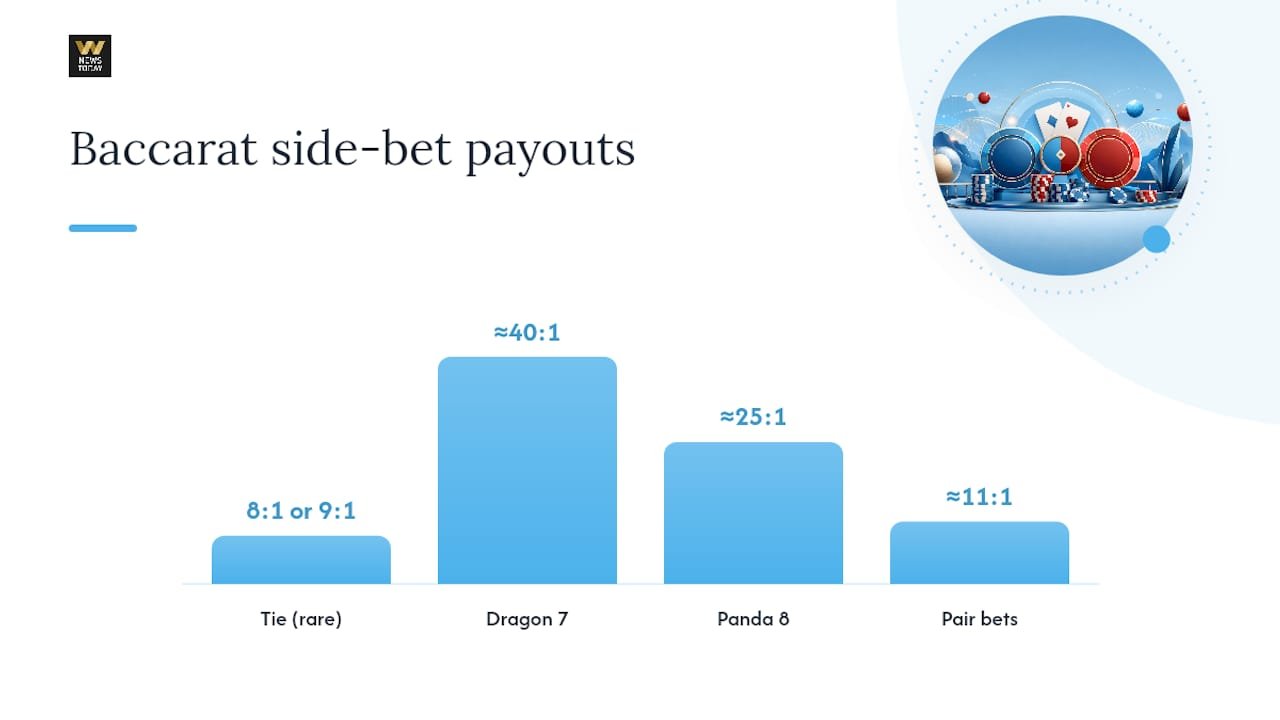
The rule to remember: always check the Banker payout table and any side-bet paytable posted at the game before you sit down. A five-second glance can tell you whether the table’s version of “Banker” is the same bet you think you’re making.
What Do the Actual Odds Tell You About Winning?
Baccarat’s house edge is small compared to most casino games, which is exactly why it attracts serious players. The Banker bet runs a house edge of roughly 1.06% after the standard 5% commission, the Player bet sits around 1.24%, and the Tie bet is dramatically worse, according to Sportsline’s baccarat strategy breakdown. That gap between Banker and Player, just under two tenths of a percentage point, is small in any single hand but compounds over hundreds of hands into a real difference.
Expected loss = total amount wagered × house edge.
Say you bet $20 per hand on Banker for 100 hands, wagering $2,000 total. Bet the same $2,000 total on Player instead, and expected loss rises to roughly $24.80. Bet it all on Tie, and the number climbs sharply higher because the tie house edge runs well into double digits.
Every hand in baccarat is an independent event. The cards dealt on hand 40 have no memory of what happened on hand 39, and streaks of Banker or Player wins carry zero predictive value for what comes next. This isn’t a matter of opinion. It’s the same statistical principle behind research on gambler’s fallacy and independence of events, which shows that betting patterns based on “due” outcomes don’t hold up against how randomness actually behaves. Scoreboards showing recent results at live tables are entertainment, not information.
What Mistakes Should You Avoid at the Table?
The single most common mistake is chasing a losing streak by increasing bets beyond your planned progression, hoping the next hand “has to” turn things around. It doesn’t have to do anything. The cards don’t know your bankroll.
Other frequent errors:
- Ignoring commission or no-commission rules before choosing which bet to favor.
- Running Martingale or Fibonacci without a hard stop-loss, letting one bad streak erase a night’s winnings.
- Treating side bets as fun “extras” without checking their real house edge first.
- Playing past your planned time limit because you’re “close to even.”
If a table’s payout rules seem unclear, ask the dealer or check the posted paytable before betting; sticking to certified, transparent casino operators makes this easier. Use deposit limits, session timers, or self-exclusion tools if you notice yourself struggling to stop. Baccarat, like every casino game, is entertainment with a built-in cost, not a source of income.
How Was This Baccarat Strategy Guide Put Together?
This guide draws on published casino rules pages, probability analyses of Banker, Player, and Tie odds, and peer-reviewed research on gambling behavior and streak fallacies.
- Rule mechanics: verified against established casino rules references.
- House-edge figures: sourced from published baccarat probability breakdowns.
- Streak and pattern claims: checked against research on the independence of random events.
This piece was written for W88News.Today’s card-games coverage, alongside resources like our blackjack strategy charts. We also track new baccarat releases and variant rule changes, including recent launches like Gameplay Interactive’s Baccarat Squeeze, so this guide gets updated as the game itself evolves.
Which System Actually Fits Your Style?
If you want to survive long sessions without drama, flat betting is your best friend. It’s boring, and boring is the point. A small positive progression like Paroli suits players who want to ride winning runs without turning every loss into a bigger loss. Martingale, in my view, is a system for players who fully accept they might lose their entire stop-loss in one unlucky streak. That’s not a criticism, some players want that risk profile, but go in knowing it, not hoping otherwise.
Switch your approach when the table rules change (no-commission Banker 6 half-pay, for instance) or when your bankroll takes a hit that would put your next bet outside your comfort zone. The hardest skill in baccarat isn’t picking a system. It’s sticking to your own stop-loss when you’re down and every instinct says one more hand will fix it.
Where W88News.Today Fits Into Your Baccarat Game Plan
Picking the right table matters as much as picking the right bet, and that’s where W88News.Today earns its keep. Beyond this strategy breakdown, our library covers rule variations across live-dealer rooms, side-bet paytables worth avoiding, and the newest baccarat releases hitting online casinos, so you’re never guessing what a “no-commission” label actually means at a specific table.

If you play at crypto-friendly tables, operators like Cardano Casino’s table games section and Solana Casino’s house games lineup list baccarat variants worth checking against the payout rules covered above before you sit down. And if bankroll discipline is your weak spot, our responsible gambling resource hub walks through deposit limits, session timers, and self-exclusion tools that do the disciplined work for you. Head to W88news for the latest game guides, bonus breakdowns, and new baccarat variant coverage before your next session.
Sources
These sources back the numbers and rules used throughout this guide:
Table-specific rules vary by casino and by variant, so confirm the exact paytable and commission structure at your chosen table before applying any strategy above.
This article is general information, not a substitute for advice from a qualified financial advisor. Consult a qualified financial professional about your own circumstances before acting on anything here.
FAQ
Is Banker Always the Best Bet in Baccarat?
Does the Martingale System Work in Baccarat?
Martingale can recover losses when a losing streak ends quickly, but table maximums and bankroll limits mean a long losing streak can wipe you out before it works.
Why Should I Avoid the Tie Bet?
The Tie bet pays big odds, often 8:1 or 9:1, but it wins rarely enough that its house edge runs far higher than either Banker or Player.
Can Pattern Spotting or Streaks Predict Baccarat Outcomes?
No. Each hand in baccarat is an independent event, and research on gambler’s fallacy confirms that past outcomes carry no predictive value for future hands.
How Much Should My Baccarat Betting Unit Be?
Where Can I Find Updated Baccarat Variant and Game News?
W88News.Today tracks new baccarat releases and variant rule changes, including titles like Gameplay Interactive’s Baccarat Squeeze, alongside its ongoing strategy and rules coverage.