



An over/under bet, also called a totals bet, is a wager on whether the combined score of both teams in a game will finish higher or lower than the number posted by the sportsbook. You don’t pick a winner. You pick a direction.
- Push rule: If the final combined score lands exactly on the posted total, your stake is refunded in full. Half-point totals (like 46.5) eliminate this possibility entirely.
- Standard odds: Most totals are priced at -110 on both sides, meaning you risk $110 to win $100. That built-in margin is the sportsbook’s vig.
- First move: Shop lines across at least two sportsbooks before placing any totals bet. A half-point or a few cents in odds can shift your payout meaningfully over time.
Key Takeaways
Over/under betting rewards bettors who understand the vig, shop lines, and check pace, injuries, and weather before every wager.
| Point | Details |
|---|---|
| Standard vig is -110 | You must win more than 52.4% of -110 bets to break even, so every edge matters. |
| Half-points prevent pushes | A .5 total eliminates the refund scenario; whole-number totals carry push risk. |
| Shop lines before every bet | A half-point or a few cents in juice compounds into real money across a full season. |
| CLV beats short-term results | Consistently beating the closing line is a stronger signal of edge than recent wins. |
| Keep bets recreational | Limit totals wagers to 1–3% of bankroll and treat betting as entertainment, not income. |
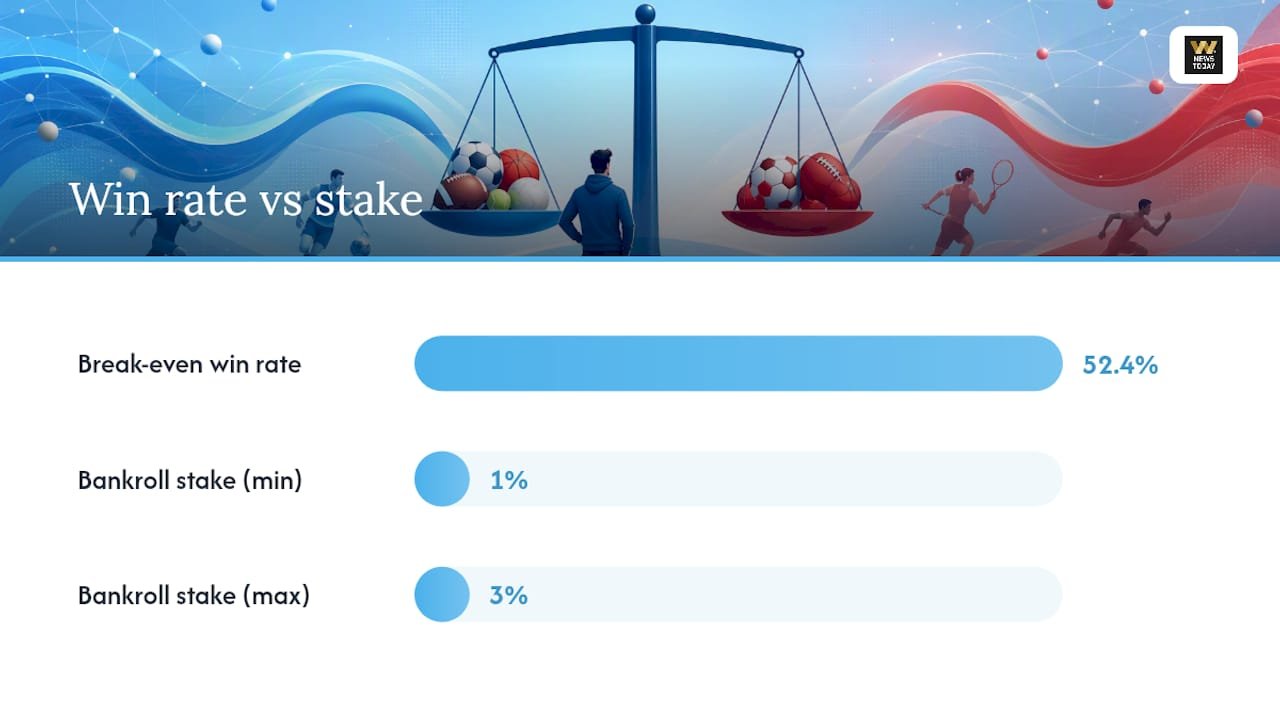
Table of Contents
- How does over/under betting actually work?
- Worked payout examples you can actually use
- How do sportsbooks set and move totals?
- What types of totals markets can you bet?
- How to place an over/under bet on a US sportsbook
- Practical strategies for betting totals
- Common mistakes bettors make on totals
- Research checklist before placing a totals bet
- An honest perspective on totals betting
- Sources
- FAQ
How does over/under betting actually work?
The sportsbook posts a single number, the total, and you decide whether the combined final score will go Over or Under that number. FOX Sports explains that oddsmakers project this number using offensive and defensive strength, pace of play, and recent form, then adjust it to balance incoming money rather than to nail a perfect prediction.
Reading the notation
A typical NFL totals line looks like this on a sportsbook slip:
- Total: 46.5 | Over -110 | Under -110
That 46.5 means the two teams are projected to combine for roughly 46 or 47 points. Bet the Over and you need 47 or more. Bet the Under and you need 46 or fewer.
A soccer total looks different: Total Goals: 2.5 | Over -115 | Under -105. Here, 2.5 goals is the line. Three or more goals cashes the Over; two or fewer cashes the Under.
Why half-points matter
Sportsbooks use half-point totals (.5) to prevent pushes. A whole-number total of 46 creates a push scenario if the game ends 46 combined points, and the house refunds every bet. Half-points remove that outcome entirely. When you see a whole-number total, check the house rules, because a push is live and your stake comes back rather than winning or losing.
Key grading rules to know:
- Overtime typically counts toward the final total unless the sportsbook’s rules state otherwise.
- A push refunds your original stake with no profit and no loss.
- Some markets use quarter-point increments (common in Asian handicap betting), which split your stake between two adjacent lines to reduce push risk further.
Worked payout examples you can actually use
Two scenarios cover the math you’ll encounter most often.
Example 1: Standard -110 totals bet
You bet $110 on the Over 46.5 at -110 odds. The game finishes 49-31, combined 80 points. Your bet wins.
Payout formula for negative American odds: (Stake ÷ Odds) × 100 + Stake
(110 ÷ 110) × 100 + 110 = $210 returned ($100 profit)
Example 2: Plus-money totals bet
Some alternate totals or live markets carry plus-money odds. You bet $100 on the Over at +150.
Payout formula for positive American odds: (Stake × Odds) ÷ 100 + Stake
(100 × 150) ÷ 100 + 100 = $250 returned ($150 profit)
Odds conversion quick reference
Converting between formats helps you compare lines across sportsbooks instantly.
Implied probability from American odds:
- Negative: Odds ÷ (Odds + 100) × 100
- Positive: 100 ÷ (Odds + 100) × 100
CBS Sports notes that standard totals lines use -110 pricing on both sides, which builds a combined implied probability above 100%. That gap is the vig, the sportsbook’s built-in edge on every market.
How do sportsbooks set and move totals?
Oddsmakers don’t guess. They build totals from a stack of inputs, then watch the money and adjust.
Primary inputs oddsmakers use:
- Offensive and defensive efficiency: Points per possession, yards per play, goals per 90 minutes.
- Pace of play: A fast-paced NBA game produces more possessions and more scoring chances than a slow, grind-it-out matchup.
- Injuries: A starting quarterback or top scorer sitting out can shift a total noticeably.
- Weather: Wind above 15 mph and cold temperatures consistently suppress NFL scoring. Rain affects soccer and baseball totals too.
- Venue: Indoor arenas remove weather as a variable; altitude affects pace in soccer.
- Head-to-head history: Some matchups consistently trend high or low regardless of current form.
The sportsbook’s real objective, as Investopedia describes, is to balance liability on both sides of the total, not to predict the exact score. That distinction creates opportunity. When public money floods one side, the line moves to attract action on the other, and that movement carries information you can use.
Line movement drivers:
Sharp bettors (professionals) moving large amounts early can push a total up or down before the public even notices. Public bettors flooding in late often inflate the Over. News, like a late injury report, can trigger a sudden move of 1–2 points in minutes.
Pro Tip: Watch the opening line versus the current line. If a total opened at 47.5 and sits at 45.5 by kickoff, sharp money likely hit the Under hard. That’s a signal worth respecting, even if you don’t fully understand the reason yet.
What types of totals markets can you bet?
The standard game total is just the starting point. US sportsbooks offer several variants, each with a different use case.
- Game total (standard): The combined score for both teams across the full game. This is the most liquid market and usually has the tightest lines.
- Team total: A total set for just one team’s scoring output. Useful when you have a strong read on one offense or defense but not the other side of the matchup.
- Player prop totals: A line set on an individual stat, like passing yards, points scored, or strikeouts. These markets are less efficient and can offer more value, but they also carry more variance.
- Alternate totals: The sportsbook offers you a higher or lower total than the standard line, but adjusts the odds accordingly. Drop the total from 46.5 to 42.5 and you’ll pay something like -175 instead of -110. Raise it to 50.5 and you might get +145. You’re buying or selling certainty.
- Live/in-play totals: The total adjusts in real time as the game progresses. A scoreless first quarter in an NFL game might push the live total down; a fast start pushes it up. These markets reward bettors who track momentum and pace in real time.
Sport-specific shapes matter here. CBS Sports confirms that NFL totals typically land in the 40s–50s, NBA totals run in the 200s–220s, and soccer totals most often sit at 2.5 or 3.5 goals. Knowing the typical range for your sport helps you spot an outlier line quickly.
How to place an over/under bet on a US sportsbook
Follow these steps on any legal US sportsbook and you won’t miss a critical detail.
- Choose a licensed sportsbook in your state. Legal US sportsbooks are regulated at the state level, so confirm the operator holds a valid license where you’re located. Check sportsbook reviews to compare options before committing.
- Find the game and the totals market. Look for “Total,” “O/U,” or “Game Total” on the bet menu. It usually sits alongside the spread and moneyline for the same game.
- Read the total and the odds. Confirm the number (46.5, not 46) and the price (-110, -115, etc.) before tapping.
- Check house rules. Does overtime count? Is this regular-season or playoff grading? A quick look at the sportsbook’s rules page takes 60 seconds and prevents disputes.
- Enter your stake. The slip calculates your payout automatically. Confirm the return matches your math before submitting.
- Submit and save your confirmation. Screenshot or note the bet ID for reference.
Pro Tip: Open accounts at two or three sportsbooks and compare the total and odds before placing. A half-point difference (46 vs. 46.5) or a price difference (-110 vs. -105) compounds into real money across a full season. Pair this with sports betting bonuses to stretch your bankroll further.
Practical strategies for betting totals
Smart totals betting comes down to checking the right signals before you commit a dollar.
Pre-wager checklist:
- Team pace and tempo: Faster-paced teams produce more possessions and more scoring opportunities. Check pace rankings before any NBA or college basketball total.
- Offensive and defensive efficiency ratings: A top-10 offense against a bottom-10 defense is a different game than two average units meeting.
- Recent scoring trends: Relevant over a meaningful sample (10+ games), not just the last two. Recency bias is a real trap.
- Injury report: A missing starter, especially a quarterback, point guard, or top striker, can swing a total by several points.
- Weather: For outdoor sports, check wind speed, temperature, and precipitation forecasts on game day.
- Public betting percentages: If 75%+ of bets are on the Over, the line may already be inflated. That’s where contrarian value often hides.
Bankroll management for totals:
Totals parlays are tempting but multiply the vig with every leg you add, making them a fast way to drain a bankroll. Treat each totals bet as a standalone decision.
Investopedia highlights that public bettors lean toward the Over, which can inflate totals beyond their true value. Tracking public-betting percentages alongside pace and defensive metrics often reveals contrarian Under value that casual bettors miss entirely.

Pro Tip: Track your closing-line value (CLV) over time. If you consistently beat the closing line, meaning you got a better number or price than where the market settled, you’re making good decisions even during losing stretches. CLV is a stronger signal of long-term edge than any short-term win rate.
Common mistakes bettors make on totals
Avoid these and you’re already ahead of most casual bettors.
- Ignoring half-points. Betting a 46 total without checking push rules is a basic error. Always confirm whether the total is a whole number and what the house does with a push.
- Skipping line shopping. Taking the first line you see leaves money on the table. A half-point or a few cents in juice matters across dozens of bets.
- Not checking overtime rules. Some sportsbooks exclude overtime from totals grading; others include it. FOX Sports notes that overtime typically counts, but house rules vary by operator. Check before you bet.
- Overweighting small samples. A team that went Over in three straight games is not a trend. Ten games is a starting point; 20 is better.
- Misusing parlays. Stacking totals into a parlay multiplies the vig on every leg. The payout looks exciting; the math is not your friend.
- Over-betting the Over. Public optimism about scoring is real. Bettors consistently overestimate how much teams will score, which is why sharp money frequently lands on Unders.
The cognitive bias driving most of these mistakes is optimism. High-scoring games are more exciting to watch, so bettors project excitement onto their picks. Recognizing that bias is the first corrective step.
Research checklist before placing a totals bet
Run through this before every wager. Confidence levels reflect how heavily to weight each signal.
- Initial posted line vs. current line — Did the total move? How far and in which direction? Confidence: Strong. Sharp movement of 1.5+ points is meaningful information.
- Injury report confirmation — Are key offensive or defensive starters confirmed in or out? Confidence: Strong. A missing starter changes the math significantly.
- Pace metrics — Check pace-of-play rankings for both teams. Confidence: Moderate. Pace predicts possessions, not outcomes, so combine with efficiency data.
- Recent matchup scoring — How have these two teams scored against each other historically, and against similar opponents this season? Confidence: Moderate. Small samples reduce reliability.
- Weather and venue — Outdoor game? Check wind and temperature. Indoor? Weather is irrelevant. Confidence: Strong for outdoor sports, irrelevant for indoor.
- Public betting percentages — Where is the majority of bets and money going? Confidence: Weak on its own, stronger when combined with line movement in the opposite direction.
- Early sharp activity — Did the line move opposite to public money? That’s a sign sharp bettors hit the other side. Confidence: Moderate to Strong.
The vig reality: Standard -110 pricing on both sides of a totals market means the sportsbook holds a built-in edge of roughly 4.5% on every bet. You need to win more than 52.4% of -110 bets just to break even. That’s why disciplined research and line-shopping aren’t optional extras; they’re the baseline for any serious totals bettor.
For additional smart wagering tips that complement this checklist, W88news covers the full range of sports betting strategies in plain language.
An honest perspective on totals betting
Totals betting rewards patience more than excitement. The bettors who do well over time aren’t the ones chasing big Over payouts in shootout games. They’re the ones who spotted a defensive matchup the public ignored, got a better number by shopping lines, and tracked their CLV to confirm they’re making sound decisions even when results run cold.
My approach is straightforward: I check the opening line, note where it moves, and only bet when I have at least two independent signals pointing the same direction, pace data, an injury, or a weather factor, alongside a line that hasn’t already moved to reflect that information. If the public has already pushed the total to where I’d want it, the value is gone.
Totals betting is genuinely fun when you treat it as a skill game with a real edge to find. But it carries real financial risk. If betting stops feeling recreational or starts affecting your finances, reach out to Mdgamblinghelp for free, confidential support. W88news also maintains a responsible gambling page with US-focused resources and guidance on setting limits.
Sources
- What Is the Over Under in Sports Betting? Totals Explained | FOX Sports
- What Is an Over-Under Bet? Types, Examples, and Strategies
- Over/Under betting: What is it, how it works and best strategies for betting totals
- Mdgamblinghelp
This article is general information, not a substitute for advice from a qualified financial advisor. Consult a qualified financial professional about your own circumstances before acting on anything here.
FAQ
What does +/- mean in over/under betting?
The +/- sign indicates American odds. A -110 total means you risk $110 to profit $100; a +150 total means a $100 bet returns $150 profit. Negative odds show the favorite side; positive odds show the underdog side.
Is it better to bet the over or the under?
Neither side has a built-in advantage, but public bettors consistently favor the Over, which can inflate totals and create contrarian value on Unders. The better side is whichever one your research supports after checking pace, injuries, and line movement.
What is over/under 1.5 in betting?
A total of 1.5 means you need two or more combined goals (or points) to cash the Over, and one or zero to cash the Under. Soccer markets frequently use 1.5 and 2.5 because low-scoring games make whole-number pushes common.
What does +150 mean in a totals bet?
A +150 price means a $100 stake returns $250 total ($150 profit) if your bet wins. Plus-money totals often appear on alternate lines or live markets where one side carries more risk.