



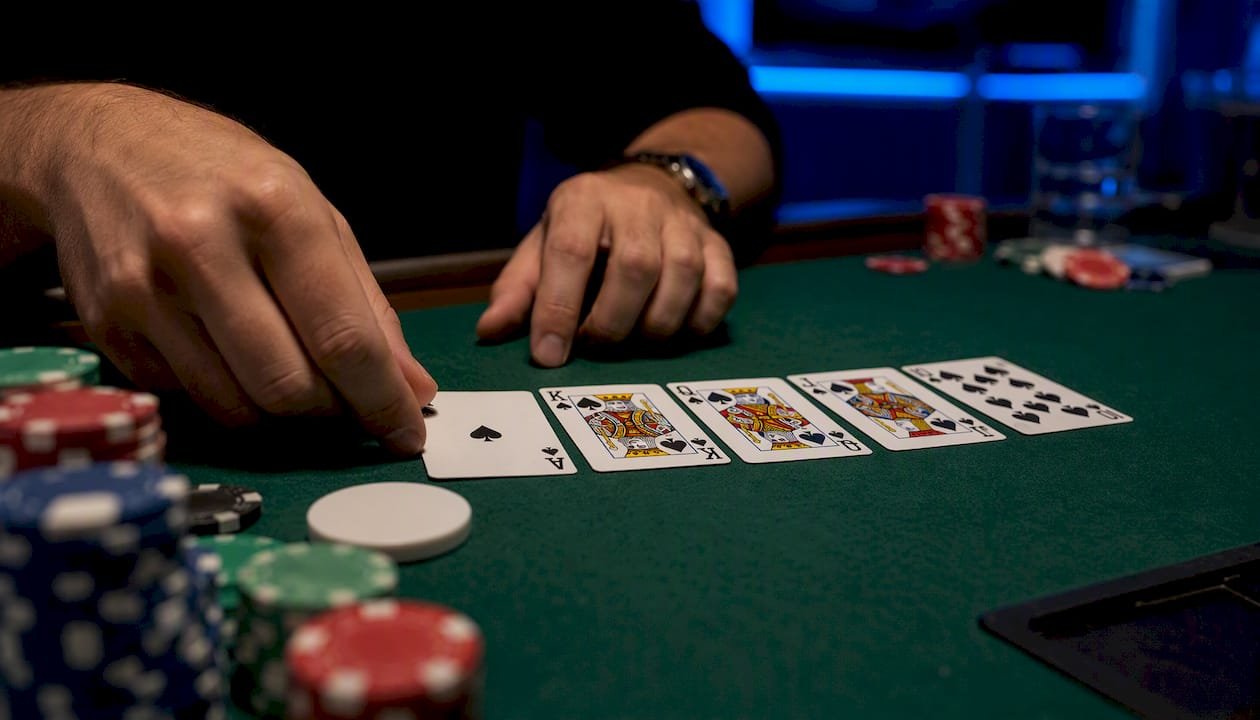
The 10 poker hand rankings from strongest to weakest are: Royal Flush, Straight Flush, Four of a Kind, Full House, Flush, Straight, Three of a Kind, Two Pair, One Pair, High Card. That order never changes in standard high-hand games. The reason it exists is pure math: rarer hands beat common ones, and ranking follows mathematical rarity in a standard 52-card deck.
Here’s the full poker hands order at a glance:
- 🥇 Royal Flush
- 🥈 Straight Flush
- 🥉 Four of a Kind
- 🥉 Four of a Kind
- Full House
- Flush
- Straight
- Three of a Kind
- Two Pair
- One Pair
- High Card
Print this list, save it to your phone, or keep it open during your first few sessions. Everything below explains exactly what each hand means and how to win with it.
Key Takeaways
The 10 poker hand rankings run from Royal Flush (rarest) to High Card (most common), and every showdown is decided by hand category first, then primary rank, then kickers.
| Point | Details |
|---|---|
| The full ranked ladder | Royal Flush, Straight Flush, Four of a Kind, Full House, Flush, Straight, Three of a Kind, Two Pair, One Pair, High Card. |
| Tie-breaker priority | Compare hand category first, then primary rank or top card, then kickers one by one. |
| Ace rules in Straights | Ace plays high (A-K-Q-J-10) or low (A-2-3-4-5) but cannot wrap around mid-sequence. |
| Memorization shortcut | Master the top six hands first; the bottom four follow naturally with minimal study. |
| Get the printable chart | Use the cheat-sheet table in this guide for home games and study sessions. |
Table of Contents
- Your poker hand rankings cheat sheet (printable)
- Detailed breakdown of every hand, from Royal Flush to High Card
- How the rankings function in practical play
- How common is each hand? Probability table
- Fast ways to memorize the hand rankings
- Common misconceptions about poker hand rankings to avoid
- A note on learning the ladder and playing smart
- Sources
- FAQ
Your poker hand rankings cheat sheet (printable)
This reference table covers every hand you’ll encounter at the table. Save it as a phone wallpaper, print it on A4, or pin it next to your monitor during home games.
| Rank | Hand | What you need | Example |
|---|---|---|---|
| 1 | Royal Flush | A-K-Q-J-10, same suit | A♠ K♠ Q♠ J♠ 10♠ |
| 2 | Straight Flush | Five consecutive cards, same suit | 7♥ 8♥ 9♥ 10♥ J♥ |
| 3 | Four of a Kind | Four cards of the same rank | K♣ K♦ K♥ K♠ 3♦ |
| 4 | Full House | Three of a kind + a pair | Q♠ Q♥ Q♦ 9♣ 9♠ |
| 5 | Flush | Any five cards, same suit | A♦ J♦ 8♦ 5♦ 2♦ |
| 6 | Straight | Five consecutive cards, mixed suits | 5♠ 6♦ 7♥ 8♣ 9♠ |
| 7 | Three of a Kind | Three cards of the same rank | J♣ J♦ J♥ 7♠ 2♦ |
| 8 | Two Pair | Two different pairs | A♠ A♦ 8♣ 8♥ K♠ |
| 9 | One Pair | Two cards of the same rank | 10♠ 10♦ A♣ 7♥ 3♠ |
| 10 | High Card | No combination; best single card wins | A♠ J♦ 9♣ 6♥ 2♠ |
Pro Tip: Print this chart at wallet size and tuck it in your card case. After five or six sessions, you won’t need it anymore.
The chart works for Texas Hold’em, Omaha, and most standard poker variants. Keep it handy during study sessions, and use it as a quick lookup during home games until the ladder is locked in memory.
Detailed breakdown of every hand, from Royal Flush to High Card
1. Royal Flush
The best hand in poker, full stop. You need A♠ K♠ Q♠ J♠ 10♠, all five cards in the same suit. There are exactly four possible Royal Flushes in a 52-card deck, one per suit. Two players cannot tie with a Royal Flush in a single deck game, so no tie-breaker applies.
2. Straight Flush
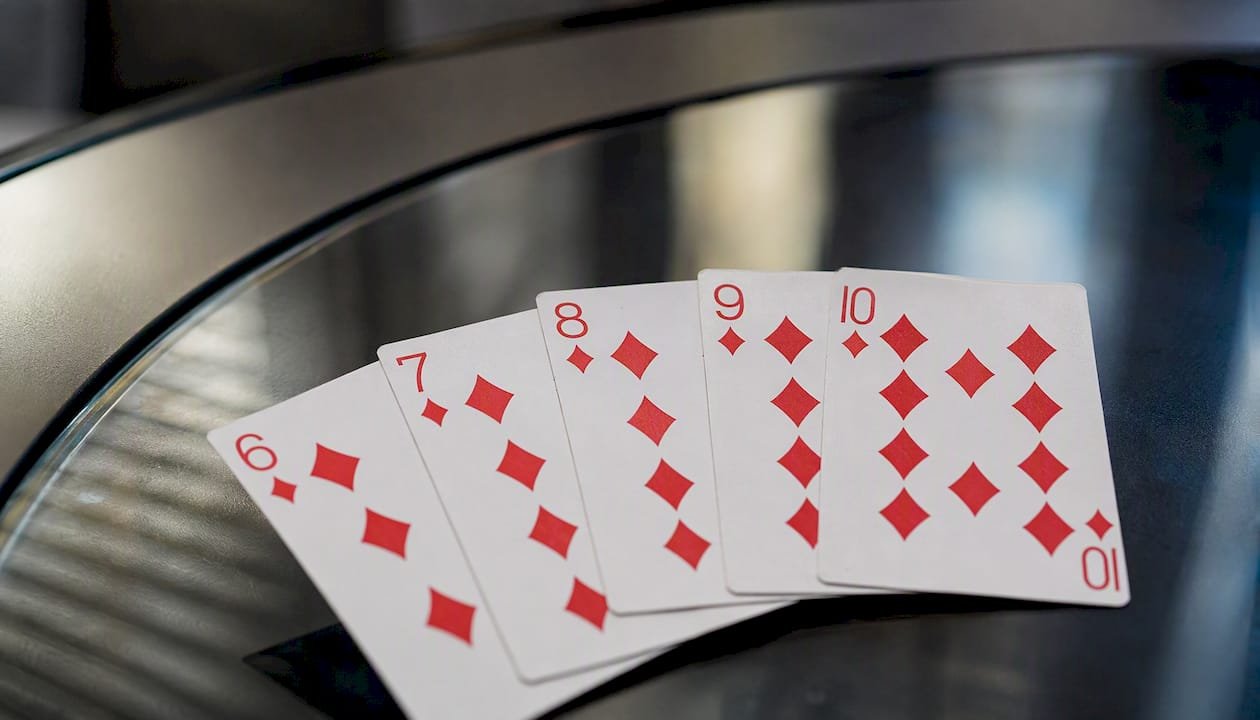
Five consecutive cards in the same suit. Example: 7♥ 8♥ 9♥ 10♥ J♥. Ties go to the player with the highest top card. The Royal Flush is technically the highest Straight Flush, but it earns its own rank because of its status.
3. Four of a Kind
Four cards sharing the same rank, plus any fifth card (the kicker). Example: K♣ K♦ K♥ K♠ 3♦. If two players somehow hold Four of a Kind (possible in community-card games), the higher rank of the four wins. If those match too, the kicker decides.
4. Full House
Three of a kind combined with a pair. Example: Q♠ Q♥ Q♦ 9♣ 9♠. Ties are broken by the rank of the three-of-a-kind first, then the pair. “Queens full of Nines” beats “Jacks full of Aces.”
5. Flush
Any five cards sharing a suit, not in sequence. Example: A♦ J♦ 8♦ 5♦ 2♦. Ties compare the highest card, then the second highest, and so on down the five cards until one player’s card outranks the other.
6. Straight
Five consecutive cards in mixed suits. Example: 5♠ 6♦ 7♥ 8♣ 9♠. The Ace plays both high (A-K-Q-J-10) and low (A-2-3-4-5, called the “wheel”), but it cannot wrap around (Q-K-A-2-3 is not a valid Straight). Ties go to the highest top card.
The wheel (A-2-3-4-5) is the lowest possible Straight, not the highest. Many beginners assume the Ace always plays high. In a Straight, it can anchor either end, but never both at once.
7. Three of a Kind
Three cards of the same rank plus two unrelated cards. Example: J♣ J♦ J♥ 7♠ 2♦. Ties compare the rank of the three matching cards first, then kickers.
8. Two Pair
Two separate pairs plus one kicker. Example: A♠ A♦ 8♣ 8♥ K♠. Ties compare the higher pair first, then the lower pair, then the kicker.
9. One Pair
Two matching cards plus three unrelated cards. Example: 10♠ 10♦ A♣ 7♥ 3♠. Ties compare the pair rank, then each kicker in descending order.
10. High Card
No combination at all. The highest single card in your hand plays. Example: A♠ J♦ 9♣ 6♥ 2♠ is “Ace high.” Ties work down through all five cards until one player holds a higher card.
Most major poker variants use this same 10-tier ladder. Short Deck Hold’em (6+ Hold’em) is a documented exception: removing the 2s through 5s makes flushes rarer than full houses, so flushes rank above full houses in that game. Treat it as a variant exception, not the standard.
How the rankings function in practical play
Understanding the poker hand hierarchy on paper is one thing. Knowing how it plays out at showdown is what actually wins pots.
Suits are never ranked. A♠ K♠ Q♠ J♠ 10♠ and A♥ K♥ Q♥ J♥ 10♥ are identical in value. In standard high-hand games, suits carry no ranking weight, so two flushes of different suits are compared only by card ranks.
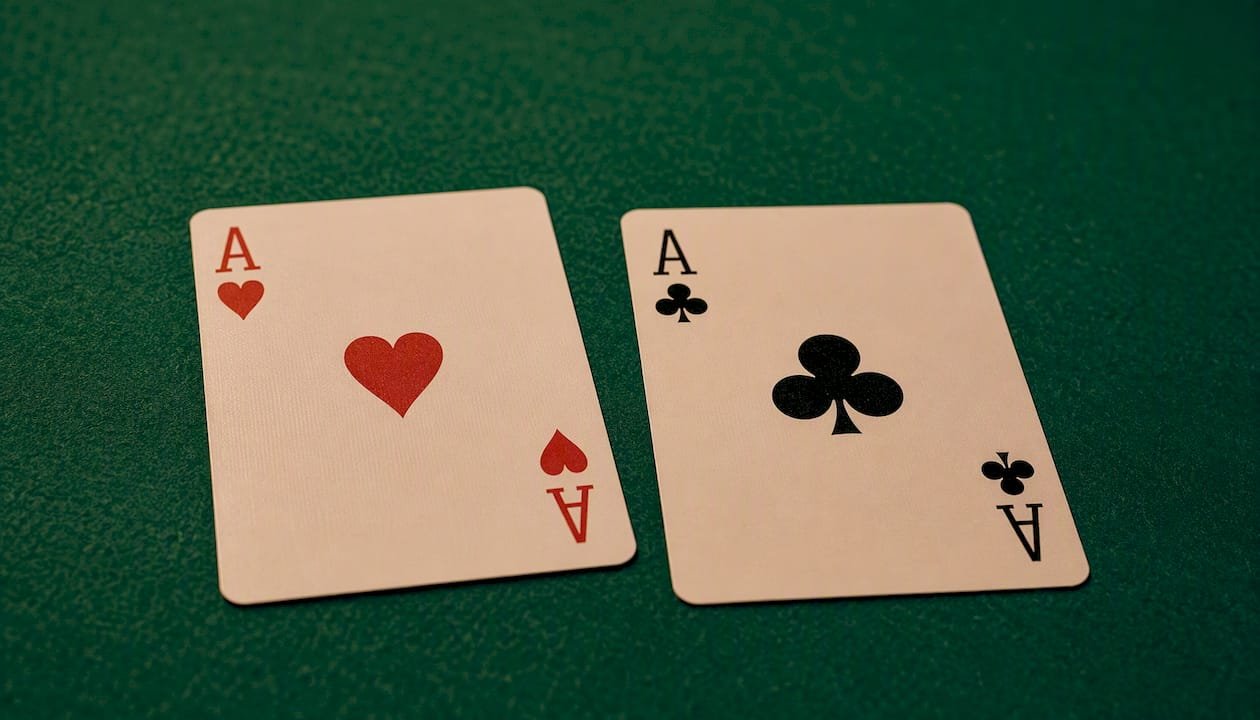
The best five cards rule in Texas Hold’em and Omaha. You use any combination of your hole cards and the community cards to build the strongest possible five-card hand. In Hold’em, you can use both hole cards, one, or neither (playing the board). In Omaha, you must use exactly two hole cards and exactly three community cards.
How ties are resolved:
- Same hand category? Compare the primary rank (the rank of the trips in a Full House, the top card in a Straight or Flush).
- Primary ranks match? Move to the next highest card.
- Still tied? Compare kickers one by one, highest to lowest.
- All five cards identical? The pot splits equally between tied players.
Kicker and tie-breaker rules settle a surprising number of showdowns, especially in Hold’em where community cards can create near-identical hands.
Ace edge cases. The Ace ranks highest (above King) in all standard hands. In a Straight, it also plays low to form the wheel (A-2-3-4-5). It cannot do both in the same hand.
Pro Tip: At showdown, run a quick three-step check: (1) identify your hand category, (2) note the primary rank or top card, (3) line up your kickers. That order catches almost every tie-breaker situation in under five seconds.
How common is each hand? Probability table
Rarity drives the ranking. The numbers below are based on a standard 52-card deck with 2,598,960 possible five-card combinations.
One Pair appears in roughly 42% of all five-card hands. A Royal Flush appears in just 4 out of 2,598,960 possible hands. That gap is why the Royal Flush sits at the top of the poker hand chart and One Pair sits near the bottom.
In seven-card Texas Hold’em, your odds of landing a Full House, Flush, or Straight all improve because you pick the best five from seven cards. Three of a Kind, Two Pair, and One Pair become less common as hands since those holdings often upgrade to stronger combinations with the extra cards.
Fast ways to memorize the hand rankings
The bottom four hands (Three of a Kind, Two Pair, One Pair, High Card) are almost self-explanatory once you know basic card matching. The top six are where most beginners stumble. Focus your study on the top six first, then let the bottom four click into place naturally.
Memory tricks that actually work:
- Group by rarity. Think of the ladder in three tiers: elite (Royal Flush, Straight Flush, Four of a Kind), strong (Full House, Flush, Straight), and common (Three of a Kind, Two Pair, One Pair, High Card).
- Use a phrase mnemonic. “Really Strong Four Full Flush Straights Three Two One High” maps to the first letter of each hand in order: R-S-F-F-F-S-T-T-O-H.
- Visualize the rarity. Picture a Royal Flush as a once-in-a-lifetime event and a High Card as your average Tuesday. That emotional contrast sticks.
Short practice drills:
- Deal five cards face-up and name the hand out loud before checking the chart. Repeat ten times per session.
- Use a hand comparator tool to test two hands against each other and see the winner instantly.
- Run a flashcard routine: write each hand name on one side, the definition and an example on the other. Review daily for one week.
Spaced practice and active recall consistently outperform single-session cramming for retaining factual material like this. Short daily drills beat one long study marathon.
Pro Tip: At a live table, scan top-to-bottom: “Do I have a Flush or better? A Straight? Trips?” Stop the moment you hit your actual hand. That top-down scan takes two seconds once it’s a habit.
Common misconceptions about poker hand rankings to avoid
Even experienced players carry a few wrong assumptions. Here are the ones that cost beginners the most pots.
“A higher suit beats a lower suit.” Suits have zero ranking value in standard poker. A King-high Flush in clubs ties a King-high Flush in spades, card for card. The standard card rank runs Ace down to 2, with no suit hierarchy at all.
“Three of a Kind beats a Straight.” It doesn’t. A Straight (six possible combinations per top card) outranks Three of a Kind because Straights are harder to make. Check the probability table above: Straights appear in roughly 0.39% of five-card hands versus 2.11% for Three of a Kind.
“The Ace always plays high.” In a Straight, the Ace plays low to form the wheel (A-2-3-4-5). Many beginners try to build a “wrap-around” Straight like Q-K-A-2-3, which is not a valid hand in any standard game.
“Two Pair beats Three of a Kind.” Two Pair ranks below Three of a Kind. Three matching cards outrank two separate pairs every time.
“Kickers don’t matter if I have a pair.” Kickers matter enormously in Hold’em. Two players holding a pair of Aces split the pot only if their remaining three cards also match. A player with A-A-K-Q-J beats A-A-K-Q-10 at showdown. Ignoring kickers is one of the most common and costly beginner mistakes.
“Short Deck poker uses the same rankings.” It doesn’t. In Short Deck Hold’em, the deck removes cards 2 through 5, which changes the frequency of each hand. Flushes become rarer than Full Houses, so Short Deck flips their ranking order. Always confirm the variant rules before you sit down.
A note on learning the ladder and playing smart
Learning the poker hand hierarchy is the single most foundational skill in the game. Without it, every decision at the table is a guess. With it, you can evaluate any situation in seconds.
My recommendation: learn the top six hands cold before you play a single real-money session. The bottom four (Three of a Kind through High Card) will feel obvious once the top six are locked in. Use the printable cheat sheet in this guide during home games, and run the ten-card deal-and-identify drill daily for one week. You’ll have the full ladder memorized faster than you expect.
If you plan to use this knowledge in real-money play, set a session budget before you sit down and stick to it. BeGambleAware offers free tools and support for anyone who wants to keep their play in check.
Sources
- List of poker hands – Wikipedia
- Poker Hand Ranker & Comparator — Visual Hand-Rankings Chart
- Poker Hand Rankings: Every Starting Hand Ranked
- PMC article — learning/memory research
- Standard Poker Hand Ranking
- BeGambleAware
For real-money play, check out the latest poker news and big hand stories to see how the rankings play out at the highest levels.
FAQ
What is the strongest hand in poker?
The Royal Flush (A-K-Q-J-10 of the same suit) is the strongest hand in standard poker. Only four exist in a 52-card deck, making it the rarest possible holding.
Does suit matter in poker hand rankings?
No. Suits carry no ranking value in standard high-hand poker. Two flushes of different suits are compared only by card ranks, highest to lowest.
Can an Ace be used as a low card in a Straight?
Yes. An Ace plays low in the wheel Straight (A-2-3-4-5), which is the lowest possible Straight. It cannot wrap around to form a sequence like Q-K-A-2-3.
What happens when two players have the same hand?
Compare the primary rank first (e.g., the rank of the trips in a Full House), then work through kickers one by one. If all five cards match exactly, the pot splits equally.
Do poker hand rankings change in different variants?
The standard 10-tier ladder applies to Texas Hold’em, Omaha, and most common variants. Short Deck Hold’em is a notable exception where flushes rank above full houses due to the reduced deck composition.