



Divine Deal – Dare the Deck, Defy the Odds, Claim Divine Fortune.
Crescendo Games (CG) introduces Divine Deal, a tarot-inspired card reveal game that combines mystical symbolism, multiplier-based rewards, and player-controlled risk decisions. Drawing inspiration from the traditional 78-card tarot deck, Divine Deal transforms familiar Major and Minor Arcana imagery into an interactive digital gaming experience.
Unlike conventional reel-based slot games, Divine Deal uses a three-card reveal system in which each card contributes to the final payout calculation. Players select their preferred difficulty, place a wager, and reveal cards that can increase their potential winnings or bring the round to an immediate end.
With four difficulty settings, a published Return to Player (RTP) of 98%, and a maximum advertised win of 5,000x the original stake, Divine Deal introduces a distinctive combination of tarot aesthetics and modern risk-and-reward gameplay.
At its core, the game presents a recurring decision: secure the available winnings or continue revealing cards in pursuit of a higher multiplier.
What Is Divine Deal by Crescendo Games?
Divine Deal is a 2D tarot-themed card game developed by Crescendo Games, featuring a 78-card concept inspired by the Major and Minor Arcana.
Traditional tarot decks contain 22 Major Arcana cards and 56 Minor Arcana cards. Divine Deal draws on these two categories to create a multiplier-based gaming experience in which different card positions perform specific functions.
The game’s three-card reveal structure consists of:
- Major Arcana – Center Card: Establishes the base multiplier.
- Minor Arcana – Left Card: Adjusts the payout through an additional multiplier.
- Minor Arcana – Right Card: Applies the final multiplier used to determine the result.
The resulting payout is calculated from the original stake and the combined effect of the three revealed card multipliers.
However, not every card produces a positive result. Certain Minor Arcana outcomes can display a 0x multiplier, functioning as traps that immediately end the round.
This combination of positive multipliers and potential traps creates the central risk-and-reward mechanic of Divine Deal.
How to Play Divine Deal – Reveal Your Fortune
Divine Deal follows a structured gameplay sequence built around difficulty selection, card reveals, and payout decisions.
Step 1: Choose Your Difficulty
Before beginning a round, players select one of four difficulty settings:
Easy – Lower Volatility
Designed around lower volatility, Easy offers a comparatively less aggressive risk profile and smaller potential rewards.
Medium – Balanced Risk and Reward
Medium provides an intermediate setting between lower-volatility gameplay and higher-risk multiplier opportunities.
Hard – Higher Volatility
Hard introduces greater volatility and the possibility of larger payouts, accompanied by increased uncertainty.
Expert – Maximum Risk
Expert represents the highest advertised risk setting, associated with the pursuit of Divine Deal’s maximum 5,000x win potential.
The difficulty setting affects the game’s risk-and-reward profile. The exact card probabilities, multiplier distributions, and payout conditions should be checked against the official game rules.
Step 2: Place Your Bet
After choosing a difficulty level, players select their preferred wager within the available betting limits.
The original stake forms the basis for calculating the payout generated by the three revealed cards.
Step 3: Reveal Three Tarot Cards
Each card reveal involves one Major Arcana card and two Minor Arcana cards.
The cards occupy specific positions and contribute to the result in different ways.
The center Major Arcana establishes the base multiplier, while the left and right Minor Arcana apply additional multiplier values.
Together, these three values determine the resulting payout multiplier.
Step 4: Calculate the Result
When all three cards produce qualifying multiplier values, the resulting multiplier is applied to the original wager.
For example, a center card displaying 2x, a left card displaying 1.5x, and a right card displaying 2x would produce a combined multiplier of 6x.
A $10 wager at 6x would correspond to a gross payout of $60.
These values are illustrative and do not represent a confirmed card combination or official payout example from Crescendo Games.
Step 5: Watch for Trap Cards
Not every reveal leads to a payout.
If either Minor Arcana side card displays a 0x multiplier, the round ends immediately.
Because the card multipliers are multiplied together, a zero value produces a zero result regardless of the other cards.
This trap mechanic adds uncertainty to the card-reveal process.
Step 6: Cash Out or Continue
After a qualifying result, players can choose whether to secure their available winnings or continue revealing cards.
Cashing out locks in the available payout according to the game rules.
Continuing creates another opportunity to increase the reward but introduces further exposure to unfavorable card outcomes.
The decision to continue does not guarantee a higher payout.
Understanding Divine Deal’s Three-Card Multiplier System
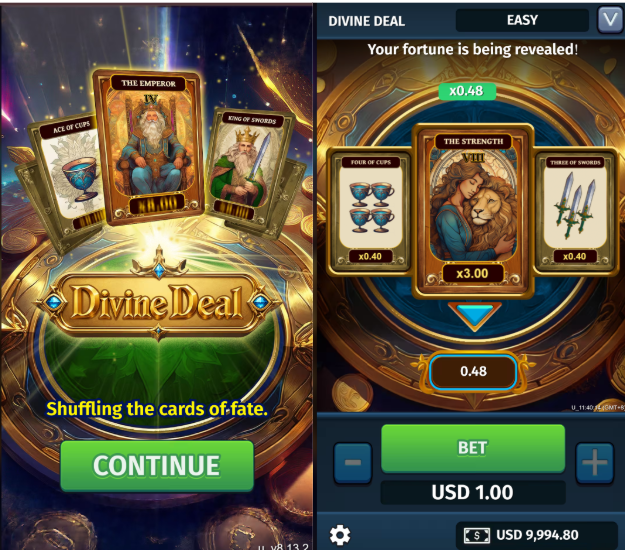
One of Divine Deal’s defining features is its use of three separate multiplier values to determine a payout.
Rather than relying on traditional paylines or symbol combinations, the game assigns mathematical roles to the revealed tarot cards.
How Are Divine Deal Payouts Calculated?
The official game description identifies the following formula:
Total Win = Bet Amount × Major Arcana Multiplier × Left Minor Arcana Multiplier × Right Minor Arcana Multiplier
Consider the following hypothetical examples:
| Bet Amount | Major Arcana | Left Minor Arcana | Right Minor Arcana | Gross Payout |
|---|---|---|---|---|
| $10 | 2x | 1.5x | 2x | $60 |
| $10 | 3x | 2x | 2x | $120 |
| $10 | 5x | 2x | 3x | $300 |
| $10 | 4x | 0x | 5x | $0 |
The table illustrates the payout formula using hypothetical multiplier values, not verified in-game card payouts.
This mathematical structure explains why every card matters.
A favorable Major Arcana multiplier may create a strong starting value, but the final result still depends on the Minor Arcana cards.
Similarly, a 0x side-card outcome eliminates the payout regardless of the center card’s multiplier.
What Makes the Three-Card System Different?
The system separates the result into three distinct components instead of treating the card combination as a single predefined symbol match.
This gives players a clearer way to understand how each revealed card contributes to the final multiplier.
It also establishes a direct relationship between tarot-card positioning, multiplier calculation, and payout outcomes.
Four Difficulty Levels – Understanding Volatility and Risk
Divine Deal offers four difficulty settings that provide different risk profiles.
In gaming mathematics, volatility describes how winnings may vary in frequency and size over time.
A lower-volatility configuration generally emphasizes less extreme payout variation, while a higher-volatility configuration may involve larger potential rewards occurring less frequently.
However, volatility alone does not determine the long-term expected return of a game.
Easy vs. Medium vs. Hard vs. Expert
| Difficulty | Advertised Risk Profile | Gameplay Focus |
|---|---|---|
| Easy | Lower volatility | Smaller, steadier reward profile |
| Medium | Balanced | Intermediate risk and potential rewards |
| Hard | Higher volatility | Greater payout variation |
| Expert | Maximum risk | Pursuit of the highest potential multiplier |
The official game description identifies Expert as the difficulty associated with the maximum 5,000x win.
The precise probabilities and payout distributions for each difficulty have not been specified in the publicly available product description.
Does Higher Difficulty Mean Better Winning Chances?
Not necessarily.
Higher difficulty generally indicates greater volatility or risk rather than an improved probability of winning.
A game can offer larger maximum payouts while making those outcomes less frequent.
Players should distinguish between a game’s maximum advertised reward, its probability of occurrence, and its expected return.
These are related but different mathematical concepts.
Divine Deal RTP Explained – What Does 98% Mean?
Crescendo Games lists Divine Deal with a 98% Return to Player (RTP).
RTP is a theoretical measure of how much a game is expected to return to players over a very large number of wagers under a specified mathematical model.
A 98% RTP corresponds to a theoretical house edge of 2%.
For example, if $10,000 were wagered across a sufficiently large number of plays under a model with a 98% RTP, the theoretical aggregate return would be $9,800.
That does not mean a player wagering $100 will receive $98 back, nor does it mean every gaming session will produce a result close to the theoretical average.
Actual outcomes can vary considerably because of randomness and volatility.
Is a 98% RTP Guaranteed?
No.
RTP describes a theoretical long-term average, not a guaranteed result for an individual player or session.
The official product page advertises a 98% RTP, but it does not specify whether that figure applies identically to all four difficulty settings.
Players should consult the game’s official rules for any difficulty-specific RTP information.
Divine Deal Maximum Win – Understanding the 5,000x Multiplier
Divine Deal advertises a maximum win potential of 5,000 times the original wager.
This figure represents the game’s published maximum payout multiplier.
For illustration:
| Original Stake | Maximum 5,000x Gross Payout |
|---|---|
| $1 | $5,000 |
| $5 | $25,000 |
| $10 | $50,000 |
| $20 | $100,000 |
These calculations are mathematical illustrations, not promises of attainable payouts for every stake. Actual betting limits, payout caps, and game conditions may restrict the amounts available.
Can Players Consistently Reach 5,000x?
No reliable method can guarantee the maximum multiplier.
The maximum win represents the upper limit advertised for the game, not an outcome that can be predicted or consistently reproduced.
Its actual probability depends on the underlying card distributions, game rules, and difficulty configuration.
Why the Tarot Theme Matters in Divine Deal
Tarot symbolism is more than a visual element in Divine Deal. It provides the framework for the game’s card-based presentation and multiplier structure.
Major Arcana – The Foundation of the Reveal
In traditional tarot, the Major Arcana consists of 22 cards commonly associated with significant archetypes and symbolic themes.
Divine Deal adapts this category into its center-card mechanic, where the revealed Major Arcana establishes the base multiplier.
Minor Arcana – Modifying the Outcome
The traditional Minor Arcana consists of 56 cards divided into four suits.
In Divine Deal, the two Minor Arcana positions modify the center card’s multiplier and determine the final result.
The possibility of a 0x side card introduces a trap mechanic that can end the round immediately.
Tarot-Inspired Design Without Fortune-Telling Claims
Although Divine Deal uses tarot imagery and mystical themes, its gameplay is based on game-defined multiplier values and outcomes rather than supernatural prediction.
The tarot setting provides thematic identity, while the game’s mathematical rules determine the payout.
This distinction helps explain Divine Deal as a digital card game rather than a tarot-reading or divination service.
Key Features of Divine Deal
Mystical Tarot-Inspired Presentation
Divine Deal incorporates cosmic visuals, glowing card reveals, and atmospheric effects to create a supernatural gaming environment.
Three-Card Multiplier Mechanics
Each reveal combines one Major Arcana card and two Minor Arcana cards, with all three multiplier values contributing to the final result.
Four Selectable Difficulty Settings
Easy, Medium, Hard, and Expert provide different risk profiles, allowing players to select a preferred gameplay configuration.
Player-Controlled Cash-Out Decisions
Players can secure an available payout or continue revealing cards under the game’s rules.
Trap Card Outcomes
A 0x multiplier on either Minor Arcana side card ends the round immediately, introducing a distinct risk mechanic.
Published 98% RTP and 5,000x Maximum Win
The official game specification advertises a theoretical RTP of 98% and a maximum win multiplier of 5,000x.
HTML5 and Multi-Platform Compatibility
Crescendo Games lists Divine Deal as compatible with HTML5, iOS, Android, Windows, and macOS environments.
The game page also identifies language support for English, Simplified Chinese, Vietnamese, Japanese, Thai, Korean, Indonesian, and Khmer.
Frequently Asked Questions About Divine Deal
What is Divine Deal by Crescendo Games?
Divine Deal is a tarot-inspired, progression-based card reveal game developed by Crescendo Games. It uses a 78-card tarot theme, three-card multiplier mechanics, four difficulty levels, and player-controlled cash-out decisions. The developer advertises a 98% RTP and a maximum win of 5,000x.
How do you play Divine Deal?
Players select a difficulty, place a bet, and reveal one Major Arcana and two Minor Arcana cards. The three card multipliers determine the payout. Players can secure available winnings or continue revealing cards, while a 0x side card ends the round.
How many cards are used in Divine Deal?
Divine Deal is based on a 78-card tarot deck, traditionally consisting of 22 Major Arcana and 56 Minor Arcana cards. Its reveal system uses one Major Arcana card and two Minor Arcana cards.
What are the four difficulty levels?
Divine Deal offers Easy, Medium, Hard, and Expert. The settings range from lower volatility to maximum risk, with Expert associated with the advertised 5,000x maximum win.
What is the RTP of Divine Deal?
Crescendo Games advertises a theoretical RTP of 98%. This represents a long-term mathematical expectation rather than a guaranteed return for individual rounds or sessions.
What is the maximum win in Divine Deal?
The maximum advertised win is 5,000x the original stake, subject to the game’s payout conditions, betting limits, and applicable rules.
What happens if a Minor Arcana card reveals 0x?
A 0x multiplier on either side card acts as a trap and ends the round immediately. Because the three multipliers are multiplied together, a zero value results in no payout for that reveal.
Is Divine Deal a traditional slot game?
Divine Deal is classified by Crescendo Games as a 2D card/tarot game. Its primary mechanics involve card reveals, multiplier calculations, and cash-out decisions rather than traditional spinning reels and paylines.
Can players predict the next tarot card?
There is no established reliable method for predicting the next game result. Tarot symbolism provides the game’s theme, but does not give players a means of forecasting outcomes.
Is Divine Deal available on mobile devices?
Crescendo Games lists compatibility with iOS, Android, and HTML5, alongside Windows and macOS. Actual availability depends on participating operators and supported platforms.
Is Divine Deal a Provably Fair game?
The official Divine Deal product description does not specify a Provably Fair verification system. Its presence, verification method, and any independent testing or certification should therefore be confirmed with Crescendo Games rather than assumed.
Who developed Divine Deal?
Divine Deal was developed by Crescendo Games (CG), an iGaming content developer offering digital games with distinctive themes and interactive mechanics.
Available Now – Discover Divine Deal by Crescendo Games
Divine Deal brings together tarot-inspired design, three-card multiplier calculations, selectable difficulty levels, and cash-out decisions in a modern digital gaming format.
Its combination of Major and Minor Arcana mechanics, trap cards, and different volatility settings creates an experience built around uncertainty and player-controlled stopping decisions.
With an advertised 98% RTP and 5,000x maximum win, Divine Deal offers a distinctive example of how traditional card imagery can be adapted into contemporary multiplier-based gameplay.
The game is featured in the Crescendo Games portfolio, with availability through participating operators subject to applicable market requirements.
Divine Deal – Dare the Deck, Defy the Odds, Claim Divine Fortune.
About Crescendo Games (CG)
Crescendo Games (CG) is an iGaming content developer creating digital gaming titles that combine distinctive themes, modern presentation, and interactive gameplay features.
Its game portfolio includes original concepts designed around recognizable mechanics, accessible interfaces, and engaging visual environments.
Divine Deal reflects the company’s approach to adapting familiar cultural imagery into modern digital entertainment through tarot-inspired presentation and multiplier-based gameplay.
For more information about Divine Deal, other Crescendo Games titles, or partnership opportunities, visit:
Official Website: https://crescendogames.com/
Divine Deal Game Page: https://crescendogames.com/divine.html
Game outcomes involve chance. RTP and maximum win figures are theoretical product specifications, not guarantees of individual results. Players should consult official game rules and applicable operator conditions.