




Hedging a bet means placing a second wager on the opposite outcome of a position you already hold, so the result of your betting is locked in no matter what happens next. Bettors hedge to guarantee a profit on a winning ticket that’s still in play, or to cap the damage on one that’s about to go sideways. It shows up most often on futures tickets, on the final leg of a parlay, and in live betting once a game gets close.
TL;DR:
- Hedging is most effective when the original bet is a significant portion of your bankroll and the market is genuinely two-way.
- Full hedges guarantee an equal payout regardless of outcome but require betting enough to cover the total return, which may be costly.
- Partial hedges limit downside while keeping some upside, but they do not lock in total profits and depend on precise odds and position size.
- Line shopping across multiple sportsbooks and stripping out the sportsbook margin improves hedge accuracy and reduces costs.
- Hedging typically incurs expected value loss due to bookmaker vig, so it should be based on calculated benefits rather than emotional impulses.
Table of Contents
- How Hedging Bets Explained: The Mechanics Behind the Move
- Types of Hedges: Partial, Full, and Situational
- When to Hedge (and When to Leave It Alone)
- How to Size a Hedge: Formula and Worked Example
- Pros, Cons, and the EV Trade-Off
- Three Worked Examples: Futures, Parlays, and Live Bets
- W88 News Today’s Hedging Checklist
- A Betting Writer’s Take on Hedging
- Find More Betting Tools at W88 News Today
- Sources
- FAQ
How Hedging Bets Explained: The Mechanics Behind the Move
Hedging only works because your original bet is already sitting there, waiting on an outcome. You place a second, reactive wager on the other side, and the odds movement between your first bet and now is what creates room to lock something in. If your team’s futures odds shortened dramatically after a hot streak, the payout on betting against them has grown enough to make hedging worthwhile.
The core math is simple in concept: compare what your original bet pays out in total against what it costs to buy the opposite outcome at today’s price. If the hedge stake is smaller than the guaranteed return it buys, you’ve found a real hedge.
The catch is the vig, also called the juice, the built-in cut the sportsbook takes on every line. That’s why a “perfect” hedge rarely returns exactly what your original bet promised.
- Your first bet is fixed; the hedge is the flexible, reactive piece
- Odds movement is the fuel that makes hedging profitable
- Vig eats into the guaranteed outcome on both sides
- “De-vigging” a line strips out the book’s cut so you can see the true implied probability before deciding
Types of Hedges: Partial, Full, and Situational
Not every hedge locks in the same kind of outcome, and picking the wrong type for your situation leaves money on the table.
- Full hedge: You bet enough on the opposite side to guarantee an identical payout regardless of the result. Simple, safe, and it removes all variance.
- Partial hedge: You bet less than the full amount, guaranteeing a smaller profit if you lose the original bet, while keeping some upside alive if you win it.
- Middles: A rare setup where a line moves enough that you can win both bets, though this is uncommon outside of stale numbers at slower-moving books.
- Cashout vs. placing your own hedge: Sportsbook cashout offers are convenient but usually price in extra margin. Placing your own hedge bet elsewhere, or line shopping across multiple books, typically nets you more.
- Parlay and futures hedges: Parlays are usually hedged only on the final leg, while futures get hedged once the ticket has grown large relative to your bankroll.
- Live hedges: In-play markets let you hedge mid-event, but odds swing fast and you’re working against a shrinking window.
When to Hedge (and When to Leave It Alone)
Hedging isn’t automatic just because you’re winning. Run through this checklist before you touch the hedge slip:
- Check the size of the position. A futures ticket that’s grown to represent a meaningful chunk of your bankroll is a strong hedge candidate; a $10 parlay usually isn’t.
- Protect true windfalls. If a long shot came in and you’re sitting on a payout you didn’t expect, locking in guaranteed profit removes the temptation to let it ride into a loss.
- Wait for a two-way market. Hedging works cleanest when the outcome is binary, one team wins or the other does. Three-way markets, like soccer with a draw, add a variable that usually kills a clean hedge.
- Skip it on small stakes. If the vig on the hedge side eats most of the guaranteed gain, you’re paying for peace of mind you don’t need.
- Run the numbers, not your nerves. Decide with a calculator, not with how anxious you feel watching the second half.
How to Size a Hedge: Formula and Worked Example
The standard hedge-stake formula is straightforward:
Hedge stake = Original total return ÷ Decimal odds of the hedge
To use it, convert any American odds to decimal first. Positive odds: decimal = (American odds ÷ 100) + 1. Negative odds: decimal = (100 ÷ absolute value of American odds) + 1.
- Example: You bet $100 on a futures ticket at +900 odds. If it hits, your total return is $1,000 ($900 profit plus your $100 stake).
- The team is now heavily favored, and the opposing side is priced at +150 (decimal odds of 2.50) to eliminate that outcome.
- Hedge stake = $1,000 ÷ 2.50 = $400.
Pro Tip: If you bet $400 on the other side, your outcome is locked at roughly $600 profit either way, minus whatever the vig shaved off along the way. For a full hedge, always divide the total return, not just your original stake, by the hedge’s decimal odds. For a partial hedge, plug in a smaller target return to keep some upside alive.
Pros, Cons, and the EV Trade-Off
Hedging trades potential upside for certainty, and that trade is worth understanding before you make it.
Benefits:
- Removes variance from an outcome that’s still technically live
- Locks in a known profit instead of hoping
- Cuts emotional stress during the final minutes of a close game
Costs:
- Hedging almost always costs some expected value because you’re paying the vig twice, once on the original bet, once on the hedge
- You cap your upside if the original outcome would have paid more
- Careful line shopping can shrink that EV cost, but it rarely disappears entirely
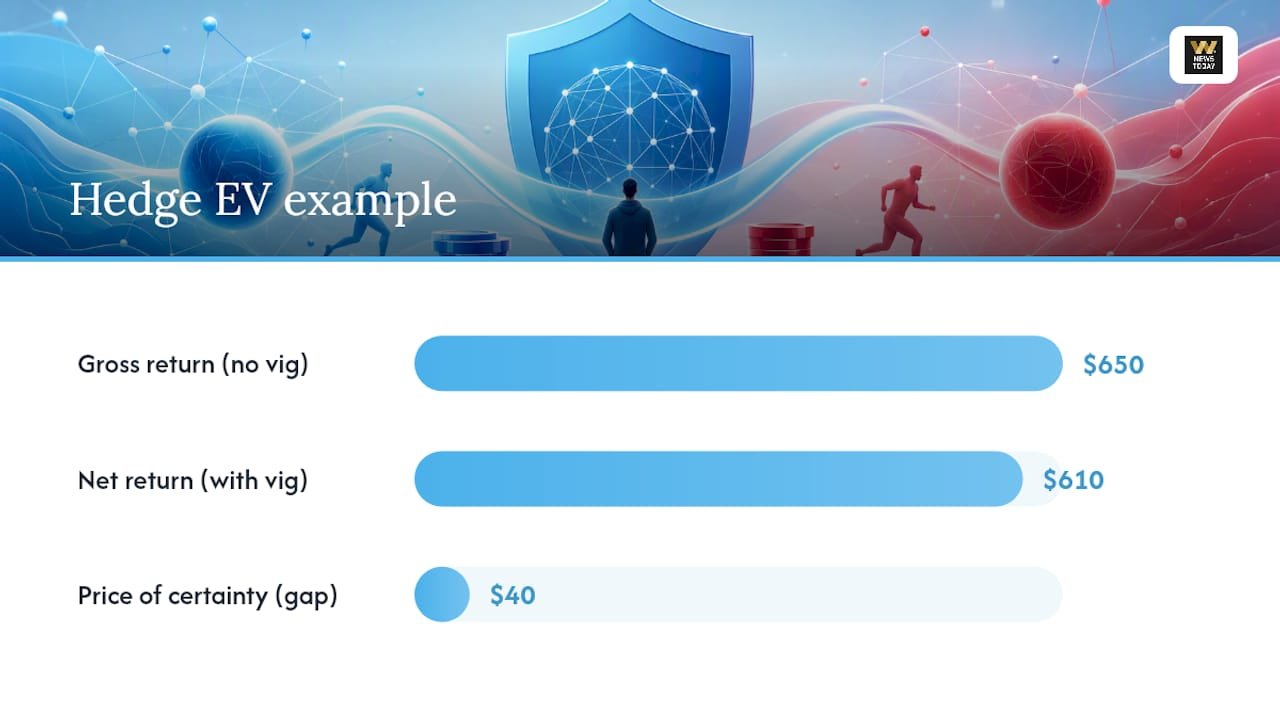
Quick EV example: if a full hedge would have returned $650 without any vig drag, but the vig-adjusted hedge nets you $610, that $40 gap is the price of certainty. Small, but real.
Three Worked Examples: Futures, Parlays, and Live Bets
- Futures: You bet $50 on a team at +2000 preseason to win a title. They make the final, and the other side is now priced at +120 (decimal 2.20) for a total guaranteed return near $1,050. Hedge stake = $1,050 ÷ 2.20 = about $477, locking in a profit regardless of who wins.
- Parlay final leg: Your four-leg parlay has three legs settled and pays $800 if the last one hits. The opposing side of that last leg sits at +140 (decimal 2.40). A partial hedge of $200 on the other side guarantees a smaller profit if you lose, while keeping most of the $800 upside alive if you win.
- Live/in-play: You’re up big on a moneyline bet at halftime, and the opposing side is now available at generous live odds. You hedge quickly before the number moves again, accepting a smaller guaranteed win in exchange for locking something in before the market corrects.
W88 News Today’s Hedging Checklist
Before you place a hedge, run it against this short list:
- Bankroll impact: does this position actually represent enough of your bankroll to justify the move?
- Line shopping: have you checked odds across more than one book, including a partner resource like BetMzansi’s strategy basics?
- De-vig check: have you stripped out the book’s margin to see the real implied probability?
- Timing: are you waiting for a genuinely binary market before locking anything in?
Pro Tip: Wait until the market is two-way and shop at least two sportsbooks before you hedge; that combination consistently produces the cleanest, least expensive locks. Sound bankroll management underpins every one of these decisions.
A Betting Writer’s Take on Hedging
Hedging gets treated like a magic trick online, and it isn’t one. It’s a math exercise with a real cost attached, and the biggest mistake I see bettors make is hedging out of anxiety rather than out of a genuine EV case. The formula doesn’t care how nervous you are watching the fourth quarter.
Covering iGaming and sports betting for W88 News Today has shown me that the bettors who hedge well are the ones who treat their bankroll like a budget, not a mood. Play within your means, and let the math decide when to lock a result instead of your gut.
— jeff
Find More Betting Tools at W88 News Today
This platform offers calculators, odds explainers, and game breakdowns that make hedging decisions faster instead of guesswork. Beyond hedging math, our team also tracks new game releases across online casinos, so you’re never behind on the latest slots, table games, or live dealer launches worth checking out.

If you’re ready to size your next hedge with real numbers instead of a hunch, start with our betting odds explained guide to nail down your conversions, then browse the sports betting hub for more strategy breakdowns. Head to W88news to get started.
Sources
- A complete guide to how hedging works in sports betting | Sporting News
- How to hedge a bet | The New York Times
- Hedging Bets: Meaning, Sports Betting Examples & Expert Analysis
FAQ
What Is an Example of Hedging Bets?
A common example is a futures bet on a team to win a championship: if they reach the final at much shorter odds than your original price, you bet the opposing team to guarantee a profit either way.
What Is the Best Strategy for Hedging Bets?
The strongest approach is waiting for a binary, two-way market, shopping odds across multiple books, and using the hedge-stake formula (total return divided by the hedge’s decimal odds) rather than guessing a number.
What Is the Bet-Hedging Strategy?
It’s the practice of placing an opposite wager on a position you already hold, converting an uncertain outcome into a guaranteed result, whether that’s locked profit or a capped loss.
Why Is It Called Hedging Bets?
The term borrows from the general meaning of “hedge,” to protect against loss if your original plan doesn’t work out, the same way a hedge acts as a protective barrier.