





A parlay is a single wager that links two or more individual bets into one ticket, and every leg must win for the parlay to pay out. Miss even one, and the whole ticket loses. That’s the deal, and it’s worth understanding before you place your first multi-leg bet.
Three things to know right away:
- Minimum legs: At least two; many sportsbooks allow up to 25 legs on one ticket, according to Sporting News.
- How payouts grow: Each leg’s odds multiply together, so adding legs compounds the potential payout fast.
- The catch: Every extra leg you add also multiplies your chance of losing. The payout looks exciting; the probability of hitting it drops sharply.
You’ll also see parlays called “accas” or accumulators in the UK and international soccer markets. The terms are functionally identical; “parlay” is the standard U.S. label, while “acca” dominates British and European betting culture.
Key Takeaways
A parlay multiplies every leg’s odds together, which means every leg must win and the house edge compounds with each one you add.
| Point | Details |
|---|---|
| Every leg must win | One losing leg kills the entire parlay ticket, regardless of how many other legs hit. |
| Four-step payout math | Convert to decimal, multiply all decimals, multiply by stake, subtract stake for profit. |
| Payout compression is real | A two-team NFL spread parlay typically pays about 2.64:1; true 50/50 combined odds are 3:1. |
| Keep legs to 2–4 | Probability of winning drops sharply beyond four legs; stake 1–5% of bankroll per parlay. |
| Pushes reduce, not void | A pushed leg is removed and the parlay recalculates at the next size down. |
Table of Contents
- How do parlays actually work?
- How do you calculate parlay payouts?
- Three worked parlay examples you can reproduce
- Why sportsbook payouts are lower than true odds
- When should you use parlays, and how do you stay safe?
- How sportsbooks build and adjust parlay odds
- An editor’s perspective on parlay betting
- Sources
- FAQ
How do parlays actually work?
A leg is any single bet within the parlay. You can mix and match bet types: moneylines, point spreads, totals (over/under), and even player props can all serve as legs on most major platforms. The sportsbook combines them into one ticket with one combined payout.
Same-game parlays, Round Robins, and teasers
Same-game parlays (SGPs) bundle multiple bets from a single contest, say a Chiefs game where you parlay Patrick Mahomes over 280 passing yards AND the Chiefs to cover the spread. SGPs are popular on DraftKings and FanDuel, but both platforms apply algorithmic restrictions to prevent obviously correlated combinations. You generally can’t parlay a team to win big AND the game total to go over, because those outcomes move together.
Round Robins automatically convert your picks into a set of smaller, overlapping parlays. Pick five teams, and a Round Robin might generate ten two-leg parlays from those five selections. You win on whichever smaller parlays hit, so you get partial coverage even if one pick loses.
Teasers let you shift the point spread in your favor (typically 6 points in football) across multiple legs in exchange for a reduced payout. They’re a more conservative structure than a standard parlay.
What happens when a leg pushes or is voided?
A push means the result lands exactly on the line (a spread of -3 and the team wins by exactly 3). A void happens when a game is postponed, a prop bet is canceled, or a player doesn’t take the field. According to CBS Sports, most sportsbooks handle both the same way: the pushed or voided leg is simply removed, and the parlay recalculates as if it never existed. A four-leg parlay with one void becomes a three-leg parlay.
Correlated-leg rules
Books block or restrict legs that are obviously correlated because combining them would give you an unfair edge. A classic example: parlaying a quarterback to throw four touchdowns AND the game total to go over. Both outcomes are driven by the same underlying event, so the true combined probability is much higher than the multiplied odds suggest. Sportsbooks use proprietary algorithms, especially for SGPs, to detect and either block or reprice these combinations.
Pro Tip: Before building a same-game parlay, check the sportsbook’s SGP rules page. DraftKings and FanDuel both publish which prop types can and cannot be combined within a single game.
How do you calculate parlay payouts?
The math follows four repeatable steps, and once you run through it once, you can check any sportsbook’s bet slip yourself.
- Convert each American odd to a decimal. For a favorite (negative odds): decimal = 1 + (100 ÷ |American odd|). For an underdog (positive odds): decimal = 1 + (American odd ÷ 100). So -110 becomes 1 + (100 ÷ 110) = 1.909, and +150 becomes 1 + (150 ÷ 100) = 2.50.
- Multiply all the decimal odds together. Two legs at 1.909 each: 1.909 × 1.909 = 3.645.
- Multiply that result by your stake. A $100 bet × 3.645 = $364.50 total return.
- Subtract your stake to find profit. $364.50 − $100 = $264.50 profit, which is roughly +264 in American odds format.
That four-step method is confirmed by both Fox Sports and Action Network. Sportsbooks sometimes round to the nearest cent, which is why your bet slip might show $264.45 instead of $264.50.
Sample parlay payouts on a $100 stake
All legs priced at -110 (decimal 1.909) unless noted. Profit figures are approximate.
The “mix” column shows a three-leg parlay: two legs at -110 and one at +150. Decimal calculation: 1.909 × 1.909 × 2.50 = 9.11; $100 × 9.11 = $911 return; profit ≈ +$811. The +150 underdog leg dramatically lifts the combined payout. Sportsbooks like FanDuel display the expected payout live on the bet slip as you add legs, so you can watch the number update in real time.
Three worked parlay examples you can reproduce
Example A: Two-leg spread parlay at -110 each
You back the Eagles -3.5 and the Bills -2.5, both at -110. Stake: $50.
- Convert: -110 → 1.909 (both legs)
- Multiply: 1.909 × 1.909 = 3.645
- Total return: $50 × 3.645 = $182.25
- Profit: $182.25 − $50 = $132.25
Example B: Three-leg moneyline mix
You take the Dodgers (-150), the Celtics (+120), and the Chiefs (-200). Stake: $20.
- Convert: -150 → 1.667; +120 → 2.20; -200 → 1.50
- Multiply: 1.667 × 2.20 × 1.50 = 5.501
- Total return: $20 × 5.501 = $110.02
- Profit: $110.02 − $20 = $90.02
Example C: Same-game parlay with a push
You build a three-leg SGP: Jalen Hurts over 240 passing yards (-115), Eagles to cover -3.5 (-110), and Eagles/Cowboys total over 47.5 (-110). Stake: $25. The total lands exactly on 47.5, so that leg pushes.
The sportsbook removes the pushed leg. Your three-leg SGP becomes a two-leg parlay.
- Convert remaining legs: -115 → 1.870; -110 → 1.909
- Multiply: 1.870 × 1.909 = 3.570
- Total return: $25 × 3.570 = $89.25
- Profit: $89.25 − $25 = $64.25
Without the push, the three-leg version would have paid more. The push removal, as Action Network explains, always reduces the parlay to the next size down rather than voiding the whole ticket.
Why sportsbook payouts are lower than true odds
Here’s where parlays get honest. Sportsbooks don’t pay you at true probability; they compress the payout to build in their margin.
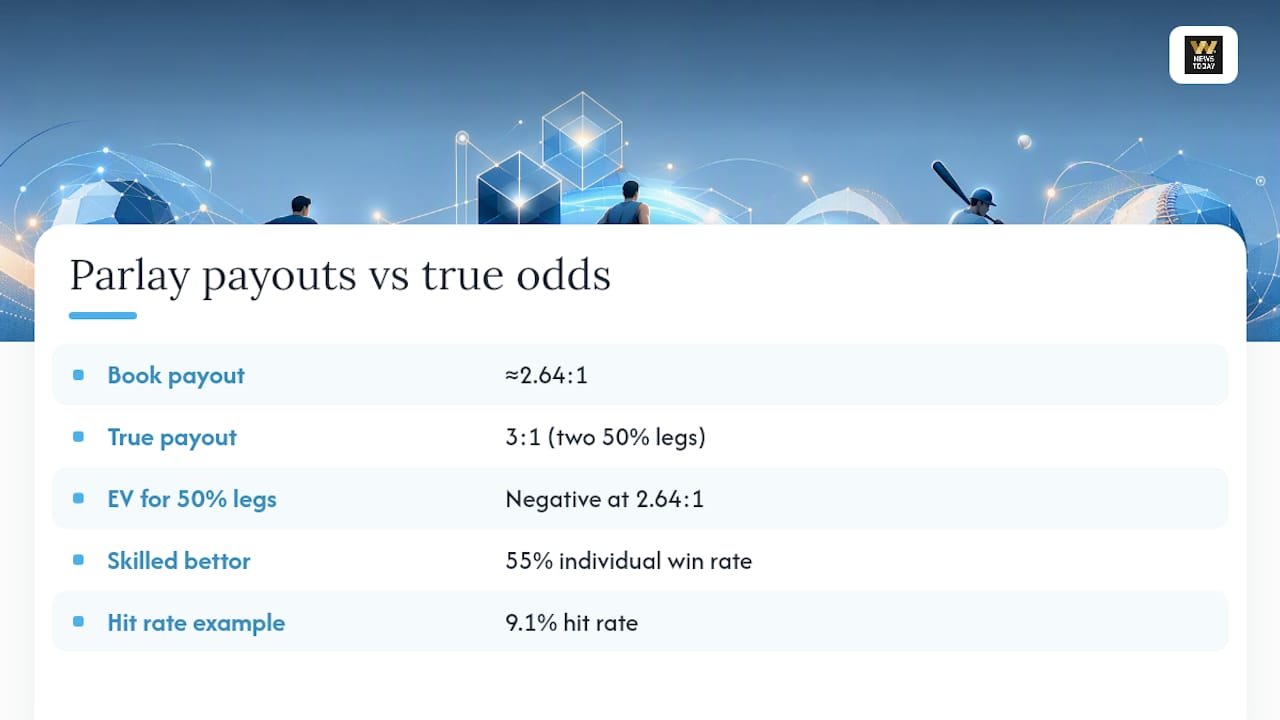
The numbers: A standard two-team NFL spread parlay at -110 per leg typically pays about 2.64:1. The true combined odds for two independent 50/50 bets would be 3:1. That gap is the house edge built into every parlay.
The expected value (EV) formula is: EV = (probability of winning × payoff) − (probability of losing × stake). If you win 50% of the time on each leg and the book pays 2.64:1 instead of 3:1, your EV on a two-leg parlay is negative even before you account for variance.
Now consider a bettor who genuinely wins 55% of individual bets, which is a strong edge. On a single bet at -110, that 55% win rate is profitable. At compressed parlay odds, that 9.1% hit rate often still doesn’t overcome the payout gap the book has built in. The house edge compounds with each leg added, not just the difficulty.
The practical takeaway: parlays can be EV-positive for a bettor with a genuine, documented edge on each individual leg, but only if the combined payout exceeds the true combined probability. For most beginners, that condition is rarely met.
When should you use parlays, and how do you stay safe?
Parlays work best as a small, entertainment-focused slice of your betting activity, not a primary strategy. Here’s how to keep them fun without burning your bankroll:
- Stick to 2–4 legs. The probability of winning drops fast beyond four legs, and the house edge compounds with every addition.
- Size stakes at 1–5% of your total bankroll per parlay. A $500 bankroll means parlay stakes of $5–$25, not $100 shots.
- Shop for the best odds before you build. A difference of -110 vs. -115 per leg compounds across every leg, so the starting price matters more in parlays than in single bets. Check sports bonuses and promotions to find profit boosts that temporarily improve payout math.
- Avoid correlated legs. Combining a team to win big with the game total going over is the most common beginner trap.
- Don’t ignore pushes. A push reduces your parlay, which is better than a loss, but it changes the payout you were expecting.
Pro Tip: Round Robin parlays give you partial coverage. If you have four strong picks but don’t want to risk a single four-leg parlay, a Round Robin turns those four picks into six two-leg parlays. You’ll win on whichever combinations hit.
Responsible gambling matters here. The National Council on Problem Gambling recommends setting hard deposit and loss limits before you bet, and treating near-miss parlay losses as losses, not “almost wins.” The psychological pull of a near-miss is real, and it’s one reason sportsbooks promote parlays so heavily. For broader sports betting tips and responsible-wagering guidance, W88news keeps a dedicated resource section updated regularly.
How sportsbooks build and adjust parlay odds
Behind the bet slip, sportsbooks run a straightforward process with a few important wrinkles.
- Rounding creates compression. Each leg’s decimal odds are already slightly below true probability (that’s the vig). Multiplying several slightly-compressed decimals together compounds the compression, so the final parlay payout is always lower than the “true” combined odds.
- SGPs require algorithmic treatment. Same-game parlays can’t just multiply standard odds because the legs share an underlying event. Books use proprietary correlation models to price SGPs, which is why SGP odds often look different from what you’d calculate manually.
- Promotions change short-term math. Profit boosts, parlay insurance, and minimum-leg promos temporarily improve your payout or reduce your downside. A 25% profit boost on a three-leg parlay genuinely shifts the math in your favor for that specific bet. But as CBS Sports notes, these promotions don’t change the long-term house edge; they’re designed to attract volume and build parlay habits.
- Books may limit or adjust correlated SGP legs. If a combination is flagged as highly correlated, the platform either blocks it outright or reprices it to restore the house margin.
An editor’s perspective on parlay betting
Parlays are genuinely exciting, and there’s nothing wrong with placing a small two-leg ticket on a Sunday afternoon. What concerns me is the way sportsbook apps frame them as a path to big payouts without making the math visible. The payout compression on a six-leg parlay is substantial, and most beginners never run the EV calculation before they bet.
My honest advice: learn the four-step decimal conversion, run it once on your next parlay before you submit it, and compare what the book pays to what true odds would pay. That single habit will change how you approach every multi-leg ticket going forward.
W88news covers the full range of betting guides, casino game reviews, and new game releases so you can stay sharp across every format. For the latest sportsbook news and rule changes, the W88news news hub is updated regularly.
Sources
The following sources informed this guide and are worth bookmarking if you want to go deeper on parlay math, platform rules, or responsible gambling:
- How to bet parlays | Fox Sports
- What are parlays? How to bet parlays guide – CBS Sports
- What Is a Parlay in Sports Betting? Definition, Examples
- Parlay
W88news also maintains sports betting tips and responsible-wagering guides for beginners who want ongoing support beyond this article.
FAQ
What is a parlay bet in simple terms?
A parlay is one ticket that combines two or more bets, and every single leg must win for the ticket to pay out. If one leg loses, the whole parlay loses.
What is an acca, and is it the same as a parlay?
Yes. “Acca” (short for accumulator) is the British and international term for the same bet type. In the U.S., it’s called a parlay; the mechanics and payout math are identical.
How many legs should a beginner put in a parlay?
Two to four legs is the practical range for beginners. Beyond four legs, the probability of hitting every selection drops sharply and the house edge compounds significantly.
What happens to a parlay if one leg pushes?
The pushed leg is removed and the parlay recalculates as if it had one fewer leg. A four-leg parlay with one push pays out as a three-leg parlay.
Are parlays profitable long-term?
For most bettors, no. Sportsbooks compress parlay payouts below true combined odds, which builds in a house edge that grows with each leg added. Parlays are best treated as entertainment with a small portion of your bankroll.