




Keno is a long-shot game by design. Pick one number and you have about a one-in-four chance of hitting it. Pick all 10 spots and nail every one? Your odds drop to roughly 1 in 8,911,711. A quick 4-spot ticket lands all four catches rarely, with a probability a bit less than half a percent. These numbers matter before you spend a dollar, because almost every published Keno paytable carries a negative expected value — meaning the house keeps a slice of every wager over time, no matter which numbers you circle.
- 1-spot ticket: 25% chance of a hit (1 in 4)
- 4-spot perfect hit: roughly 1 in 326 (about 0.31%)
- 10-spot perfect hit: approximately 1 in 8,911,711
That negative EV is not a rumor. It is baked into the paytable math, and the sections below show you exactly how to calculate it yourself.
Key Takeaways
Keno’s house edge is baked into every paytable, and understanding the hypergeometric formula lets you calculate your exact odds before you wager a single dollar.
| Point | Details |
|---|---|
| 1-spot hit probability | A single-number pick hits 25% of the time — the best odds in the game. |
| 10-spot perfect hit | Odds of catching all 10 are roughly 1 in 8,911,711 per draw. |
| House edge reality | Live Keno historically returns 65%–80% to players; video Keno can reach 84%–95%. |
| Paytable selection matters | Maryland, Ohio, and Massachusetts pay different amounts for identical catches — always check your venue’s chart. |
| Use a calculator | kenocalc.com computes exact-hit and cumulative probabilities instantly for any spot count. |
Table of Contents
- How Keno works — the rules you need before the odds make sense
- The combinatorics formula that powers every Keno probability
- Worked probability examples for common ticket sizes (1–10 spots)
- Expected value and house edge — converting a paytable into long-term loss
- What actually changes your odds, and which myths to ignore
- How to calculate Keno odds yourself in a few steps
- Responsible gambling: setting limits and finding help
- An editor’s note on why these numbers actually matter
- Sources
- FAQ
How Keno works — the rules you need before the odds make sense
Classic Keno typically uses a pool of 80 numbered balls (or an RNG equivalent). The house draws a subset of them. You pick between 1 and 10 numbers on your ticket — those are your spots. When a drawn number matches one of yours, that is a catch. Your payout depends on how many catches you land relative to how many spots you picked.
Ticket sizing and wager rules vary by venue:
- State lotteries (Maryland, Ohio, Massachusetts) typically allow 1–10 spots per ticket, with fixed wager amounts and printed paytables.
- Casino video Keno machines often let you pick up to 10 or 20 spots, with multiplier features that can boost a single win without changing the underlying hit probability.
- Crypto/online Keno variants sometimes use a 40-ball pool with 10 draws — a completely different probability set, so never apply 80/20 formulas to those games.
- Multipliers and bonus buys increase variance and can shift the displayed RTP, but they do not change how often you catch numbers.
The core rule: more spots means bigger potential prizes and worse odds of a perfect hit. That tradeoff is the whole game.
The combinatorics formula that powers every Keno probability
Every Keno probability comes from the hypergeometric distribution — the same math used whenever you draw a fixed sample from a finite pool without replacement. The exact-hit formula is:
P(k) = C(20, k) × C(60, n − k) / C(80, n)
Where n = spots you picked, k = catches you want to calculate, C(a, b) = the number of combinations of a things taken b at a time.
C(a, b) counts how many ways you can choose b items from a group of a, with no regard for order. C(80, 10), for example, counts every possible 10-number ticket from an 80-ball pool.
Here is a step-by-step calculation for catching exactly 5 out of 8 spots:
- Count winning combinations among the 20 drawn numbers: C(20, 5) = 15,504 ways to choose 5 hits from the 20 drawn balls.
- Count non-winning combinations from the remaining 60: C(60, 3) = 34,220 ways to fill the other 3 spots from the 60 undrawn balls.
- Multiply them: 15,504 × 34,220 = 530,546,880 favorable outcomes.
- Count all possible 8-spot tickets: C(80, 8) = 1,558,008,000.
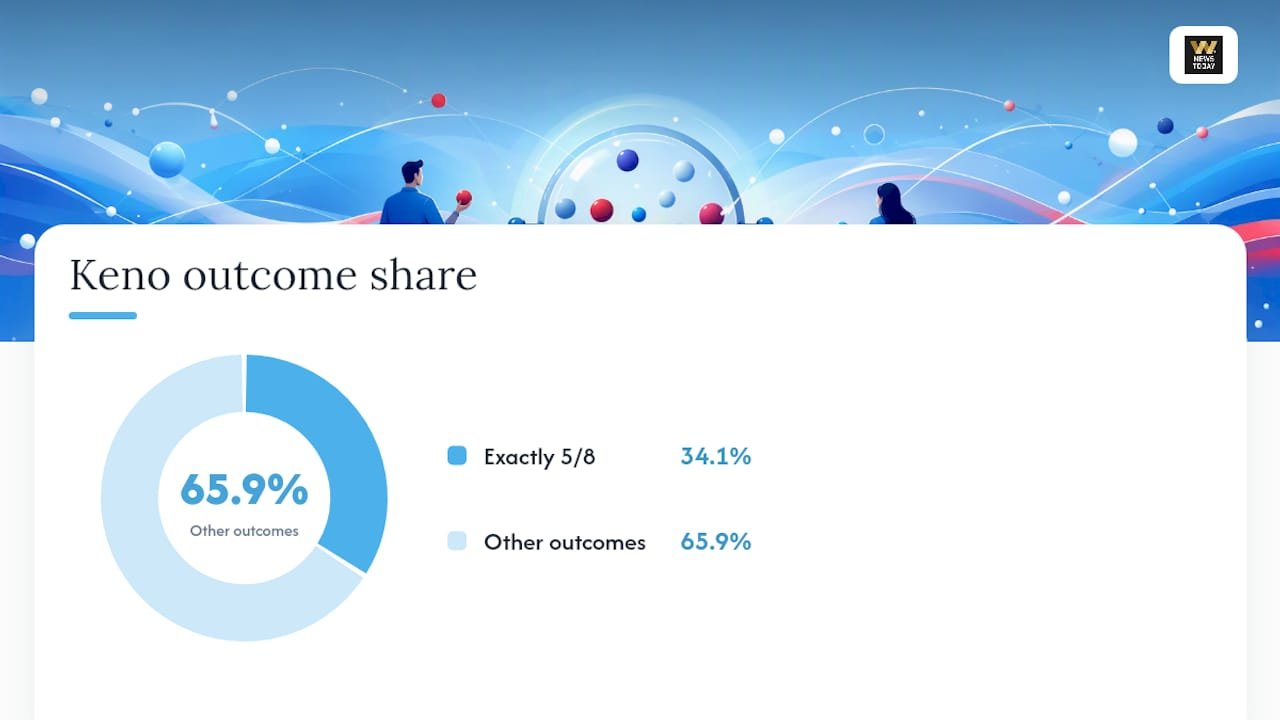
- Divide: 530,546,880 / 1,558,008,000 ≈ 0.3407, or about 34.1%.
That single outcome — catching exactly 5 of 8 — is actually the most probable result on an 8-spot ticket. The hypergeometric formula and full probability tables confirm this pattern across all spot sizes.
Worked probability examples for common ticket sizes (1–10 spots)
The table below shows the probability of a perfect hit (catching all your spots) for each ticket size, plus the single most likely catch outcome.
A few things stand out from these numbers:
- On a 6-spot ticket, you will catch 2 numbers roughly 31% of the time — but most paytables do not pay anything for 2-of-6. You need at least 3 catches to see money.
- On a 10-spot ticket, catching 0 numbers happens about 1 in 21.8 times. Some state lotteries actually pay a small consolation prize for a zero-catch on 9- and 10-spot tickets precisely because it is that common.
- Interpreting “1 in N” vs. percent: 1 in 8,911,711 sounds more dramatic than 0.0000112%, but they mean the same thing. Percentages are easier to compare across ticket sizes; “1 in N” is more intuitive for jackpot-style prizes.
State paytables vary significantly for identical catch counts. Maryland, Ohio, and Massachusetts publish different dollar amounts for the same catches, which changes your return even though the hit probabilities are identical everywhere.
Expected value and house edge — converting a paytable into long-term loss
Expected value (EV) is the average dollar return per wager over many plays. House edge is 1 minus the return-to-player (RTP) percentage — the share the house keeps. The formula:
EV = Σ [P(k) × Payout(k)] − Wager
Here is a sample EV calculation using a realistic $2, 8-spot ticket with a simplified paytable:
- List every catch level (0 through 8) with its probability and its payout from the paytable.
- Multiply each probability by its payout: e.g., P(5) ≈ 0.3407 × $2 payout = $0.68.
- Sum all those products.
- Subtract your $2 wager.
A LibreTexts worked example for an 8-spot, $2 ticket shows a significant expected loss per play — meaning the player generally gets back less than they wager, consistent with a house edge in the range of 40%.
Keno house edge in practice: Wizard of Odds surveys show live casino Keno historically returning roughly 65%–80% to players, while some video Keno machines reach 84%–95% RTP. That gap is enormous compared to roulette’s house edge or blackjack, where the house typically keeps 1%–5%.
Multipliers and bonus buys raise variance — you can win bigger — but they generally do not improve net RTP unless the operator explicitly states otherwise. Always check the paytable math, not just the jackpot size.
What actually changes your odds, and which myths to ignore
What genuinely affects your chances:
- Spot count: Fewer spots mean better odds of a perfect hit but smaller prizes. More spots mean bigger jackpots and far longer odds.
- Pool and draw size: A 40/10 game has completely different probabilities than an 80/20 game. Never mix up the formulas.
- Paytable selection: The same 6-spot ticket pays differently at different venues. RTP varies by operator, not by which numbers you pick.
What does not change your odds at all:
- Which specific numbers you choose (every number has the same probability)
- Previous draw results (each draw is independent)
- “Hot” or “cold” numbers, streaks, or patterns
Common myths to skip:
- Hot numbers win more often. Every ball has an equal probability on every draw. Past frequency is irrelevant.
- Picking more numbers improves your overall chances. More spots increase prize potential but reduce the probability of a perfect hit.
- Patterns or sequences are luckier. The RNG or ball machine has no memory.
Analysts often suggest 4–6 spot tickets as a middle ground: the hit probabilities are still meaningful, mid-tier payouts are reachable, and you are not chasing a 1-in-8.9-million jackpot. For bankroll longevity, a smaller spot count with a modest wager stretches your entertainment budget further than a 10-spot ticket on the same dollar amount.
Pro Tip: *Before you pick a spot count, pull up the venue’s paytable and calculate the minimum catch needed to break even on a single play.
How to calculate Keno odds yourself in a few steps
You do not need a statistics degree. Here is the process:
- Identify your inputs: pool size (usually 80), draw size (usually 20), spots you picked (n), and the catch count you want to evaluate (k).
- Compute C(20, k): the number of ways to choose k hits from the 20 drawn numbers.
- Compute C(60, n − k): the ways to fill your remaining picks from the 60 undrawn numbers.
- Multiply those two results to get favorable outcomes.
- Compute C(80, n): total possible tickets of your size.
- Divide favorable outcomes by total outcomes to get the exact-hit probability.
- For “at least k” probability: sum the exact probabilities for k, k+1, k+2 … up to n.
The Keno Odds Calculator at kenocalc.com handles all of this instantly and offers exact-hit, cumulative (“at least”), and zero-hit modes. Use exact-hit when a paytable pays only one specific catch count. Use “at least” when the paytable pays for multiple catch levels — it maps directly to the probability of winning anything at a given tier or above.
Pro Tip: *In a spreadsheet, use the COMBIN(a,b) function to compute combinations. =COMBIN(20,5)COMBIN(60,3)/COMBIN(80,8) returns the exact probability for catching 5 of 8 spots — no manual arithmetic needed.
Responsible gambling: setting limits and finding help
Keno is entertainment, not a wealth-building strategy. Set clear limits before you play:
- Session budget: decide the maximum you will spend before you start, and stop when you hit it.
- Time limit: set a timer. Keno draws are fast, and sessions can extend longer than intended.
- Stop-loss rule: if you lose a set percentage of your session budget (many players use 50%), walk away.
- Never chase losses: the math does not change because you are down. Each draw is independent.
U.S. and international help resources:
- National Council on Problem Gambling (NCPG): call or text the helpline at 1-800-522-4700 for confidential support, available 24/7.
- BeGambleAware: Begambleaware offers self-assessment tools, spending trackers, and referrals to counseling services.
- W88news Responsible Gambling Guide: the W88news responsible gambling page covers limit-setting tools and self-exclusion options in plain language.
Gambling laws vary by state. Confirm your local rules before playing Keno online or at a lottery retailer — age requirements and legal formats differ across jurisdictions.
An editor’s note on why these numbers actually matter
Keno odds are not just abstract math. They are the difference between walking into a game with clear expectations and walking out confused about where your money went. Most players focus on the jackpot number — that 1-in-8.9-million perfect 10-spot prize — and tune out the house edge sitting quietly in the paytable. But the EV calculation tells the real story: on many live Keno games, you are getting back less than 75 cents per dollar wagered over time.
That does not make Keno a bad choice for entertainment. It makes it an honest one, as long as you know what you are buying. The players who get the most out of Keno are the ones who check the paytable first, pick a spot count that matches their risk appetite, and treat the session budget as the price of admission rather than an investment. The math is not your enemy here. Ignoring it is.
Sources
- Wild
- Keno – How to Play, Rules, Odds & Strategies – Wizard of Odds
- Keno — Mathematics and Gambling (LibreTexts)
- Keno Payouts Chart by Spot Count: What Each Catch Pays — Wild.io Academy
- BeGambleAware
FAQ
How do Keno odds work?
Keno odds come from the hypergeometric distribution: the formula P(k) = C(20,k) × C(60,n−k) / C(80,n) calculates the probability of catching exactly k numbers when you pick n spots from an 80-ball pool with 20 drawn. Every catch level has its own probability, and the paytable assigns a dollar value to each.

What are the odds of hitting all 20 numbers in Keno?
Hitting all 20 drawn numbers on a 20-spot ticket carries odds of approximately 1 in 3.5 quintillion — a figure so extreme that most casinos and lotteries cap tickets at 10 spots and offer a capped jackpot rather than an infinite prize.
What Keno game has the best odds for players?
Within any format, the specific paytable determines your return — compare paytables across venues before you play.
What is the statistically best way to play Keno?
No strategy changes the underlying hit probabilities, since each draw is independent. The practical best approach is to choose a venue with a high-RTP paytable, pick a spot count in the 4–6 range where mid-tier prizes are reachable, and set a firm session budget before you start.
Why does the house edge vary so much in Keno?
Operators set their own paytables, and the dollar amounts assigned to each catch level directly determine RTP. Two venues can offer identical 6-spot tickets with identical hit probabilities but pay out very different amounts for a 4-of-6 catch — that difference is entirely where the house edge lives.