




Set a dedicated bankroll, size every bet at 1–2% of that total, and log each wager before you place the next one. That three-step plan keeps you alive through variance long enough for any real edge to show up in your results.
Here is your immediate action checklist:
- Set your bankroll today. Move a fixed, affordable amount into a separate account or e-wallet. This is your betting fund, nothing else.
- Pick your unit percentage. Beginners: 1%. Intermediate bettors with a tracked record: 1–2%. Experienced bettors with a verified edge: up to 3%. Hard cap on any single bet: 5%.
- Open a tracking sheet. Record every bet before settlement. No exceptions.
The Kelly criterion is the gold standard for sizing bets when you have a proven probability edge. For everyone else, flat 1–2% units are the safer default. Use fractional Kelly (half or quarter of the full formula output) when you do apply it. The industry standard range of 1–3% per bet, as documented by OddsShopper, applies across casual to serious bettors. One critical caveat: bankroll management cannot manufacture an edge. It preserves capital long enough for a genuine edge to compound. Without positive expected value in your selections, even perfect staking discipline loses over time.
Key Takeaways
Disciplined bankroll management in sports betting comes down to three variables: unit size, tracking consistency, and the emotional discipline to follow your rules when variance hits hardest.
| Point | Details |
|---|---|
| Set a dedicated bankroll | Move betting funds into a separate account before placing any bet. |
| Use 1–2% unit sizing | Beginners start at 1%; never exceed 5% on a single selection. |
| Apply fractional Kelly carefully | Use half or quarter Kelly only when you have a verified, sample-backed edge. |
| Track every bet | Log date, odds, stake in units, estimated probability, result, and running bankroll. |
| Bankroll management doesn’t create edge | It preserves capital; positive expected value in bet selection is still required for long-term profit. |
Table of Contents
- What a betting bankroll is and why it matters
- How to pick your bankroll size and set your unit size
- Comparing staking strategies: flat units, percentage, and Kelly
- Kelly criterion explained: the formula, worked examples, and real cautions
- Protecting your bankroll through losing streaks and variance
- The tracking spreadsheet you actually need
- Common mistakes and myths that drain bankrolls
- Worked examples and bankroll templates
- What experienced bettors actually do differently
- Sources
- FAQ
What a betting bankroll is and why it matters
A betting bankroll is a purpose-built pool of money, completely separate from your household income, savings, and emergency fund. It is not “money you can afford to lose” in the casual sense. It is a dedicated capital reserve with its own rules, its own accounting, and its own performance metrics.
Three practical benefits follow immediately from ring-fencing your funds this way.
First, it protects your essential finances. When your rent money and your betting money live in the same account, a losing streak creates real-world pressure. That pressure distorts decisions. A separate bankroll means a 10-bet losing run stays a statistical event, not a financial emergency.
Second, it preserves decision quality. Variance is brutal in the short term. If those eight losses come out of a mixed account, the emotional weight of “real” losses inflates stakes and triggers chasing. A ring-fenced bankroll reframes those losses as expected variance, not catastrophe.
Third, it gives your edge time to play out. Rationalodds makes the point directly: a 100-unit bankroll with a 1% unit baseline provides the runway to survive downswings. Stake sizing and tracking determine survival more than starting size does.
Consider a concrete case. A bettor deposits $500 into a mixed account and runs into a 12-game losing streak at $25 per bet. That is $300 gone from a pool that also covers groceries. The emotional response is almost always to “get it back.” A separate $500 bankroll with $5 units (1%) loses $60 on the same streak and stays fully operational. The math is identical. The psychology is completely different.
For support and governance around responsible play, W88news’s responsible gambling resource covers deposit limits, self-exclusion tools, and when to step back.
How to pick your bankroll size and set your unit size
Follow these steps in order before placing a single bet.
Run an affordability check. List your monthly income and all fixed expenses. What remains after bills, food, transport, and a savings contribution is your discretionary pool. Your betting bankroll should come from a portion of that pool, never from savings or credit.
Decide your time horizon. A seasonal bankroll covers one sport’s calendar (roughly four to six months). A long-term bankroll runs indefinitely and scales with performance. Beginners should start seasonal so they can evaluate results before committing further.
Confirm your emergency fund is untouched. Three to six months of living expenses should sit in a separate account before you allocate a single dollar to betting. This is non-negotiable.
Set the bankroll amount. A practical starting point is an amount you could lose entirely without changing your lifestyle. For most recreational bettors, that is a few hundred dollars or its equivalent. The exact number matters less than the discipline around it.
Convert to units. A unit is a percentage of your bankroll, not a fixed dollar amount. Units scale as your bankroll grows or shrinks, which prevents over-betting a depleted roll. The standard baseline: 1 unit = 1% of your current bankroll.
Apply the recommended ranges. Per Rationalodds.com:
- Beginners: 1% per bet (flat staking)
- Intermediate bettors with a tracked record: 1–2%
- Experienced bettors with a verified edge: 2–3%
- Hard cap on any single selection: ~5%
Target 50–100 units of depth. A 100-unit bankroll at 1% units means you need to lose 100 consecutive bets at even money to go broke, which is statistically near-impossible with any positive edge. Fifty units is the minimum for meaningful variance survival.
Worked example (currency-neutral): You set a bankroll of 200 units of account (dollars, euros, rupees, whatever). A 10-loss streak costs 20 units of account, leaving 180. No crisis.
Comparing staking strategies: flat units, percentage, and Kelly
Three methods cover the practical range of what most bettors actually use. Each has a different risk profile, complexity level, and ideal user.
| Strategy | Risk / Volatility | Recommended % per bet | Best for | Complexity | Pros | Cons |
|---|---|---|---|---|---|---|
| Flat unit staking | Low | 1–2% (fixed) | Beginners | None | Simple, consistent, easy to track | Doesn’t scale with bankroll growth automatically |
| Percentage of bankroll | Medium | 1–3% (recalculated each bet) | Intermediate | Low | Auto-scales up and down with bankroll | Stake fluctuates; harder to compare performance |
| Kelly criterion | High (full) / Medium (fractional) | Formula-driven; typically 1–5% | Experienced, edge-verified | High | Theoretically optimal growth | Requires accurate probability estimates; large drawdowns on full Kelly |
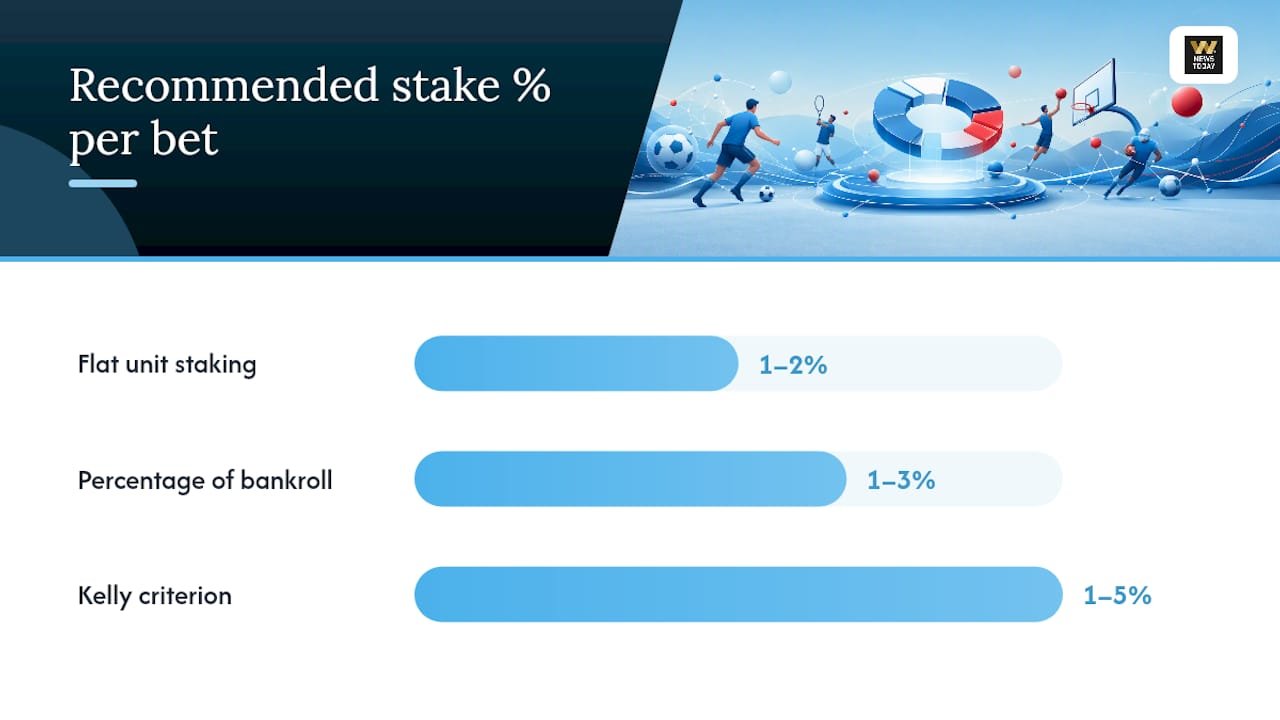
Flat unit staking is the default recommendation for anyone without at least 200 tracked bets. It is boring. That is the point. Consistency lets you measure performance cleanly.
Percentage-of-bankroll staking recalculates your unit before each bet based on your current total. This method naturally compounds gains and reduces stakes during losing streaks. The trade-off: your stake fluctuates, which makes ROI comparisons across time periods slightly messier.
Kelly criterion is the mathematically optimal approach when you have a genuine, quantified edge. OddsShopper’s guide recommends fractional Kelly as the practical default because full Kelly causes drawdowns most bettors cannot stomach emotionally. More on the formula in the next section.
Sample calculation for a $500 bankroll:
- Flat 1%: $5 per bet, every bet
- Percentage 1%: $5 on bet one; if bankroll grows to $550, $5.50 on the next
- Half-Kelly (assuming 2% Kelly output): $5 per bet (half of 2% = 1%)
Switch to percentage-based staking once you have a 200+ bet sample. Consider fractional Kelly only after you can demonstrate a verified edge with statistical confidence.
Kelly criterion explained: the formula, worked examples, and real cautions
The Kelly formula: Kelly % = W − (1 − W) / R
Where W = your estimated win probability and R = the ratio of net profit on a win to net loss on a loss (your win/loss ratio at the odds taken).
In plain language: W is how often you expect to win, and R is how much you gain relative to how much you risk.
That is a large stake. A five-game losing streak drops you to roughly $295. Most bettors cannot maintain discipline through that drawdown, and Investopedia’s Kelly criterion explainer confirms that fractional Kelly (half or quarter of the output) is the widely recommended practical approach.
That same five-game losing streak drops you to about $380. Survivable, and psychologically manageable.
This is the conservative end, capturing most of the growth benefit while dramatically cutting drawdown risk, as Expected Value’s Kelly analysis notes. Full Kelly delivers theoretical optimal long-term growth but causes drawdowns that push most bettors into emotional decisions.
When NOT to use full Kelly:
- Your probability estimate comes from fewer than 200 bets of sample data
- You are betting correlated markets (parlays, same-game multis) where naive Kelly over-allocates
- Your edge estimate is based on a short winning run rather than a calibrated model
- You have experienced a 15%+ drawdown recently and your judgment may be compromised
Correlated bets deserve a specific warning. If you place two bets where the outcomes are linked (same team winning two legs of a parlay, for example), the Kelly formula applied independently to each over-states your true edge. The fix is to shrink combined stakes below what two independent Kelly calculations would suggest, or to avoid parlays entirely until you have multivariate modeling in place.
The Wikipedia entry on the Kelly criterion states the core risk plainly: over-betting relative to Kelly increases ruin risk, and betting more than twice the Kelly fraction can drive expected long-term growth to zero or negative. That is the mathematical case for staying conservative.
Protecting your bankroll through losing streaks and variance
Losing streaks are not signs of failure. They are statistical certainties. The question is whether your rules survive it.
Core protection rules:
- Stop-loss at 10% drawdown: Reduce your unit size by 20% immediately. Do not wait to “see if it turns around.”
- Stop-loss at 20–25% drawdown: Pause betting entirely for at least seven days. Review your bet log, not your feelings.
- Daily deposit limit: Set a hard cap on how much you can add to your betting account in any 24-hour period. Most reputable sportsbooks allow you to set this in account settings.
- No-chase rule: If you lose your planned bets for the day, stop. No “one more” to recover. The next bet is tomorrow’s bet.
- Unit re-sizing triggers: Recalculate your unit size every time your bankroll moves 10% in either direction. Scale down on losses, scale up on gains.
Drawdown response plan:
- At 10% down: Reduce unit size by 20%, continue betting, increase tracking frequency.
- At 20–25% down: Stop betting. Audit your last 30 bets for calibration errors, line-shopping gaps, or market selection mistakes.
- At 30%+ down: Treat the bankroll as critically depleted. Either rebuild from a smaller base or step away entirely and reassess your edge.
Pro Tip: Remove emotion from stake sizing by calculating your unit size at the start of each week, writing it down, and treating it as fixed for that week regardless of results. This one-week freeze prevents the most common mistake: inflating stakes after a bad run to “catch up.”
Cashback promotions can soften the blow of losing streaks without requiring you to chase. W88news covers the top casino cashback offers that can help offset losses within a disciplined bankroll framework.
The tracking spreadsheet you actually need
You cannot manage what you do not measure. A simple spreadsheet with the right columns tells you whether you have an edge, whether your probability estimates are calibrated, and when to adjust your unit size.

| Column | What to record | Why it matters |
|---|---|---|
| Date | Day of the bet | Identifies timing patterns and tilt periods |
| Sport / Market | Sport and bet type | Reveals which markets you perform best in |
| Odds taken | Decimal or fractional odds | Needed for ROI and EV calculations |
| Estimated probability | Your assessed win % | Tests calibration against actual results |
| Stake (units) | Units wagered, not dollars | Normalizes performance across bankroll sizes |
| Expected value | (W × profit) − (L × stake) | Confirms whether the bet was +EV before result |
| Result | Win / Loss / Push | Raw outcome |
| ROI on bet | (Profit or loss) / Stake | Per-bet efficiency metric |
| Running bankroll | Bankroll after settlement | Tracks overall trajectory |
Per Rationalodds.com’s tracking guidance, these fields let you test calibration and detect genuine edge over time. The minimum useful sample is 200 bets before drawing conclusions.
ROI calculation example: You bet 2 units on a selection at 2.50 decimal odds. It wins. Profit = 2 × 1.50 = 3 units. Over 100 bets, sum all profits and losses in units, divide by total units staked, and multiply by 100.
When to adjust unit size:
- Bankroll up 10%: Recalculate 1% of the new total and use that as your new unit.
- Bankroll down 10%: Same process, downward. Never skip this step.
- After a 200-bet sample with positive ROI: Consider moving from flat staking to percentage-based staking.
Common mistakes and myths that drain bankrolls
Myths, debunked:
- “I can chase losses to get back to even.” Chasing increases stake size at the worst psychological moment, when judgment is most compromised. It accelerates ruin, not recovery.
- “I should increase my stake after a win streak.” Win streaks are not evidence of increased edge. They are variance. Inflating stakes after a run is how bettors give back gains.
- “Full Kelly is always the optimal choice.” Full Kelly is theoretically optimal only with perfectly accurate probability estimates. Real estimates are always imperfect, making fractional Kelly the practical standard.
- “Bankroll management will make me profitable.” It will not. As Rationalodds.com makes clear, bankroll management extends survival but does not convert negative-EV bets into profit. Edge comes from bet selection, not staking discipline.
- “Accumulators are a good way to grow a small bankroll fast.” Accumulators multiply variance, not edge. Each leg compounds the probability of losing, and the house margin applies to every leg.
Red-flag behaviors that signal poor bankroll hygiene:
- Mixing betting funds with everyday spending accounts
- Skipping the tracking sheet for “obvious” bets
- Increasing unit size after three or more consecutive wins
- Placing bets you haven’t logged in advance
- Depositing additional funds to chase a losing session
Sport-specific variance note: Higher-odds markets (underdogs at 4.0+, accumulators, long-shot outrights) carry significantly more variance than even-money markets. Online roulette and similar high-variance games follow the same logic: the wider the outcome range, the smaller the unit.
Worked examples and bankroll templates
Starting bankroll: 100 units. You hit 10 consecutive losses.
- After loss 1: 99 units
- After loss 5: 95 units
- After loss 10: 90 units
You continue.
Example B: Fractional Kelly stake calculation
Net profit on a win = 0.90 units per unit staked. Net loss on a loss = 1 unit.
- W = 0.58, R = 0.90
- Full Kelly = 0.58 − (0.42 / 0.90) = 0.58 − 0.467 = 0.113, or 11.3%
- Half-Kelly = 5.65%
- Quarter-Kelly = 2.83%
For a 100-unit bankroll, half-Kelly means a stake of 5.65 units. Quarter-Kelly means 2.83 units. Most experienced bettors using Kelly in practice land between quarter and half Kelly to balance growth and drawdown risk, per Expected Value’s analysis.
Depth (50–100 units minimum) and conservative unit sizing are the two variables that most reliably separate survivors from those who bust out during normal variance. The math supports what experienced bettors already know intuitively: staying in the game is the prerequisite for everything else.
Building your template: Copy these column headers into a spreadsheet: Date | Sport/Market | Odds | Estimated Probability | Stake (Units) | EV | Result | ROI | Running Bankroll. Add one row per bet, fill it before settlement, and review weekly. That is the complete system.
What experienced bettors actually do differently
Most bettors who survive long-term share one habit that recreational bettors consistently skip: they treat their tracking sheet as the source of truth, not their memory. Gut feel about recent performance is almost always wrong. The spreadsheet is almost always right.
The second habit is conservative scaling. Experienced bettors do not rush to increase unit size after a good month. They wait for a statistically meaningful sample (usually 300–500 bets) before concluding that performance reflects edge rather than variance. That patience is uncomfortable. It is also what separates a sustainable approach from a lucky streak followed by a bust.
The third habit is the one most people underestimate: they freeze their stakes during drawdowns. Not reduce. Freeze. This removes the single most dangerous variable in bankroll management: real-time emotional adjustment.
One final tip you can use today: set a weekly bet limit by number of bets, not just by dollar amount. Overtrading (placing bets out of boredom or to “stay active”) is as damaging as overbetting. Fewer, higher-confidence bets at disciplined unit sizes outperform a high volume of marginal selections every time the sample gets large enough to matter.
Sources
These are the sources that underpin the guidance in this article, ranked by how directly they apply to the core mechanics of staking and bankroll control.
- Bankroll Management in Sports Betting: The Complete Guide
- Bankroll Management Sports Betting: Unit & Kelly Guide | OddsShopper
- Kelly Criterion Definition
- Kelly criterion – Wikipedia
For responsible gambling tools and deposit limit settings, W88news’s responsible gambling page is the right starting point. If you are exploring crypto-based sportsbooks where instant deposits and withdrawals affect bankroll liquidity, Cardano Casino’s fairness page covers provable mechanics worth understanding before depositing.
This article is general information, not a substitute for advice from a qualified financial advisor. Consult a qualified financial professional about your own circumstances before acting on anything here.
FAQ
How do you manage a betting bankroll effectively?
What is a good starting bankroll for sports betting?
The right size is whatever you can afford to lose entirely without affecting your lifestyle or emergency fund.
What is the most successful betting strategy?
No single staking method creates profit on its own. Fractional Kelly adds precision once you have a verified, sample-backed edge.
What does the Kelly criterion tell you about bet sizing?
The Kelly formula (Kelly % = W − (1 − W) / R) calculates the fraction of your bankroll that maximizes long-term growth given your win probability and win/loss ratio. In practice, most bettors use half or quarter Kelly to reduce drawdown risk, since the formula requires accurate probability estimates that are difficult to achieve consistently.