




Betting odds are a sportsbook’s price tag on any outcome, showing you exactly how much you can win and the implied probability that the outcome happens. Every number you see on a betting screen, whether it’s +200, 2.50, or 5/1, is saying the same thing in a different language. There are three common formats you’ll encounter:
- American (moneyline): Standard in U.S. sportsbooks, uses + and − signs
- Decimal: Dominant in Europe, Australia, and Canada; the fastest format for quick comparisons
- Fractional: Traditional in UK horse racing markets, written as a ratio like 5/1
Quick recommendation: switch your sportsbook display to decimal odds when you want to compare prices fast. It’s the simplest math. American odds are fine once you know the rules, and fractional shows up mostly in racing. All three formats represent the same underlying price, as Investopedia confirms, so learning to convert between them is the real skill.
Key Takeaways
Decimal odds are the fastest format for comparing prices: multiply your stake by the decimal to get total return, convert to implied probability with 1 ÷ decimal, and always check that implied probability against your own read of the outcome before staking.
| Point | Details |
|---|---|
| Three formats, one price | American, decimal, and fractional odds all express the same implied probability and payout. |
| Decimal is fastest | Stake × decimal = total return; 1 ÷ decimal = implied probability. No extra steps. |
| Vig exceeds 100% | A standard −110/−110 market sums to 104.8% implied probability, not 100%. |
| Parlays multiply risk | Three legs at 2.00 each produce a 9.00 combined decimal but only a 12.5% combined probability. |
| Shop lines | Even small differences in implied probability compound over many bets, so compare books. |
Table of Contents
- How betting odds work: probability, favorites, and the payout trade-off
- Decimal odds explained: reading, converting, and calculating payouts
- Fractional odds: what the ratio means and how to convert it
- American (moneyline) odds explained: reading + and −
- How to convert between decimal, fractional, and American odds
- How to calculate payouts for single bets and parlays
- What the vig is and why implied probabilities add up past 100%
- Common wager types and how odds apply to each
- Why decimal odds make line-shopping faster
- A quick note from the editor
- Sources
- FAQ
How betting odds work: probability, favorites, and the payout trade-off
Every set of odds tells you two things at once: how likely the sportsbook thinks an outcome is, and how much you’ll collect if you’re right. That likelihood, expressed as a percentage, is called implied probability. The higher the implied probability, the more likely the sportsbook considers the outcome, and the lower your payout will be. That’s the core trade-off.
Converting odds to implied probability is the key step before you stake anything. According to Bodog’s betting guide, comparing implied probability to your own estimate of the outcome’s likelihood is how you spot value. The formulas differ slightly by format, but each section below walks you through them with worked examples.
Favorites vs. underdogs in American odds: a minus sign (−) marks the favorite, a plus sign (+) marks the underdog. Say Team A is −150 and Team B is +130. Team A is the favorite: you’d need to stake $150 to profit $100. Team B is the underdog: a $100 stake profits $130. The favorite has a higher implied probability and a lower payout. The underdog has a lower implied probability and a higher payout. That relationship holds across every format.
Pro Tip: Before placing any bet, convert the odds to implied probability and ask yourself: “Do I think this outcome is actually more likely than the percentage the sportsbook is showing?” If the answer is no, the bet doesn’t offer value.
Decimal odds explained: reading, converting, and calculating payouts
Decimal odds show your total return per unit staked, including your original stake. A decimal of 3.00 means you get back $3.00 for every $1.00 you put in. That’s $2.00 profit plus your $1.00 stake returned. TopEndSports notes that this format is the simplest for quick payout math precisely because of that single multiplication step.
Implied probability from decimal odds:
Implied probability = 1 ÷ decimal odds
Worked example, step by step:
- You see odds of 2.50 on a tennis match.
- You want to stake $40.
- Total return = $40 × 2.50 = $100.
- Profit = $100 − $40 = $60.
- Implied probability = 1 ÷ 2.50 = 0.40 (40%).
Try it with a second example: odds of 1.80, stake of $50.
- Total return = $50 × 1.80 = $90.
- Profit = $90 − $50 = $40.
- Implied probability = 1 ÷ 1.80 = 0.556 (55.6%).
Lower decimal = bigger favorite = smaller payout. That pattern is instant to read once you’re used to it, which is exactly why experienced line-shoppers default to this format.
Fractional odds: what the ratio means and how to convert it
Fractional odds show your profit relative to your stake. The number on the left is what you win; the number on the right is what you stake. So 5/1 (spoken as “five to one”) means you profit $5 for every $1 you bet. Your stake comes back on top of that, giving you $6 total return per $1 staked.
You’ll see fractional odds written with a slash (5/1) or a hyphen (5-1). Both mean exactly the same thing. Horse racing in the UK and Ireland still uses fractional odds almost exclusively, so you’ll run into this format whenever you bet on racing markets.
Conversion formulas:
- Fraction to decimal: (numerator ÷ denominator) + 1
- Implied probability: denominator ÷ (numerator + denominator)
Worked example with a $20 stake at 5/1:
- Decimal equivalent: (5 ÷ 1) + 1 = 6.00
- Total return: $20 × 6.00 = $120
- Profit: $20 × 5 = $100 (or $120 − $20)
- Implied probability: 1 ÷ (5 + 1) = 16.7%
A common beginner mistake is confusing profit and total return. At 5/1, your $20 stake earns $100 profit, but you collect $120 in total because your original $20 comes back. Always separate those two numbers in your head.
One more example at 11/2:
- Decimal: (11 ÷ 2) + 1 = 5.5 + 1 = 6.50
- Implied probability: 2 ÷ (11 + 2) = 2 ÷ 13 = 15.4%
- On a $10 stake: total return = $10 × 6.50 = $65, profit = $55
American (moneyline) odds explained: reading + and −
American odds use a $100 reference point. A positive number (+200) tells you the profit on a $100 stake. A negative number (−120) tells you the stake required to profit $100. Your original stake is always returned on top of any profit.
Implied probability formulas:
- Positive odds: 100 ÷ (odds + 100)
- Negative odds: |odds| ÷ (|odds| + 100)
Worked example: +200
- Profit on $100 stake: $200
- Total return: $100 + $200 = $300
- Implied probability: 100 ÷ (200 + 100) = 100 ÷ 300 = 33.3%
Worked example: −120
- Stake required to profit $100: $120
- Total return: $120 + $100 = $220
- Implied probability: 120 ÷ (120 + 100) = 120 ÷ 220 = 54.5%
Common beginner questions about American odds:
- Does my stake come back? Yes, always. Your profit is on top of your returned stake.
- What does +200 mean exactly? A $50 stake profits $100 (half of $200), returning $150 total. The $100 reference scales proportionally.
- What does −120 mean in betting? You’re risking $120 to win $100. The minus sign marks the favorite.
- Is −110 common? Very. It’s the standard line for point spreads and totals in U.S. sportsbooks.
As CBS Sports explains, odds are dynamic prices that shift in real time as sportsbooks react to wager volume, injuries, and news. Once you place your bet, though, your odds are locked at the price posted at that moment.
How to convert between decimal, fractional, and American odds
All three formats represent the same underlying price. Converting between them is just arithmetic, and Investopedia’s breakdown confirms that a decimal of 2.50 equals +150 in American odds and 3/2 in fractional, all pointing to roughly a 40% implied chance.
Conversion formulas at a glance:
- American (+) to decimal: (odds ÷ 100) + 1
- American (−) to decimal: (100 ÷ |odds|) + 1
- Decimal to American (+): (decimal − 1) × 100 when decimal ≥ 2.00
- Decimal to American (−): −100 ÷ (decimal − 1) when decimal < 2.00
- Decimal to fractional: subtract 1, then express as a fraction (e.g., 3.00 − 1 = 2.00 = 2/1)
- Fractional to decimal: (numerator ÷ denominator) + 1
Cheat-sheet: common prices in all three formats
Quick conversion walkthrough: +200 to decimal to fractional
- +200 is positive, so: (200 ÷ 100) + 1 = 3.00 decimal
- Decimal to fractional: 3.00 − 1 = 2.00 = 2/1
- Implied probability: 1 ÷ 3.00 = 33.3%
Three formats, one price. Once you can do that chain in your head, comparing lines across sportsbooks becomes fast.
How to calculate payouts for single bets and parlays
For any single bet, total return and profit are the two numbers you need before you stake. Here’s the step-by-step method for each format:
- Decimal: Stake × decimal = total return. Subtract stake for profit. ($30 × 2.50 = $75 total; $45 profit.)
- Fractional: Stake × (numerator ÷ denominator) = profit. Add stake for total return. ($30 × 5/1 = $150 profit; $180 total.)
- American (+): (Stake ÷ 100) × odds = profit. ($30 at +200: $30 ÷ 100 × 200 = $60 profit; $90 total.)
- American (−): (100 ÷ |odds|) × stake = profit. ($30 at −150: 100 ÷ 150 × $30 = $20 profit; $50 total.)
- Easiest universal method: Convert everything to decimal first, then multiply by stake.
Parlay (accumulator) example:
Say you combine three legs, each at decimal odds of 2.00, 2.50, and 1.80. Multiply the decimals together: 2.00 × 2.50 × 1.80 = 9.00. On a $10 stake, your total return is $10 × 9.00 = $90, and your profit is $80.
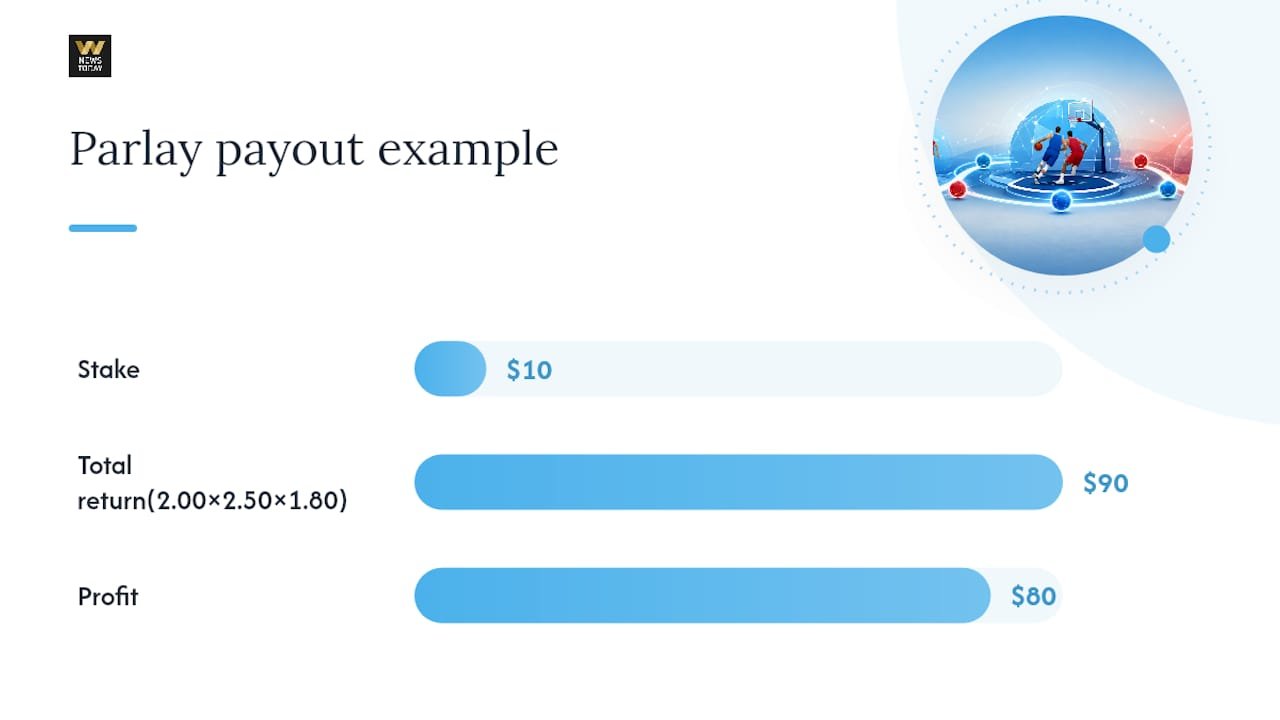
That multiplier is why parlays look so attractive. But each leg must win. If any single leg loses, the entire parlay is lost. The reward amplifies, and so does the risk.
Pro Tip: When calculating multi-leg parlays, convert all odds to decimal first, multiply them together, then multiply by your stake. Keep a note of your stake and the combined decimal so you can track your exposure across multiple bets without losing track of currency units.
What the vig is and why implied probabilities add up past 100%
That extra percentage is the house edge.

The clearest example: a standard NFL spread market where both sides are priced at −110.
As Bodog’s guide explains, the vig is precisely why implied probabilities typically exceed 100% and why two −110 lines don’t represent a fair coin flip.
Practical implications for you:
- Shop lines across multiple books. A difference of just a few cents in implied probability compounds over many bets.
- Prefer lower vig. A −105/−105 market (combined ≈ 102.4%) is meaningfully better than −115/−115 (combined ≈ 107.1%) for the same bet.
- Know your break-even rate. At −110, you need to win 52.4% of your bets just to break even, not 50%. That gap matters over a long betting season.
- Check sportsbook reviews to find books that consistently offer tighter margins on the sports you bet most.
Common wager types and how odds apply to each
Odds attach to every bet type, and the format stays the same regardless of what you’re betting on. Here’s a quick rundown of the types you’ll see most often:
- Moneyline: Straight win/lose bet. Example: Lakers −180 vs. Celtics +155. Pick the winner, collect at those odds.
- Point spread: One team gives or receives points. Both sides typically priced at −110. Example: Chiefs −6.5 (−110) means Kansas City must win by 7 or more for the bet to pay.
- Total (over/under): Bet on the combined score. Example: Over 48.5 points at −110. Both over and under usually carry −110, reflecting the standard vig.
- Prop bet: A wager on a specific player or event stat. Example: LeBron James over 27.5 points at −115. Props often carry higher vig than game lines.
- Parlay/accumulator: Combine two or more legs. All must win. Decimal odds multiply together. Example: three legs at 2.00, 1.91, and 2.50 = combined decimal of 9.55 on a single stake.
Spreads almost always show −110 on both sides as the default, but that’s not universal. For smart wager strategies on parlays, props, and totals, the math above applies directly regardless of the bet type.
Why decimal odds make line-shopping faster
Decimal odds are the clearest tool for comparing prices across sportsbooks, and TopEndSports backs this up: they show total return per unit staked, so a higher number is always a better price. No sign conventions, no fraction arithmetic.
Quick comparison example. You want to bet on the same soccer match at three different books:
- Book A: 1.87 decimal
- Book B: 1.91 decimal
- Book C: 1.85 decimal
On a $100 stake, Book B returns $191, Book A returns $187, and Book C returns $185. Book B is the best price. That comparison takes about three seconds in decimal. In American odds (−115, −110, −118), you’d need to do three separate calculations to reach the same conclusion.
Pro Tip: Set your sportsbook display to decimal by default. When you encounter American or fractional odds on a different platform, convert to decimal first using the formulas above, then compare. Track your stake-to-payout ratio on each bet so you can spot which books consistently offer you the best prices.
A quick note from the editor
Getting comfortable with odds math is genuinely one of the most useful things you can do before placing a real bet. Start with small stakes while you’re learning. Set a clear limit on what you’re willing to spend in a session, and treat that limit as fixed before you open the app. Responsible gaming means the math stays fun, not stressful.
W88news covers new game releases, sportsbook guides, bonus breakdowns, and casino reviews regularly. If you want to explore the latest sports bonuses that can effectively improve your odds value, or check out new slot releases and casino game guides, head over to W88news for the full library.
Sources
These are the reputable sources used throughout this guide, each worth bookmarking for deeper study:
- Sports Betting Odds: How They Work and How to Read Them
- How to Read Sports Betting Odds | Complete Beginner’s Guide
- What Are Betting Odds? | How to Read Betting Odds Guide
- How to read betting odds | CBS Sports Betting
FAQ
What does +200 odds mean?
+200 means a $100 stake profits $200, returning $300 total.
What does 11/2 odds mean?
11/2 means you profit $11 for every $2 staked.
What do negative odds mean in betting?
Negative odds mark the favorite and show the stake required to profit $100. At −120, you stake $120 to win $100, collecting $220 in total.
What does −120 mean in betting?
−120 means you must risk $120 to profit $100.